Hindu families forced to migrate amid fear, harassment, and deteriorating living conditions caused by Muslim locals in Jaipur, Rajasthan
 Jaipur, Rajasthan, India
  13 March, 2026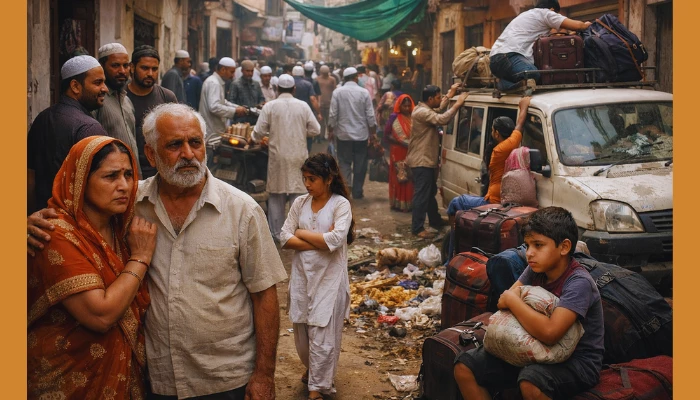
Case Summary
In Jaipur, Krishna Colony, around 500 Hindu families were forced to flee their homes because of continued harassment by Muslims, as recorded in a video report from the locality. According to the video, Krishna Colony, situated within the walled city area of Jaipur, had once been home to more than 500 Hindu families. At the time of recording, only around 100 Hindu families remained, showing that nearly 80% of the Hindu residents had migrated out of the colony over the years. The report further referred to posters that had been put up in 2023, highlighting Hindu migration from the area. These posters stated that 256 Hindu families had once resided in the locality, but that the number had reduced significantly, with only around 100 families remaining. Alok Parik, who identified himself as the President of the Krishna Colony Development Committee and a resident of more than 25 years, stated that the colony had earlier enjoyed a harmonious atmosphere and had housed nearly 500 Hindu families. He stated that over time, Hindu families had gradually left the area and referred to protests held in 2023 over the migration of Hindus from the colony. Several residents interviewed in the video stated that Hindu families had been selling their ancestral homes and leaving the locality because of fear, insecurity, and worsening living conditions. In one particular lane, residents stated that there had earlier been 28 houses, out of which only 7 Hindu houses were left, while the remaining houses had been sold and occupied by Muslim families. Multiple residents stated that the Muslim population in the locality had increased steadily and that Hindu families had increasingly felt outnumbered in their own colony. Residents stated that this demographic change had taken place rapidly in recent years. Women residents stated that Hindu girls and women felt unsafe moving into the locality. Several interviewees stated that girls were subjected to lewd staring and hostile looks, with one resident describing it as being looked at with “criminal eyes”. Some residents stated that women avoided stepping out alone, particularly at night, due to fear for their safety. Further, the children are locked in houses and have no free movement in the lane because of insecurity; they cannot play outside. Residents also stated that Muslim gatherings and functions regularly blocked roads and narrow lanes. It was stated that tents were erected far beyond the premises of individual houses, causing obstruction to movement. Residents further stated that after such functions, garbage, food waste, paper, and bones were left scattered across the streets, creating unhygienic conditions. Several residents also referred to incidents of theft and damage to property, including theft of mobile phones, a gas cylinder, bicycles, and damage to parked vehicles. One resident stated that the glass of a vehicle had been broken approximately 15–20 days before the recording. The video further recorded repeated complaints regarding the lack of civic amenities. Residents stated that the streets had not been regularly cleaned, sewer lines remained blocked, and dirty water had accumulated in the lanes and inside homes. Several residents stated that repeated complaints had been made to the municipal authorities and their Muslim mayor, but no effective action had been taken. Shopkeepers and long-time residents in adjoining lanes similarly stated that Hindu families had been selling their houses and shifting elsewhere. One shopkeeper stated that local festivals such as Holi and Diwali no longer had the same atmosphere or participation because most Hindu families had already left. Advocate Arvinder Singh Chauhan, who identified himself as a resident, stated in the video that colonies that had earlier been fully Hindu had been reduced to a negligible Hindu presence. He stated that Hindu families had not left voluntarily but had migrated because of fear, persistent disturbance, and concern for the safety of their families.
Why it is Hate Crime ?
This case has been added to the tracker under the primary category of: - Attack resulting in death. Within it, the sub-category selected is: Attacked to induce migration from a non-Hindu-dominated area. There have been cases where the Hindus living in an area, often with a majority dwelling belonging to non-Hindus or those harbouring animosity towards the Hindu faith, the Hindu residents experience threats and violence. The violence is employed to make the Hindus leave the area and relocate, so the area could be turned into an exclusive ghetto for adherents of the non-Hindu faith or those who harbour animosity towards the Hindu faith. In several cases, the aim of the exodus is explicit. However, in several cases, the demand for the exodus of Hindu residents is not explicit; however, violence by non-Hindu residents leaves the Hindu residents no option but to leave the area, thereby turning the area into an exclusive ghetto of non-Hindu residents. In such cases, there are instances of violence against the Hindu residents explicitly. For example, in the Hauz Qazi case of 2019, the Muslim residents claimed that mob violence against the Hindu residents had been triggered by a parking dispute. However, the violence did turn religious, with a temple being desecrated and directed specifically against the Hindu residents. The Hindu residents of the area were clear that the violence was religiously motivated, and one of the motives was to affect an exodus of the Hindu residents. In such cases, even though the perpetrators have not explicitly expressed the aim of affecting exodus, the given circumstances and violence and precedent point to the intention of exodus and therefore would be categorised under this sub-category. Such crimes are religiously motivated and therefore are hate crimes. Another sub-category selected is: Attacked for Hindu identity. Any sort of physical attack against a Hindu or a group of Hindus, resulting in death, due to religious motivations of Abrahamics would be included in this category. This would include local communal clashes, attacks due to Abrahamic blasphemy, Hindus crossing through so-called "Muslim areas", refusal to convert, and any other religious supremacy reasons. The cases categorised here should have resulted in the death of a Hindu victim. Since the attack itself is motivated by religious considerations, the crime would be considered a hate crime. In cases where the trigger of the violence is not religious, however, the conflict takes on a religious nature, and during the course of the violence would also be categorised as a hate crime. This case warranted inclusion because it reflected a sustained and systematic pressure placed upon Hindu residents, the effect of which was to force them out of a historically Hindu locality. The circumstances went far beyond isolated civic inconvenience or sporadic neighbourhood disputes. What emerged instead was a prolonged environment in which Hindu families were no longer able to continue their ordinary lives with safety, dignity, and security. A significant feature of this pressure was the gradual denial of normal day-to-day freedoms that any residential community ought to enjoy. Children were no longer able to play outside freely, residents could not leave their vehicles parked outside for fear of theft or damage, and women were increasingly unable to move about the locality without apprehension. When routine aspects of family life became constrained in this manner, the resulting migration could not be viewed as a voluntary relocation. It became a compelled response to an atmosphere of fear and persistent communal pressure. The effect on women and girls was especially grave. Once a locality became such that families no longer felt secure allowing women to step out, particularly during evening or night hours, the pressure upon households intensified substantially. In such circumstances, the decision to leave one’s ancestral home often became a protective necessity rather than a matter of preference. Another central factor was the continued deterioration of living conditions. The failure to improve sanitation, clear blocked sewer lines, and restore basic civic amenities despite repeated representations created an environment that was increasingly unlivable for the remaining Hindu households. This gave the situation the character of a structured pressure mechanism, where worsening civic conditions contributed directly to distress sales and the eventual exodus of Hindu families. Importantly, the civic conditions remained neglected despite repeated complaints, deliberately. This pattern was a well-planned attempt to sell properties at reduced prices to local Muslim buyers. Therefore, this neglect was wilfully observed by the Muslim mayor to facilitate demographic displacement. The role of the local Muslim mayor and the continued municipal inaction was relevant not as an established conclusion in itself, but as part of the residents’ perception that official apathy had reinforced the pressure upon Hindu families. From the standpoint of tracker documentation, what remained material was that the non-response by public authorities was seen as deepening the distress and creating circumstances in which Hindu residents felt compelled to sell their homes at undervalued rates and move out. The conduct of the local municipal leadership assumed importance in this context. Residents stated that despite the scale of the problem and repeated complaints, meaningful steps were not taken to improve the area. This inaction reinforced the perception among Hindu residents that the conditions were being allowed to deteriorate so that they would be left with no practical option but to sell their properties cheaply and relocate. The sustained fear, civic neglect, restriction on women’s mobility, and the inability of families to carry on normal life in their own neighbourhood clearly pointed towards identity-based pressure directed at the Hindu community. The resulting migration altered the demographic and cultural character of the locality and therefore met the threshold of a hate crime involving coercive displacement. Disclaimer: In this case, it was stated that Krishna Colony had once housed approximately 500 Hindu families, and that only around 100 families remained, indicating that nearly 400 Hindu families had migrated out. As the exact number of individuals affected was not specified in the source material, the Hinduphobia Tracker applied a standardised household estimation method based on the most recent Indian demographic average household size of 5 members per family. On this basis, the estimated number of affected victims was calculated at 2,000 individuals (400 families × 5 members per family). This figure has been recorded as an indicative estimate for documentation purposes only and does not represent an official or verified count. Since no gender-wise or age-wise break-up was available in the source material, any internal demographic segregation, if required, may be proportionately estimated on the basis of Census 2011 and NFHS-5 urban population data. Accordingly, the 2,000 participants were estimated as 1,040 men (52%) and 960 women (48%), reflecting the slightly higher male proportion consistent with typical urban demographics. As the age-wise segregation was also not specified in the media report, the Hinduphobia Tracker used a proportional demographic estimate derived from the same data sources. Accordingly, the 2,000 participants were estimated as 1,600 adults (80%) and 400 children (20%). As the exact commencement date of the residents’ ordeal and migration was not specifically stated, the date on which the video report documenting the issue came into the public domain has been used as the indicative incident date for tracker purposes.
Victim Details
Total Victim
2000
Deceased
0
Gender
- Male 1040
- Female 960
- Third Gender 0
- Unknown 0
Caste
- SC/ST 0
- OBC 0
- General 0
- Unknown 2000
Age Group
- Minor 400
- Adult 1600
- Senior Citizen 0
- Unknown 0


Case Status
Unknown


Perpetrators Details
Perpetrators
Muslim Extremists
Perpetrators Range
Unknown
Perpetrators Gender
unknown
 Sources




