Hindu villagers in Bihar targeted for conversion through prayer meetings by Christian missionaries
 Bettiah, Bihar, India
  3 January, 2026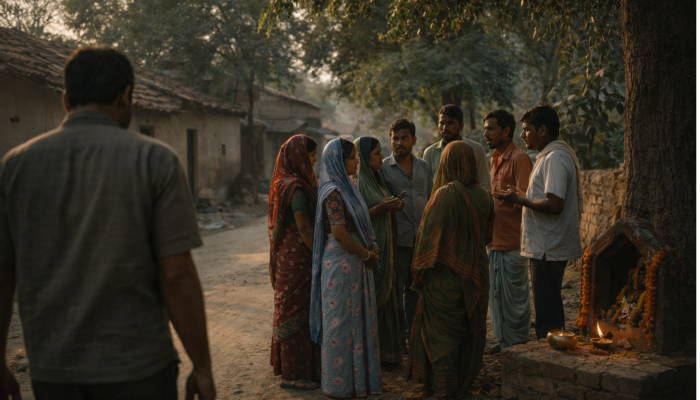
Case Summary
Hindu villagers in Bharpatiya village, Pipraashi block, Bettiah district, Bihar raised alarm over sustained missionary activities in which individuals were drawing them into Christian prayers and pressuring them to convert to Christianity. The situation generated significant tension in the village, prompting police intervention and an investigation. Residents of Bharpatiya village, which falls under Muradih Panchayat, stated that certain individuals had been approaching Hindu villagers and persuading them through inducement and manipulation to participate in Christian prayers. The missionary activity had been creating unease within the village and raised concerns about the disruption of social harmony in the community. Local administration and police were informed of the situation. Police took immediate cognisance of the matter and launched an investigation. The atmosphere in the village was one of anger and tension at the time of police intervention. Pipraashi police station in-charge Rajeev Kumar confirmed that the matter was being investigated with full seriousness. He assured residents that all relevant parties would be questioned during the investigation and that action would be taken in accordance with the law on the basis of the facts established. Police maintained continuous surveillance in the village to preserve peace and order, and appealed to villagers to remain calm and disregard rumours.
Why it is Hate Crime ?
The primary category for this case is "Predatory Proselytisation". The sub-category here for this case is "Conversion/attempts to convert by inducement". Predatory Proselytisation is not just limited to threat, harassment, force and violence, but it also has contours of stealth. In several cases, the Hindu victim is exploited to convert, with non-Hindus taking advantage of their poverty. In such cases, the Hindu victim who is suffering financially is offered monetary benefits, including lucrative offers for jobs, health treatment, education, etc, to induce the victim into changing his/her religion. In such cases, the religious identity of the victim and the aim to disenfranchise him from his faith form the heart of the crime. Also, taking advantage of and exploiting an individual’s economic vulnerabilities is widely acknowledged as exploitation, forms of which are often penalised by law. Such cases therefore are considered religiously motivated hate crimes since the victim’s religious identity forms the very heart of the crime itself. Another primary category for this case is "Proselytisation by grooming, brainwashing, manipulation and subtle indoctrination". The tertiary category here is "Pattern of targeting Hindus". Religious brainwashing essentially means the often subtle and forcible indoctrination to induce someone to give up their religious beliefs to accept contrasting regimented ideas. Religious grooming or brainwashing also involves propaganda and manipulation. It involves the systematic effort, driven by religious malice and indoctrination, to persuade “non-believers’ to accept allegiance, command, or doctrine to and of a contrasting faith. Cases of such grooming or brainwashing are far more nuanced than direct threats, coercion, inducement and violence. In such cases, it is often seen that there is repeated, subtle and continual manipulation of the victim to induce disaffection towards their own faith and acceptance of the contrasting faith of the perpetrator. While subtle indoctrination is widely acknowledged as predatory, an element which is often understated in such conversions or the attempts of such conversion is the role of loyalty and trust which might develop between the perpetrator and the victim. Fiduciary relationships are often abused to affect such religious conversion. For example, an educator transmitting religious doctrine of a competing faith to a Hindu student. The Hindu student is likely to accept what the teacher is transmitting owing to existence of the fiduciary relationship. The exploitation of the fiduciary relationship to religiously indoctrinate victims would also be included in this category. Since the underlying animosity towards the victim’s faith forms the basis of predatory proselytization, such cases are considered religiously motivated hate crimes. This case qualifies as a religiously motivated hate crime in which Hindu villagers in Bharpatiya village, Bettiah district, Bihar were subjected to a sustained campaign of predatory proselytisation by Christian missionaries who drew them into Christian prayers through inducement and manipulation with the deliberate objective of converting them away from their Hindu faith. The campaign was not overt or confrontational. It was subtle, patient, and designed to erode Hindu religious identity through gradual participation in Christian devotional practices before the full nature of the conversion campaign became apparent. The targeting of a rural Hindu community through induced participation in Christian prayers is the primary religious marker of this case. The missionaries did not approach the Hindu villagers of Bharpatiya with an open declaration of their conversion objectives. They used beguiling and persuasion to draw villagers into Christian prayer sessions, creating a gradual process of religious reorientation in which participation in Christian devotional practice preceded any explicit demand for conversion. This approach is a recognised pattern of predatory proselytisation in which the boundaries between social engagement and religious conversion are deliberately blurred to lower the resistance of the target community. The use of inducement as the mechanism of conversion is the second religious marker. The source confirms that villagers were drawn in through persuasion and enticement rather than overt coercion. Inducement-based conversion targeting rural Hindu communities is prohibited under multiple state-level religious freedom laws across India precisely because it exploits the socioeconomic vulnerability and limited institutional access that characterise many rural Hindu communities. The offer of material assistance, social belonging, or spiritual benefit as an incentive to participate in Christian prayers is a form of religious manipulation that is specifically designed to make the conversion process feel voluntary while removing the conditions under which genuine free choice is possible. The pattern of targeting Hindus as a community is the third religious marker. The missionaries did not approach individual Hindu villagers in isolation. They conducted their activities within the village as a whole, with the evident objective of drawing in as many Hindu residents as possible simultaneously. This community-level approach reflects an institutional strategy of mass religious transformation in which the social bonds and collective identity of a Hindu village community are used as the mechanism of conversion. When members of a tightly knit rural community begin participating in Christian prayers together, the social cost of maintaining one's Hindu identity within that community rises, making the conversion self-reinforcing and progressively more difficult to resist. The community's anger and the resulting tension in the village confirm the religious gravity of what was occurring. Hindu villagers recognised the missionary activities as a threat to the social and religious cohesion of their community and responded with sufficient alarm to prompt police intervention. Their response reflects a collective understanding that what was being done to their community was not a benign religious outreach but a deliberate and sustained campaign to displace their Hindu identity. Given that this case met the parameters of a religiously motivated hate crime, it was added to the hate crime database of the tracker. Disclaimer: The Hinduphobia Tracker records incident dates based on when the crime occurred rather than when it was reported or published. The source does not specify the exact date on which the missionary activities began or when individual acts of inducement took place, noting only that the activities had been ongoing in the village for a period of time before the complaint was raised. The publication date of 4 January 2026 has been used as the indicative incident date for documentation purposes. This was recorded for documentation purposes only.


Case Status
Complaint filed


Perpetrators Details
Perpetrators
Christian Extremists
Perpetrators Range
Unknown
Perpetrators Gender
unknown
 Sources




