Indian Hindu gurus targeted, defamed, deliberately vilified with false charges by American journalist on social media
 United States
  6 March, 2025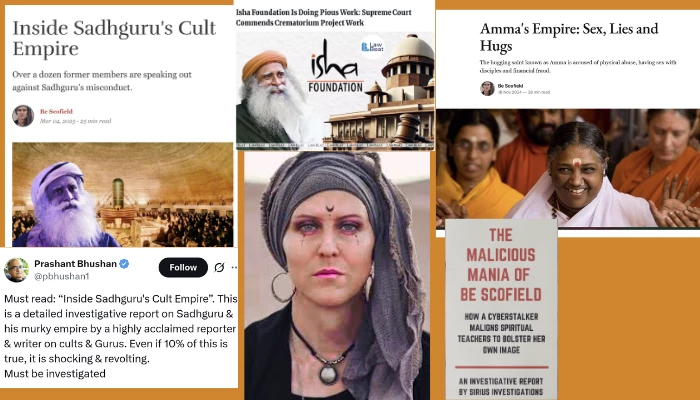
Case Summary
Indian Hindu gurus targeted with false charges, defamed and vilified by American journalist Be Scofield, through her website GuruMag. She published a series of articles targeting Shri Sadhguru Jaggi Vasudev and Mata Amritanandamayi, based on unverified, unsubstantiated claims. As per reports, Be Scofield, through her website GuruMag, published a series of articles targeting Shri Sadhguru Jaggi Vasudev and the Isha Foundation, namely “Sadhguru’s Wife’s Death: The Untold Story of Vijji’s Mahasamadhi”, “Inside Isha Foundation: Allegations of Financial Misconduct and Organisational Irregularities”, “The Dark Side of Sadhguru and the Isha Empire”. Among the most serious claims made in these articles were insinuations surrounding the death of Sadhguru’s wife, Vijji, in 1997. She had claimed foul play, reigniting suspicion around an issue that had already been examined by the Indian judiciary. She stated in her article that Sadhguru had killed his wife. She went on to state, “One of the ladies who wrapped the sari was suspicious that he beat her up." There was a large black bruise on Vijji's abdomen above the belly button where the ribs meet. "Sadhguru claims she left her body through the heart chakra." Further, she made unverifiable and baseless claims on her webpage stating Vijji was physically abused. The courts had found nothing suspicious or criminal in the death and had closed the matter without charges, with the case finally being thrown out in 1999. Despite this judicial conclusion, Scofield continued to revive and circulate the same claims in subsequent publications. In addition, Scofield also published further articles targeting Sadhguru and the Isha Foundation on allegations of misconduct and financial impropriety. These writings raised claims of financial fraud and questioned the foundation's functioning, relying on anonymous sources and without providing verifiable documentary evidence. This was done notwithstanding that the Isha Foundation’s finances had been subject to audit and public scrutiny, and its major initiatives, including Cauvery Calling and Rally for Rivers, had been publicly documented. Scofield’s publications also targeted Mata Amritanandamayi, namely “The Hidden Controversies Around Amma” and “Inside the World of Mata Amritanandamayi and Her Organisation”. Like the articles about Sadhguru, these pieces relied on unnamed sources and unverified assertions. Her writings went further and portrayed Mata Amritanandamayi’s long-standing spiritual practice of offering hugs and blessings in a sexualised manner. The articles framed compassionate religious gestures in a distorted light and repeated accusations unsupported by identifiable sources or independently verifiable material. She went so far as to twist Mata Amritanandamayi’s compassionate gestures, including her well-known hugs and blessings, into false narratives by portraying them as sexual. This amounted to a blatant misrepresentation of a well-respected spiritual tradition that had brought comfort and healing to millions worldwide. These fabrications not only sought to undermine her mission but also insulted the sentiments of her devotees, who had experienced genuine solace and transformation through her guidance. Notably, a recurring feature across these publications was the use of anonymous sourcing, selective presentation of facts, sensationalist headlines, and the absence of verified documentary support. The pattern reflected repeated targeting of Indian spiritual leaders through allegations that remained unsubstantiated by judicial findings or verifiable evidence. This pattern was further borne out in Scofield’s earlier publication concerning Aaravindha Himadra. In early 2019, she published the article titled “Aaravindha Himadra and the Mysterious Orcas Island Death of Carla Jean Shaffer”, seeking to connect him with the death of Carla Jean Shaffer. Following this, Sirius Investigations, a licensed private investigation firm, conducted a six-month inquiry into the matter. The Sirius report concluded that there was absolutely no evidence that any crime had been committed, echoing the findings already reached by law enforcement agencies, the coroner, medical examiners, and the prosecuting attorney. The investigations had found no link between Himadra and the death. The Sirius report specifically documented Scofield’s method as targeting a spiritual figure, collecting hearsay and gossip to fit a pre-decided narrative, ignoring contradictory facts, and then publishing sensational accusations online. Placed alongside her writings on Sadhguru and Mata Amritanandamayi, the Himadra investigation established a discernible pattern in the manner in which such allegations were constructed and disseminated.
Why it is Hate Crime ?
This case has been added to the tracker under the prime category of- Hate speech against Hindus. Under this, the sub-category selected is- Anti-Hindu subversion and prejudice. The tertiary category selected is: Anti-Hindu Fake News or Downplaying. Hate speech is defined as any speech, gesture, conduct, writing, or display that is prejudicial against a specific individual and/or group of people, which leads to or may lead to violence, prejudicial action or hate against that individual and/or group. Media plays a specific and overarching role in perpetuating prejudicial attitudes towards a community owing to unfair, untrue coverage and/or misrepresentation/misinterpretation, selective coverage and/or omission of facts of/about issues affecting a specific religious group. This type of bias can dehumanise the victim group, making it easier for others to justify harmful actions against them, which aligns with the objectives of hate speech laws aimed at preventing such harm. It is often observed that the media takes a prejudicial stand against the Hindu community, driven by their need to shield the aggressor community, which happens to be a numeric minority; however, that is the one perpetrating violence against Hindus. For example, the media is often quick to contextualise religiously motivated crimes against Hindus, omit or misrepresent facts that point towards religiously motivated hate crimes, justify and/or downplay religiously motivated hate crimes, or simply present fake news to stereotype Hindus. Such media bias leads to the denial of persecution and is often used to dehumanise Hindus, leading to justification for violence against them. For example, the media covered several fake allegations of Hindus targeting Muslims and forcing them to chant Jai Shree Ram. Most of these cases were proved false and fabricated after police investigation. These fake news reports were subsequently never retracted or clarified. Such fake news led to the justification of violence and dehumanisation of Hindus based on the argument that since Hindus targeted Muslims and forced them to chant Jai Shree Ram, the dehumanisation of Hindus and violence against them was par for the course and merely a retaliation. Such media bias leads to prejudicial portrayals of Hindus and offers a justification for violence against them and, therefore, is considered hate speech under this category. The other subcategory selected is- Subversion of scriptures. Subverting the religious scriptures of Hindus has particularly devastating consequences. Subversion of the scriptures of Hindus is often done to justify or promote hatred, discrimination, or violence against specific individuals or groups of Hindus. Religious scriptures are often nuanced and those who harbour religious animosity towards Hindus often misquote or misrepresent the scripture to legitimise their animosity and hate towards the faith and its adherents. Any such misquoting of scriptures or subversion to justify hate, violence and discrimination against Hindus owing to religious animosity is hate speech and is categorised as such. This incident squarely warranted inclusion under the category of hate speech against Hindus because it involved the deliberate circulation of false, unverified, and sensational allegations against prominent Hindu spiritual leaders with the effect of discrediting them and the traditions they represented. The repeated publication of such claims was not an isolated instance of criticism but formed part of a sustained pattern of narrative-building aimed at vilifying Hindu religious figures and institutions. By relying on anonymous sources, selective facts, and issues that had already been judicially settled, the publications created a prejudicial portrayal of Hindu gurus and, by extension, fostered distrust and contempt towards the Hindu traditions and communities that revere them. A particularly serious aspect of this targeting lay in the repeated revival of claims concerning Shri Sadhguru Jaggi Vasudev and the Mahasamadhi (consciously entering death )of his wife, popularly known as Vijji Maa, despite the Indian judiciary having already examined the matter and found nothing suspicious or criminal. Once a competent court had pronounced upon the issue and the matter had been closed in 1999, the continued repetition of the same allegations served no legitimate fact-finding purpose. Instead, it appeared designed to keep suspicion alive around a respected Hindu guru, thereby eroding public trust and encouraging devotees and the wider Hindu community to look upon their spiritual figures with doubt and contempt. This distortion became even graver because it directly targeted the Hindu spiritual understanding of Mahasamadhi, an age-old and deeply revered concept in Indian tradition. Mahasamadhi has long been understood in yogic and spiritual traditions as the conscious and voluntary exit of the soul from the body by an accomplished spiritual being. This concept has been recognised and revered across generations in India and has been associated with several respected spiritual figures, including Paramahansa Yogananda. By reducing such a sacred and culturally rooted concept to insinuations of foul play, the writings did not merely attack an individual but distorted an important aspect of Hindu spiritual philosophy itself. The same pattern extended to the Isha Foundation. The organisation is widely known as a volunteer-driven institution that works through large-scale public participation and social initiatives. Its activities, including environmental and social programmes such as Cauvery Calling and Rally for Rivers, have been publicly documented and supported by volunteers. Yet allegations of financial fraud and organisational misconduct were circulated without verified documentary evidence. Such portrayals were capable of creating suspicion around Hindu institutions that work to preserve and promote Indian spiritual traditions and culture. The targeting of Mata Amritanandamayi further demonstrated this prejudicial pattern. Her long-standing spiritual practice has brought comfort and healing to millions of devotees, but was portrayed in a sexualised and distorted manner. This was not a neutral critique but a misrepresentation of a compassionate religious practice central to her spiritual mission. By twisting sacred gestures into false narratives, the publications directly insulted the sentiments of Hindu devotees and sought to undermine their faith in a respected spiritual leader. Importantly, Indian Hindu gurus are not merely individuals but living representatives of Hindu civilisation, culture, and spiritual continuity. Their institutions, teachings, and traditions play a significant role in preserving Indian philosophy, practices, and civilisational memory. When Western journalists repeatedly single out such figures through selective, unverified, and sensational narratives, it reflects a broader pattern of looking down upon Indian spiritual traditions and cultural institutions. The recurring nature of such attacks suggested a clear pattern: target a Hindu guru, ignore contrary facts, revive settled issues, and disseminate narratives that diminish the credibility of Hindu culture itself. Notably, Sirius Investigations' later findings in the Aaravindha Himadra matter established a clear, repeated modus operandi. The investigation documented a pattern of selecting a spiritual figure, collecting hearsay to fit a pre-decided narrative, ignoring contrary facts, and then amplifying sensational allegations online. When read alongside the repeated targeting of Sadhguru and Mata Amritanandamayi, this established that the publications were not isolated journalistic exercises but part of a recurring method of vilifying Indian spiritual leaders. Taken together, the repeated revival of judicially settled claims, the distortion of sacred Hindu concepts such as Mahasamadhi, the targeting of volunteer-based Hindu institutions, and the sexualised portrayal of spiritual practices collectively amounted to a deliberate attempt to delegitimise Indian gurus and weaken public trust in Hindu traditions. The effect of such repeated narratives was to make Hindus look down upon their own spiritual figures and gradually lose trust, reverence, and cultural confidence in institutions that carry forward Indian traditions. For these reasons, the case rightly fell within the category of hate speech through anti-Hindu fake news and prejudice.
Victim Details
Total Victim
2
Deceased
0
Gender
- Male 1
- Female 1
- Third Gender 0
- Unknown 0
Caste
- SC/ST 0
- OBC 0
- General 2
- Unknown 0
Age Group
- Minor 0
- Adult 2
- Senior Citizen 0
- Unknown 0


Case Status
Case sub-judice


Perpetrators Details
Perpetrators
Christian Extremists
Perpetrators Range
One Person
Perpetrators Gender
female
 Sources




