Hindu temple's wall demolished and land encroached in Mahendragarh, Haryana
 Mahendragarh, Haryana, India
  31 October, 2025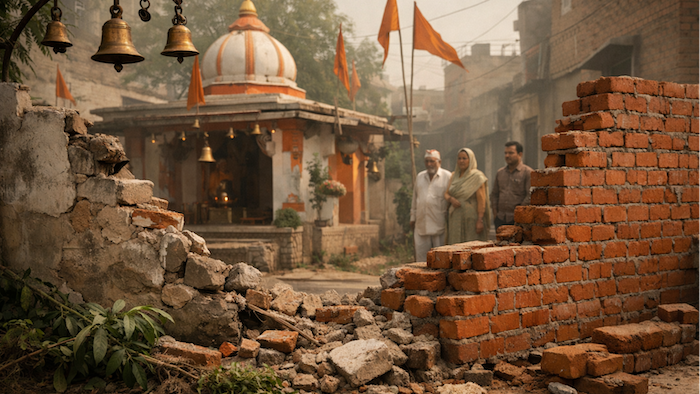
Case Summary
In Mohalla Bas, Mahendragarh, Haryana, a Hindu temple of Goddess Santoshi Mata was targeted for encroachment by an individual. The accused, along with encroaching on the temple land, also demolished the temple's boundary wall. This incident came to light when Hindu devotees in Mahendragarh stated that they faced obstruction to the functioning of Maa Santoshi Temple due to encroachment on temple land. The encroachment affected access and use of the temple premises. The issue involved damage to temple property and occupation of land associated with the temple. Local residents raised concerns over the impact on religious activities. As per reports, the Santoshi Mata Temple had been constructed by Kailash Kumar Kaushik. The temple land included an open area with trees and plants maintained by local Hindu residents. On 1 November 2025, residents of the locality formed a committee to oversee matters related to the temple and its land. During this period, a named individual demolished the boundary wall of the temple. The individual occupied the vacant space attached to the temple premises where trees and plants had been planted. A new wall was constructed on the occupied portion of land, altering the original boundary of the temple property. On 25 January 2026, residents of the locality reached a collective decision to remove the encroachment from the temple land. Despite this decision, the encroachment was not removed by the individual occupying the land. The individual stated that a complaint had already been submitted through the Chief Minister’s grievance portal. Subsequently, a second complaint was submitted to the Sub-Divisional Magistrate regarding the encroachment. The complaint sought measurement of the temple land and removal of the unauthorised construction. No removal action took place following these complaints. Residents, including Vasudev and Vikas Garg, submitted a complaint to the Additional Deputy Commissioner Tarun Kumar Pawaria requesting intervention. The complaint sought official measurement of the land and removal of the encroachment. The matter remained pending with administrative authorities at the time of reporting.
Why it is Hate Crime ?
This case has been added to the tracker under the primary category - Attack on Hindu religious representations. Within this, the subcategory selected is - Encroachment or illicit takeover of temple land/land near temple. In Hinduism, a temple is the abode of the Deity. The Deity in the Temple is consecrated, thereby, making it a real, breathing entity. Hindus believe that not just the Deity but the temple premises itself are sacred to Hindus since Hindus hold the faith that the entire Temple space is an amalgamation of the divine energy of the deity. Not only the Temple but the Temple premises in its entirety are considered sacred by Hindus. In several cases, the premises of the Temple and/or religious centre are illicitly taken over by institutions belonging to other faiths – like the Waqf board or the Church. Other times, the temple property, land or the property of religious centres are illicitly encroached by non-Hindu groups. Any illicit take over or encroachment is a crime an initio, however, when non-Hindu groups illicitly take over or encroach the sacred land of Hindus, it is an affront to the Hindu community and is therefore classified as a religiously motivated hate crime under this category. The other subcategory selected is- Desecration of Hindu religious symbol. Icons and symbols or a religious representation of a spiritual ideal are widely revered in Hinduism. Iconography is of vital significance in the Hindu milieu. It helps connect people’s spiritual beliefs with the real world. Iconography within the Hindu faith takes several shapes and forms. Murtis are of most significance to Hindus, to which daily rituals, prayers and offerings are done. Besides the murtis, there are several other symbols which have deep significance in the Hindu faith – the Om and Swastika for example. Since these Hindu religious symbols hold paramount importance in Hinduism, any desecration of symbols, icons, murtis, religious representations and manifestations, is driven by animosity towards the faith itself which manifests itself through these murtis, icons and symbols. Therefore, any desecration of these Hindu religious symbols and representations is considered religiously motivated hate crimes under this category. The other subcategory selected is- Attack on Temples. In Hinduism, a temple is the abode of the Deity. The Deity in the Temple is consecrated, thereby, making it a real, breathing entity. Hindus believe that not just the Deity but the temple premises itself are sacred to Hindus since Hindus hold the faith that the entire Temple space is an amalgamation of the divine energy of the deity. Given the central significance of Temples in Hindu Dharma, any attack against a Hindu Temple or its peripheral premises is an attack on the faith itself and is born out of animosity towards the faith, of which, the Temple is a central tenet. Any manner of attack against a Temple and/or its premises would therefore be considered a religiously motivated hate crime. This case qualified as a religiously motivated hate crime because a Hindu place of worship was directly targeted through deliberate damage and unlawful occupation of its land. The perpetrator demolished part of the temple structure and interfered with its physical integrity in a calculated manner that prevented normal operations. The act disrupted the functioning of a Hindu religious site by blocking access and hindering devotional activities essential to the community. Religion stood at the core because the structure targeted was a temple dedicated to Maa Santoshi, a deity revered by millions of Hindus for protection and prosperity. All these aspects made this an anti-Hindu hate crime, as the attack specifically undermined a key element of Hindu religious life. The perpetrator demolished the boundary wall of the Santoshi Mata Temple and altered the physical structure of the premises with clear intent to infringe upon its sacred boundaries. This held profound religious significance because a temple serves as a sacred space where rituals, prayers, and community worship occur daily, fostering spiritual connection and cultural continuity for Hindu devotees. The boundary wall defines and protects that sacred space, symbolising the demarcation between the divine and the mundane. By damaging this structure, the act directly interfered with the sanctity and integrity of the temple, violating its holiness. This targeted Hindu devotees because it affected their ability to access, maintain, and preserve a site central to their religious practice and identity. Such attacks on a temple and its entire ecosystem amounted to desecration of a sacred Hindu symbol, with temples standing as central symbols of Hindu faith and resilience. The perpetrator then occupied the vacant land attached to the temple and constructed a new wall over it, seizing control of an integral part of the temple's domain. This carried deep religious significance because temple land extends beyond mere physical property; it forms part of the religious ecosystem used for community gatherings, ritual preparations, maintenance of devotional elements, and serene devotional activities. The occupied space included areas with trees and plants that local Hindu residents had carefully maintained as enhancements to the temple surroundings, contributing to its spiritual ambiance. By encroaching upon this land, the act restricted the functional and spiritual space available to Hindu devotees, limiting their ability to perform traditions and commune in peace. This specifically targeted Hindus by reducing access to a shared religious site, altering its intended sacred use, and imposing barriers on their worship. The continuation of the encroachment despite repeated objections from residents further reinforced the severe impact on the Hindu community. This proved significant because it demonstrated that the disruption to the temple was not incidental but a sustained assault maintained over months. The refusal to remove the encroachment after a collective decision by residents prolonged the interference with religious practice, forcing devotees to endure ongoing exclusion from their place of worship. This targeted Hindus by erecting persistent barriers to the proper use, upkeep, and reverence of their sacred site. Such acts stemmed from deep-rooted undermining and animosity towards the Hindu faith and community, unequivocally marking it as a religiously motivated crime with lasting harm. Given that this case fully met the parameters of a religiously motivated hate crime, it was added to the hate crime database of the tracker.


Case Status
Complaint filed


Perpetrators Details
Perpetrators
Unknown
Perpetrators Range
One Person
Perpetrators Gender
unknown
 Sources




