Hindu students threatened with expulsion for reciting Hanuman Chalisa as Muslim and Christian religious activities go unchallenged on campus
 Warangal, Telangana, India
  16 February, 2026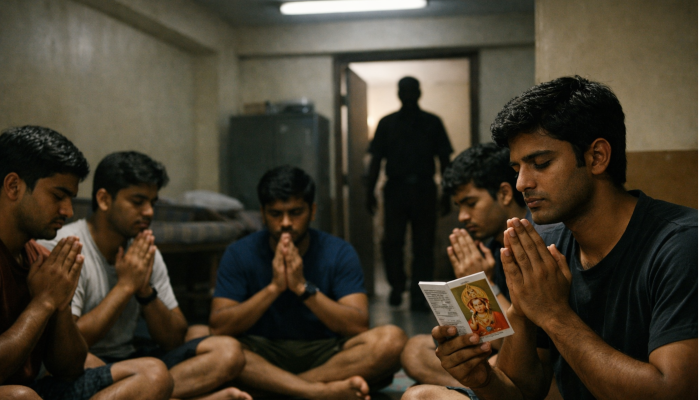
Case Summary
Hindu students at the National Institute of Technology [NIT] Warangal in Telangana had their voluntary weekly recitation of the Hanuman Chalisa [a devotional hymn dedicated to Lord Hanuman, one of the most widely recited prayers in Hinduism] forcibly stopped by institute officials who threatened them with expulsion if they continued. The same administration that silenced Hindu students had provided Muslim students a dedicated prayer space in the hostel and had allowed Christian events to be held on campus with senior administrators in attendance. A formal complaint was filed with the National Human Rights Commission [NHRC] demanding an independent inquiry. Every Tuesday evening, Hindu students residing in the 1.8K Hostel had been gathering voluntarily for approximately fifteen minutes to recite the Hanuman Chalisa together. The practice was entirely student-led, peaceful, and free of any political association. It harmed no one and disrupted nothing. It was an act of quiet devotion by Hindu students in their own residential space. When a video of the recitation circulated on social media, the institute administration moved swiftly to shut it down. On 17 February 2026, the Dean of Students Welfare, Chief Warden Professor P. Abdul Azeem, and faculty members entered the hostel and ordered the Hindu students to stop the recitation immediately. They warned the students that strict disciplinary action, including possible rustication [expulsion from the institution], would follow if the practice continued. Hindu students were being threatened with the destruction of their academic careers for the act of praying together for fifteen minutes a week. The administration's treatment of Hindu students stood in direct contrast to its treatment of other religious communities on the same campus. Muslim students had been provided dedicated space in the hostel's ninth-floor common hall for namaz. Christian events, including Christmas celebrations held under the banner NITMAS, had been conducted on campus with the active participation of senior institute administrators. Hindu students received threats of expulsion. Other religious communities received institutional accommodation and administrative endorsement. Legal Rights Protection Forum submitted a petition to NHRC member Priyank Kanoongo demanding an independent inquiry into the conduct of NIT Warangal Director Professor Bidhyadhar Subudhi, Chief Warden Professor P. Abdul Azeem, and Dean of Students Welfare Professor Kiran Kumar. The petition invoked Articles 14 [right to equality], 15 [prohibition of discrimination], and 25 [freedom of religion] of the Constitution of India, arguing that as a centrally funded institution under the Ministry of Education, NIT Warangal was obligated as a state entity to uphold the fundamental rights of all students equally. The petition sought immediate protection for the Hindu students from institutional retaliation and called for the uniform application of campus regulations across all religious communities.
Why it is Hate Crime ?
The primary category for this case is "Restriction/ban on Hindu practices". The sub-category here is "Restriction on expression of Hindu identity. An example of the state-affected prejudicial and targeted orders against the Hindu community would be a government denying the right of a Hindu or a group of Hindus to hold a religious procession owing to the animosity of non-Hindu groups. Denial of the religious right of the Hindus to assuage the non-Hindu group which harbours animosity to a point where it could lead to violence against Hindus is not only a failure of law and order but is a prejudicial order against Hindus, denying them their fundamental rights to express their religious identity. An example of a hate crime against Hindus by a non-Hindu would be a non-Hindu institution forcing its Hindu employees to abandon religious symbols that a Hindu would wear as an expression of faith owing to inherent prejudice against the faith professed by the victim or a non-Hindu group of people restricting a Hindu group from constructing a place of worship simply because the demography of the area in which the temple is being built is dominated by non-Hindus. Such actions are driven by religious animosity and/or prejudice against Hindus and their faith and would therefore be categorized as a hate crime. Another sub-category for this case is "Administration restricting religious practice". In several cases, it is seen that the administration/state disallows a religious practice owing to prejudicial orders and concerns, targeted specifically against the Hindu community. Such restriction/prohibition would be considered documented as a hate crime because the orders are often a result of pressure by groups that harbour animosity towards Hinduism and Hindus. Often, the restriction by the authorities is driven by bias, hostility, or prejudice against the specific community being stopped from holding a religious practice, by pressure groups that harbour animosity towards Hindus, intrinsic to their faith. Since practices are intrinsic to the faith of the Hindus, such prejudicial restriction is considered a curtailing of the fundamental rights of the Hindu community. In several cases, for example, the authorities ban a Hindu religious practice due to pressure from groups opposed to the religion. In other instances the prohibition is selectively enforced against one religious group (Hindus) while others are allowed to proceed. There are still other cases where the authorities preemptively restrict a religious practice by Hindus because those who hold animosity towards Hindus may get “provoked” leading to them being violent, thereby assuaging the sentiments of those who hold animosity towards Hindus by curtailing the religious rights of Hindus. Such acts and orders are prejudiced, indicating discriminatory motives owing to the capitulation to groups that harbour animosity towards Hindus and therefore, would be categorized as a religiously motivated hate crime since the original pressure leading to the order itself is a result of hatred/bias/prejudice/religious hate against Hindus. This case qualifies as a religiously motivated hate crime in which Hindu students at a centrally funded public institution in Telangana had their fundamental right to religious expression suppressed by institute officials who simultaneously provided institutional accommodation and endorsement to Muslim and Christian religious activities on the same campus. The differential treatment was not accidental or procedural. It was a deliberate and documented application of unequal standards to Hindu religious practice. The suppression of the Hanuman Chalisa recitation is the primary religious marker of this case. The Hanuman Chalisa is one of the most universally recited devotional texts in the Hindu tradition. It is a forty-verse hymn dedicated to Lord Hanuman, memorised and recited by hundreds of millions of Hindu people across the world as a daily act of faith. Hindu students gathering voluntarily for fifteen minutes each week to recite it together in their own residential space were engaging in one of the most fundamental and harmless expressions of Hindu religious identity possible. The decision by institute officials to enter the hostel, order the recitation stopped, and threaten the students with rustication for continuing was a direct assault on the right of Hindu students to practise their faith in their own living space. The threat of rustication as the instrument of suppression is the second religious marker. Rustication is among the most severe disciplinary sanctions available to a university administration. It ends a student's academic career at the institution and carries lasting consequences for their professional future. The use of this threat to stop a fifteen-minute weekly prayer session reflects a deliberate decision to deploy maximum institutional force against a Hindu devotional practice. The disproportionality of the threatened punishment relative to the nature of the activity confirms that the intent was not to enforce a neutral campus policy but to suppress Hindu religious expression specifically. The provision of a dedicated namaz space for Muslim students in the same hostel is the third and most explicit religious marker. The administration that threatened Hindu students with expulsion for praying in their own hostel had simultaneously provided Muslim students with a designated space in the same building's ninth-floor common hall for namaz. This juxtaposition is the clearest possible evidence of discriminatory intent. The same physical space that was made available to Muslim students for Islamic prayer was governed by rules that threatened Hindu students with academic destruction for Hindu prayer. The differential treatment was not a matter of interpretation or procedural oversight. It was a documented institutional policy of unequal religious accommodation. The endorsement of Christian events by senior administrators is the fourth religious marker. Christmas celebrations under the banner NITMAS had been conducted on campus with the active participation of senior institute administrators. Hindu students who attempted to recite the Hanuman Chalisa for fifteen minutes in their hostel received threats of expulsion. Christian students who organised campus-wide celebrations received administrative endorsement and senior official participation. The three-way comparison, suppression for Hindus, accommodation for Muslims, and active endorsement for Christians, establishes a clear and consistent pattern of institutional discrimination directed specifically at Hindu religious expression. Given that this case met the parameters of a religiously motivated hate crime, it was added to the hate crime database of the tracker.


Case Status
Complaint filed


Perpetrators Details
Perpetrators
Muslim Extremists
Perpetrators Range
One Person
Perpetrators Gender
male
 Sources




