Hindu temple's sanctity defiled; Muslim man urinates at temple gate in Udhampur, Jammu and Kashmir
 Udhampur, Jammu and Kashmir, India
  8 April, 2026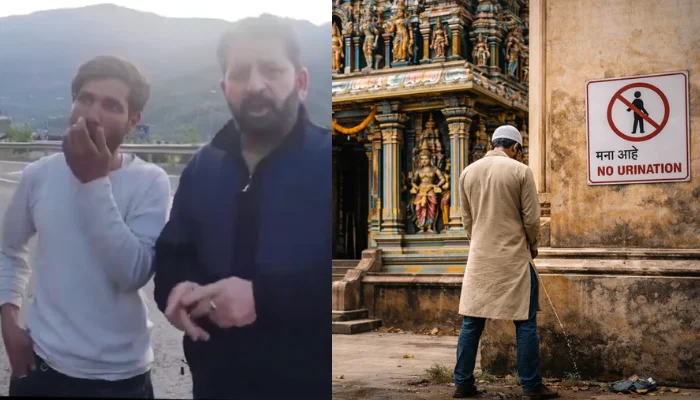
Case Summary
In Udhampur, Jammu and Kashmir, a Hindu temple named the Sharda Mata Temple was targeted for defilement as a Muslim man named Mohammad Mudassir urinated at the temple gate and on the stairs. According to media reports, the accused was travelling to Srinagar in his truck when he was passing by the temple. During this, he stopped outside the temple gate and urinated on the temple stairs at the gate. This was witnessed by a few Hindu passers-by, and they caught hold of the perpetrator and questioned him. A video of this incident went viral on social media. In the video, a Hindu man is seen saying that Mudassir stopped his vehicle near the temple gate and urinated at the gate and on the stairs. When questioned, Mudassir claimed that he did it by mistake and did not see the temple. However, Hindus questioned this explanation, stating that there was a large, clearly visible gate and a board displaying “Sharda Mata Temple,” and that the act appeared deliberate and intended to hurt Hindu sentiments. As the video of this incident spread on social media, Hindu users expressed outrage. They stated that such events hurt the religious sentiments of the Hindu community and desecrate their sacred spaces.
Case Images

Why it is Hate Crime ?
The primary category selected in this case is- Attack on Hindu religious representations. The subcategory selected is- Desecration of Hindu religious symbol. Icons and symbols or a religious representation of a spiritual ideal are widely revered in Hinduism. Iconography is of vital significance in the Hindu milieu. It helps connect people’s spiritual beliefs with the real world. Iconography within the Hindu faith takes several shapes and forms. Murtis are of most significance to Hindus, to which daily rituals, prayers and offerings are done. Besides the murtis, there are several other symbols which have deep significance in the Hindu faith – the Om and Swastika for example. Since these Hindu religious symbols hold paramount importance in Hinduism, any desecration of symbols, icons, murtis, religious representations and manifestations, is driven by animosity towards the faith itself which manifests itself through these murtis, icons and symbols. Therefore, any desecration of these Hindu religious symbols and representations is considered religiously motivated hate crimes under this category. The other subcategory selected is- Breaking rules of place of worship. Sanatan Dharma is not a religion of one book, which is to say that while it has religious scriptures that form the central tenets of the faith, there are several traditions followed through thousands of years, mostly passed from generation to generation orally. One of these oral traditions or written traditions is the rules of specific temples. Certain temples have rules which are traditional rules, dependent on the worship of the presiding deities. These rules and traditions have been followed for thousands of years whether they find scriptural mention or not. Such traditions are based on the nature and rules of worship of the presiding deity of that temple. Any non-compliance of these traditions owing to animosity towards the faith or for the sake of activism stems not only from the lack of faith in the presiding deity but also disregard for the faith of the devotees of that deity/temple and implicit bias against the faith, the tradition and the deity itself. Since these specific traditions are central to the faith of the devotees of that specific temple and presiding deity, any non-compliance with these traditional rules would be considered a religiously motivated hate crime. This case is a clear instance of a religiously motivated hate crime as the Muslim man desecrated the sanctity of a Hindu temple by urinating at the temple gate and on the stairs of the temple. The act was carried out within the temple premises, at a location that is visibly marked and recognised as sacred by devotees. Choosing such a space for an act considered impure in Hindu belief systems demonstrates not just disregard but targeted disrespect towards a place of worship. The deliberate nature of the act, performed at the temple gate, reflects an intention that goes beyond mere misconduct and enters the realm of religious hostility. Hindu temples hold profound spiritual, cultural and ritual significance within Hinduism. They are not merely physical structures but sacred spaces believed to be the abode of the deity, where strict norms of purity, reverence and discipline are observed. Devotees approach temples with a sense of sanctity, adhering to codes of conduct that emphasise cleanliness, respect and ritual propriety. Hence, any act of desecration of a Hindu temple amounts to a clear case of a religiously motivated hate crime. Here, the Muslim man deliberately chose a spot at the Hindu temple gate to urinate, showcasing clear malicious intent to defile and desecrate the sanctity of the temple. Acts involving impure substances, such as urine within temple premises, are seen as defiling not just the physical space but the sanctity of the religious symbol itself, thereby constituting a direct affront to the faith. Hindu temples operate under well-defined rules and codes of conduct where cleanliness and ritual purity are of utmost importance. Substances such as urine are considered impure and strictly prohibited within temple premises. Despite this widely understood norm, the perpetrator urinated at the temple gates and on the temple stairs, violating these sacred codes. This act reflects a conscious disregard for the religious values associated with the temple and demonstrates an intentional breach of its sanctified boundaries. Such behaviour underscores a clear instance of violating established religious norms, reinforcing the conclusion that this was a religiously motivated hate crime. The Muslim perpetrator claimed that the act was a mistake; however, the facts on the ground contradict this explanation. The temple gate is large, clearly visible, and prominently marked with a poster and banner identifying it as the Sharda Mata Temple. Such clear signage and structural visibility make it highly implausible that the location could be mistaken for anything other than a place of worship. Despite this, he maintained that he did not notice the temple and proceeded to urinate at the temple gates and on the stairs. This explanation is nothing more than an attempt to cover up the act after being confronted, and it further reinforces the inference of deliberate intent. The circumstances strongly indicate that the act was carried out with awareness of the location, thereby showcasing malicious intent rather than any genuine mistake. Overall, these instances amount to a clear case of a religiously motivated hate crime. Therefore, this case is being recorded in the Hate Crime Database of the Hinduphobia Tracker. Disclaimer: The Hinduphobia Tracker records incident dates based on when the crime occurs, not when the media reports it. In this case, media reports do not specify the exact occurrence date. Therefore, the media reporting date of 9 April 2026 serves as the indicative incident date. This recorded date is for documentation purposes only.


Case Status
Unknown


Perpetrators Details
Perpetrators
Muslim Extremists
Perpetrators Range
One Person
Perpetrators Gender
male
 Sources




