Hindu students subjected to religious brainwashing in Ujjain; government university exam pushes idea of Islamic supremacy
 Ujjain, Madhya Pradesh, India
  6 April, 2026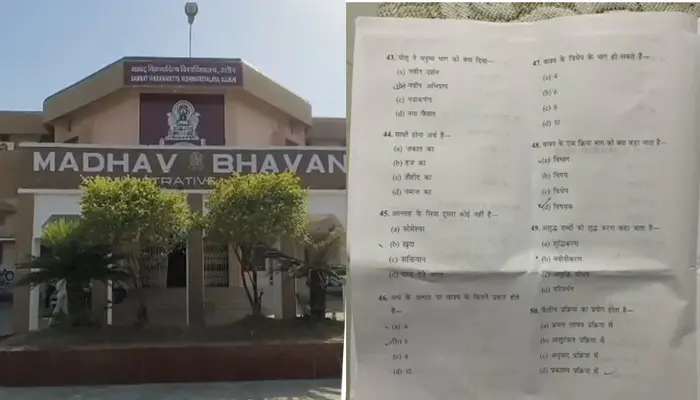
Case Summary
Hindu students were subjected to religious brainwashing when a question referencing Islamic supremacy was asked in university examinations. The incident occurred at Samrat Vikramaditya University in Ujjain, Madhya Pradesh. It took place during the Foundation Course examination for third-year BCom, BBA, and BCA students, conducted in April 2026, which included a multiple-choice question under the language and culture section. The question stated, “There is no one other than Allah,” and required students to select the correct answer from options such as Someshwar, Khuda, Shaktivan, and “the one who punishes (Dand dene wala).” The question drew attention after students flagged it, and it subsequently went viral. Thereafter, several Hindu organisations raised objections, considering the framing inappropriate for a secular academic setting. As the issue gained traction, protests occurred at multiple locations, including Ratlam and Ujjain, with demands for accountability and action against those responsible for setting the paper. The incident escalated into a broader public controversy, with concerns raised regarding academic neutrality, curriculum standards, and the inclusion of religion-specific assertions in a general university examination. In response to the growing backlash, the university administration initiated an inquiry and referred the matter to its Examination Committee for detailed review. The Registrar, Anil Kumar Sharma, stated that any question found to be controversial or inappropriate would be examined by subject experts to determine whether it aligned with the prescribed syllabus and academic framework. The committee was tasked with assessing the process through which the question paper was set and moderated, including whether proper checks had been carried out prior to finalisation. The Vice-Chancellor also sought an explanation from the Controller of Examinations, and internal meetings were convened to evaluate the lapse and determine further action. University officials indicated that if the question was found to be inconsistent with academic standards, it could be removed from evaluation, raising additional concerns regarding the marking process for affected students. The investigation also aimed to identify responsibility for the inclusion of the question and to recommend disciplinary measures if required.
Why it is Hate Crime ?
The primary category selected in this case is- Predatory Proselytisation. The subcategory selected is- Proselytisation by grooming, brainwashing, manipulation or subtle indoctrination. Religious brainwashing essentially means the often subtle and forcible indoctrination to induce someone to give up their religious beliefs to accept contrasting regimented ideas. Religious grooming or brainwashing also involves propaganda and manipulation. It involves the systematic effort, driven by religious malice and indoctrination, to persuade “non-believers’ to accept allegiance, command, or doctrine to and of a contrasting faith. Cases of such grooming or brainwashing are far more nuanced than direct threats, coercion, inducement and violence. In such cases, it is often seen that there is repeated, subtle and continual manipulation of the victim to induce disaffection towards their own faith and acceptance of the contrasting faith of the perpetrator. While subtle indoctrination is widely acknowledged as predatory, an element which is often understated in such conversions or the attempts of such conversion is the role of loyalty and trust which might develop between the perpetrator and the victim. Fiduciary relationships are often abused to affect such religious conversion. For example, an educator transmitting religious doctrine of a competing faith to a Hindu student. The Hindu student is likely to accept what the teacher is transmitting owing to existence of the fiduciary relationship. The exploitation of the fiduciary relationship to religiously indoctrinate victims would also be included in this category. Since the underlying animosity towards the victim’s faith forms the basis of predatory proselytization, such cases are considered religiously motivated hate crimes. This case clearly qualified as a religiously motivated hate crime due to the introduction of a question referencing Islamic supremacy into a formal academic examination at Samrat Vikramaditya University in Ujjain. The question stated “There is no one other than Allah” and required students to identify the correct answer from multiple options, including Someshwar, Khuda, Shaktivan, and “the one who punishes (Dand dene wala)”. It went beyond neutral academic inquiry and presented a definitive doctrinal position portraying Islamic supremacy, as the correct answer was Khuda (Allah), all within a setting expected to maintain strict secular and academic neutrality. In doing so, it placed Hindu students in a position where they had to endorse Islamic supremacy to score marks, thereby imposing Islamic theology within an educational framework. The framing of the question reflected a departure from standard pedagogical practices, which typically employ comparative or descriptive approaches to religion rather than assertions of absolute theological claims. By presenting such a statement in an objective multiple-choice format, the examination normalised an Islamic religious worldview over non-Muslim students, particularly Hindus, while demeaning their faith and beliefs. For Hindu students, whose religious traditions are diverse and non-exclusive, being assessed on a question rooted in exclusivist Islamic theology created discomfort and marginalisation, especially in a high-stakes examination where they were compelled to select the expected “correct” answer of Khuda. The incident also highlighted broader concerns about student vulnerability in institutional settings, where universities wield significant influence over intellectual and cultural discourse. The inclusion of such a question in a compulsory Foundation Course represented a deliberate attempt at subtle religious indoctrination, forcibly exposing Hindu students to alien religious practices and culture to make them more susceptible to conversion to Islam. Such acts of subtle and indirect proselytisation showcased the university's religious bias and its animosity towards the Hindu faith. Overall, the incident demonstrated how inserting a question on Islamic supremacy functioned not merely as ideological bias but as subtle religious conditioning targeted at Hindu students. By compelling them to validate a definitive theological assertion in a high-stakes academic setting, the question risked normalising Islamic doctrine as authoritative. Such framing, where Hindu students are conditioned to accept “correct” answers, held potential for gradual psychological influence that could weaken attachment to their own beliefs and foster receptivity to alternative religious narratives. This exceeded academic irregularity and reflected a pattern where institutions indirectly facilitated religious influence and conversions of Hindus to other religions. Therefore, this case was added to the hate crime database of the Hinduphobia Tracker. Disclaimer: The Hinduphobia Tracker records incidents based on when an event occurred or when the victim's ordeal began. It is important to clarify that none of the media sources covering this case has specified the exact date when the exam took place. Therefore, for documentation purposes, we have recorded the date based on when the incident was reported in the media, 7 April 2026.


Case Status
Unknown


Perpetrators Details
Perpetrators
State and Establishment
Perpetrators Range
Unknown
Perpetrators Gender
unknown
 Sources




