Anti-Hindu Indian academic in Dublin misrepresents Hindu vegetarianism as casteist in public forum
 County Dublin, Ireland
  6 April, 2026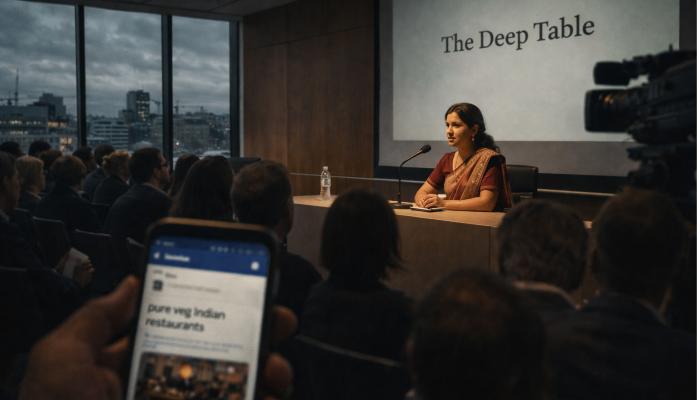
Case Summary
An Indian academic based in Dublin, Ireland, generated widespread controversy after publicly claiming that pure vegetarian Indian restaurants in Dublin were a coded expression of upper caste Hindu discrimination. The statements, made at a public forum and circulated on social media, were condemned by Hindu communities and commentators as a deliberate misrepresentation of a millennia-old Hindu religious practice rooted in ahimsa [the principle of non-violence toward all living beings]. Arpita Chakraborty, a postdoctoral fellow at the Ireland India Institute in Dublin and an alumna of the Tata Institute of Social Sciences [TISS], made the statements at a public discussion hosted by The Deep Table. She claimed that pure vegetarian Indian restaurants in Dublin were a code for upper caste identity and that they were piggybacking on the Western vegan movement to introduce casteism into Irish society. She further stated that the community structures being replicated by Indian migrants in Ireland were replicating casteism through existing social networks on platforms such as Facebook and WhatsApp. The statements were circulated widely on social media. A post on the platform X by the account Gems of Indian Academia described her claims as false and warned that they could lead to hate crimes against Indians in Ireland, calling on the Ministry of External Affairs of India [MEA India] and the High Commission of India in Ireland [HMO India] to monitor her activities. A separate post by an Irish commentator using her remarks as evidence that the Indian caste system was appearing in Ireland as a result of Indian migration was also circulated, demonstrating the real-world prejudicial impact of her framing on the perception of Hindu communities in Ireland. Critics argued that Chakraborty's characterisation of pure vegetarian restaurants as casteist ignored the foundational religious basis of Hindu vegetarianism, which predates the Western vegan movement by approximately three thousand years and is observed by Hindus, Jains, and members of numerous communities across India on the basis of deep moral and spiritual conviction rather than caste exclusivity. They further noted that her framing, presented to a Western academic audience without this context, served to generate prejudice against ordinary Hindu families and businesses in the diaspora who had no discriminatory intent.
Why it is Hate Crime ?
The primary category for this case is "Hate speech against Hindus". The sub-category here for this case is "Anti-Hindu subversion and prejudice". Hate speech is defined as any speech, gesture, conduct, writing, or display that is prejudicial against a specific individual and/or group of people, which is leading to or may lead to violence, prejudicial action or hate against that individual and/or group. Media plays a specific and overarching reach in perpetuating prejudicial attitudes towards a community owing to unfair, untrue coverage and/or misrepresentation/misinterpretation, selective coverage and/or omission of facts of/pertaining to issues affecting a specific religious group. This type of bias can dehumanise the victim group, making it easier for others to justify harmful actions against them, which aligns with the objectives of hate speech laws aimed at preventing such harm. It is often observed that the media takes a prejudicial stand against the Hindu community driven by their need to shield the aggressor community which happens to be a numeric minority, however, is the one perpetrating violence against Hindus. For example, the media is often quick to contextualise religiously motivated crimes against Hindus, omit or misrepresent facts that point towards religiously motivated hate crimes, justify and/or downplay religiously motivated hate crimes or simply present fake news to stereotype Hindus. Such media bias leads to the denial of persecution and is often used to dehumanise Hindus, leading to justification for violence against them. For example, the media covered several fake allegations of Hindus targeting Muslims and forcing them to chant Jai Shree Ram. Most of these cases were proved false and fabricated after police investigation. These fake news reports were subsequently never retracted or clarified. Such fake news led to the justification of violence and dehumanisation of Hindus based on the argument that since Hindus targeted Muslims and forced them to chant Jai Shree Ram, the dehumanisation of Hindus and violence against them was par for the course and merely a retaliation. Such media bias leads to prejudicial portrayal of Hindus and offers a justification for violence against them and therefore, is considered hate speech under this category. This case qualifies as a religiously motivated hate speech incident in which an Indian academic in Dublin, Ireland publicly misrepresented a foundational Hindu religious practice as a coded instrument of caste oppression, generating institutional prejudice against Hindu communities in the Western diaspora. The statements were not made in a private context. They were delivered at a public forum, recorded, and circulated on social media, amplifying their prejudicial impact far beyond the immediate audience. The misrepresentation of Hindu vegetarianism as casteism is the primary religious marker of this case. Vegetarianism in the Hindu tradition is not a dietary preference or a social signalling mechanism. It is a direct expression of ahimsa, the ancient Hindu principle of non-violence toward all living beings, which has been observed by Hindu, Jain, and many other communities across the Indian subcontinent for approximately three thousand years. To characterise pure vegetarian restaurants, which are the practical expression of this religious and ethical commitment in a diaspora context, as a coded form of caste discrimination is to misrepresent the religious foundation of the practice entirely. It reduces a sacred civilisational value to a conspiracy and presents Hindu religious identity itself as an instrument of oppression. The academic framing of the statements is the second religious marker. Chakraborty did not make these claims as a private individual expressing a personal opinion. She made them in her capacity as a postdoctoral fellow at a recognised academic institution, at a public forum, in a format designed to carry institutional authority. Academic claims carry a weight and credibility that private statements do not. When a researcher with institutional credentials presents Hindu vegetarianism as casteist to a Western audience that has limited direct knowledge of Hindu religious practice, that audience has no immediate framework within which to interrogate the claim. The institutional authority behind the statement amplifies its prejudicial impact and makes it significantly more difficult for Hindu communities to contest. Hindu communities in Ireland and across the Western diaspora are small minorities operating in environments where they are already subject to significant misrepresentation and where their religious practices are poorly understood. Chakraborty's statements did not merely generate academic debate. They provided a framework through which ordinary members of Irish society could interpret the presence of Hindu vegetarian businesses as evidence of discriminatory intent. The post by an Irish social media commentator, using her remarks to suggest that the Indian caste system was appearing in Ireland as a result of Indian migration, demonstrates the real-world prejudicial consequence of her framing. Her statements gave external validation to a narrative that positions Hindu cultural and religious practices as socially harmful in a country where Hindus have no institutional means of effective rebuttal. The broader pattern of anti-Hindu subversion that Chakraborty's statements represent is the final religious marker. The formula she employed, taking an ordinary Hindu religious practice, applying the language of oppression and exclusion, and presenting it to a Western academic audience as evidence of Hindu bigotry, is not unique to this case. It is a recognisable pattern in which Hindu traditions and practices are systematically reframed as instruments of social harm for audiences that lack the cultural and religious context to evaluate the claims being made. This pattern causes cumulative harm to Hindu communities in the diaspora by eroding the social legitimacy of their religious practices and generating hostility toward their cultural presence in their countries of residence. Given that this case met the criteria for a religiously motivated hate speech incident, it was added to the tracker's hate speech database.


Case Status
Complaint not filed


Perpetrators Details
Perpetrators
Others
Perpetrators Range
One Person
Perpetrators Gender
female
 Sources




