Minor Hindu boy abducted and forcibly converted to Islam by Muslims; made to offer namaz, wear Islamic attire and eat beef
 Pratapgarh, Uttar Pradesh, India
  3 April, 2026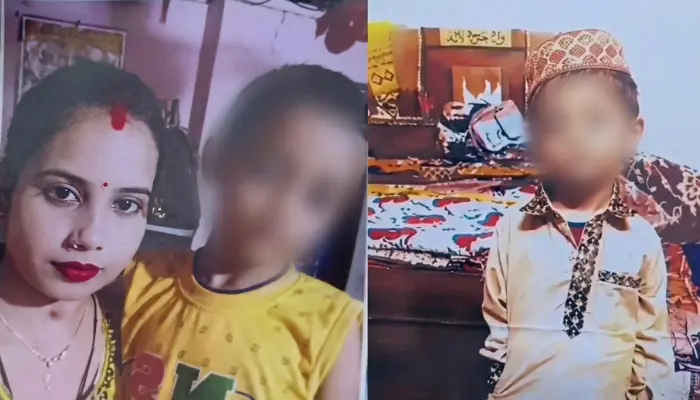
Case Summary
A 5-year-old Hindu boy named Samar Nirmal, from Pratapgarh, Uttar Pradesh, was abducted and forcibly converted to Islam. The victim was made to offer namaz, eat beef (cow meat), wear Islamic clothes and also had his name changed to Mohammad Ali, an Islamic name. According to media reports, the victim's family was from an extremely poor background. Due to this, the family gave their son, Samar, to their nephew, Bhanupratap, saying they would take him back once they became financially stable. Bhanupratap promised to raise Samar well by providing him with education and a good childhood. But later, when the family wanted to get Samar back and asked about him and his whereabouts, Bhanupratap did not give any answer for this. Being suspicious, Samar's elder brother, Pramod, went to Delhi to check on Samar, and there he discovered that Bhanupratap and a few Muslims had converted him to Islam. Pramod and his family also discovered that Bhanupratap had sold Samar to the Muslim perpetrators in Delhi. As per Pramod's own narration, he went to Delhi and asked Bhanupratap to let him meet his brother Samar. A few Muslims then arrived with Samar. The Hindu victim was dressed in Islamic attire, such as a kurta and a Muslim cap and was made to offer namaz. They had also changed his name to Mohammad Ali. Pramod confronted Bhanupratap and the Muslims, asking, "Are you making him (Samar) a Maulana?" He opposed Samar's religious conversion and took a photo of him in Islamic attire. Following this, Bhanupratap and the Muslim perpetrators brutally attacked Pramod afterwards, forcing him to flee the scene. The victim's mother stated the minor boy was forcibly converted to Islam. He was compelled to eat beef, was given a new Islamic name and made to wear Islamic attire. The victim was also made to offer namaz every day. She also stated that after being taken to Delhi, Samar did return once to Pratapgarh, where he lived with his family for one month, but again he was forcibly abducted from his home by the perpetrators. The mother also stated that while he was back home, Samar narrated his ordeal that he suffered in Delhi. He said that the Muslims harassed him constantly and force-fed him beef (cow meat). Samar was also crying to his mother, saying he did not want to go back to Delhi. The victim's family also stated that they approached the police many times regarding their ordeal, but the police took no action against the perpetrators or did not even register their cases. Disheartened by this, the victim's family appealed to Chief Minister Yogi Adityanath to take action against the perpetrators and bring Samar back home.
Why it is Hate Crime ?
The first primary category selected here is- Predatory Proselytisation. The subcategory selected is- Harassment, threats, coercion for conversion. Harassment covers a wide range of behaviours of an offensive nature. It is commonly understood as behaviour that demeans, humiliates, and intimidates a person, including threats and coercion. Harassment and threats, in this case, find their root on discriminatory grounds which has the effect of nullifying a person’s rights or infringing upon his freedom to exercise his right specifically owing to the victim’s religious identity. Verbal and physical threats and psychological or physical harassment are often used against Hindu victims because they choose to practice their professed religion. Religious harassment also includes forced and involuntary conversions by harassment, threats or coercion. Coercion includes intimidatory tactics like force-feeding a Hindu victim beef to convert to another religion, forceful circumcision etc. In several cases documented, non-Hindu perpetrators or those who harbour specific animosity towards Hinduism, harass victims simply based on their religious identity. Such cases often also include harassment to ensure the Hindu victim abandons his/her professed religion and adopts the religion of the perpetrator. Such cases where Hindu victims are harassed to convert to the perpetrator’s religion are rooted in animosity towards the victim’s religious identity and are therefore documented as religiously motivated hate crimes. The other subcategory selected is- Proselytisation by grooming, brainwashing, manipulation or subtle indoctrination. The tertiary categories selected are- Conversion of minor, Family claims grooming. Religious brainwashing essentially means the often subtle and forcible indoctrination to induce someone to give up their religious beliefs to accept contrasting regimented ideas. Religious grooming or brainwashing also involves propaganda and manipulation. It involves the systematic effort, driven by religious malice and indoctrination, to persuade “non-believers’ to accept allegiance, command, or doctrine to and of a contrasting faith. Cases of such grooming or brainwashing are far more nuanced than direct threats, coercion, inducement and violence. In such cases, it is often seen that there is repeated, subtle and continual manipulation of the victim to induce disaffection towards their own faith and acceptance of the contrasting faith of the perpetrator. While subtle indoctrination is widely acknowledged as predatory, an element which is often understated in such conversions or the attempts of such conversion is the role of loyalty and trust which might develop between the perpetrator and the victim. Fiduciary relationships are often abused to affect such religious conversion. For example, an educator transmitting religious doctrine of a competing faith to a Hindu student. The Hindu student is likely to accept what the teacher is transmitting owing to existence of the fiduciary relationship. The exploitation of the fiduciary relationship to religiously indoctrinate victims would also be included in this category. Since the underlying animosity towards the victim’s faith forms the basis of predatory proselytization, such cases are considered religiously motivated hate crimes. The second primary category selected is- Attack not resulting in death. The subcategory selected is- Attacked for opposing radicals or trying to save victims. In several cases, Hindus are attacked for opposing religiously motivated crimes being committed against a fellow Hindu or simply for voicing an opinion opposing radical elements, who either have in the past or continue to persecute Hindus. In such cases, the initial attack against the victim, against which the Hindu was trying to defend the victim, would also need to be classified as a religiously motivated hate crime. Since the initial crime itself was religiously motivated and the subsequent crime of attempting to save the victim or speaking against the radical elements ends up inviting a violent attack, it would also be classified as a religiously motivated hate crime under this category. In this case, a minor Hindu boy was abducted and forcibly converted to Islam. He was made to offer namaz, eat beef, and adopt other Islamic practices. All these actions targeted his Hindu religious identity with deliberate malice and animosity, making it a clear instance of a religiously motivated hate crime. Here, it is first important to highlight that the victim was a minor, which meant the element of consent and genuine change of conscience was entirely absent. Minors, due to their young age and lack of maturity, are by far the most vulnerable to manipulation and coercion. They lack the cognitive ability to fully understand the profound implications of converting to another religion, and the Muslim perpetrators purposely targeted and exploited this vulnerability of the minor victim, Samar. Since this case exemplifies the use of coercion, manipulation, and force to achieve religious conversion, it constituted a blatant act of religiously motivated hate crime against the Hindu boy, his family, and the larger Hindu community. The act of exploiting the victim's family's social and economic vulnerabilities, and then winning their trust only to sell off the child to Muslims as Bhanupratap did, showcased a clear-cut, calculated, and well-planned strategy rooted in anti-Hindu prejudice. The perpetrators targeted the family precisely because of their economic desperation and poverty, seizing that opportunity to traffic the boy to the Muslims for forced proselytisation. This predatory nature demonstrated a ruthless intent to prey on vulnerable Hindus, ripping a child from his family and faith solely to impose a foreign religion, which marks it as a religiously motivated hate crime driven by deep-seated hostility towards the Hindu faith and community. After being sold to Muslims, the 5-year-old Hindu victim was forcibly converted to Islam through a series of coercive measures. Forced conversion represents a grave and direct violation of the child's religious autonomy and fundamental rights, as it systematically replaced his innate Hindu convictions, cultural upbringing, and familial faith with external persuasion, psychological intimidation, and brute physical force. This ruthless overwriting of a vulnerable minor's original faith identity constitutes a textbook religiously motivated hate crime, as the perpetrators deliberately sought to eradicate every aspect of his Hindu selfhood. This included his beliefs, practices, and heritage, and reprogrammed him into an Islamic identity entirely against his will and comprehension, denying him the basic human freedom to retain, practise, or choose his birth religion while inflicting irreversible spiritual and emotional trauma on him and his family. The victim was also pressured to perform Islamic religious practices like offering namaz and wearing Islamic attire such as a kurta and cap. This showcased a systematic and gradual effort to immerse him in Islam and indoctrinate him with an Islamic lifestyle, deliberately severing his ties to his Hindu religious identity and heritage. By compelling these alien rituals on a Hindu child day after day, the perpetrators aimed to psychologically and culturally erase his roots, fostering dependence on the new faith while dismantling his sense of belonging to Hinduism, making it a clear case of a religiously motivated hate crime that attacks the essence of Hindu devotional life. The act of forcing the Hindu boy to eat beef amounted to profound religious sacrilege against his Hindu identity and a desecration of his faith. In Hinduism, the cow symbolises non-violence (ahimsa), motherhood, earth, and divine sustenance, revered in ancient scriptures like the Vedas and central to rituals, festivals like Gopashtami, and everyday reverence. Consuming beef or even associating with cow slaughter ranks as one of the gravest sins (mahapataka) in Hinduism, historically leading to excommunication, social ostracism, or complete severing from the faith community. Hence, forcibly making a minor Hindu boy eat beef was done specifically to humiliate, strip him of his Hindu faith, sever his ties from the Hindu community, and inflict maximum spiritual trauma, establishing it as a clear case of religiously motivated hate crime. Historically, Muslim extremists have repeatedly used force-feeding beef or throwing it into temples and homes to desecrate Hindu sacred spaces, provoke riots, and obliterate Hindu identity. This case mirrors the same pernicious pattern, weaponising beef as a deliberate tool to annihilate a Hindu person's religious essence and communal bonds. Samar was also assigned a new Islamic name, Mohammad Ali, as a deliberate tactic to sever him completely from his Hindu roots and heritage. This renaming amounted to a calculated psychological assault that erased his original name, Samar Nirmal, a name deeply rooted in Hindu traditions where Samar evokes battle-ready protection and spiritual resolve, and Nirmal signifies purity and sanctity, replacing it with one strongly evocative of Islamic faith allegiance. Such a profound act symbolises the perpetrators' malicious and unrelenting intent to annihilate every last vestige of his Hindu identity, from personal nomenclature to cultural essence, while socially and legally repositioning him as a Muslim and systematically alienating him from his Hindu family, community, and ancestral legacy. This targeted identity theft through forced renaming qualifies as a religiously motivated hate crime, executed through cultural erasure, psychological reprogramming, and coerced assimilation into an alien religious framework, inflicting lasting trauma on the child's sense of self and belonging. When he returned home briefly, he narrated how he was constantly harassed, force-fed beef, and coerced into conversion, revealing the depth of unrelenting hostility the perpetrators harboured for the Hindu victim. Despite this ordeal being exposed, they abducted him again, dragging him from the safe confines of his family home back to a place of captivity where he faced ongoing coercion into an Islamic lifestyle and faith. This repeated kidnapping purely to enforce religious conversion showcased unrelenting religious animosity, exploiting his Hindu vulnerability time and again without remorse, and amounted to a hate crime by placing forced Islamisation above his safety, rights, and familial bonds. When the victim's elder brother, Pramod, learned of Samar's ordeal and firmly opposed his forced conversion, he was brutally beaten and assaulted by the Muslims and Bhanupratap. This vicious and unprovoked attack exemplified targeted violence against Hindus who dare to defend fellow Hindu victims of religiously motivated hate crimes, extending the aggression beyond the child to anyone challenging the perpetrators. The perpetrators' extreme brutality towards Pramod simply for protesting his younger brother's plight and demanding his return demonstrated profound, visceral hatred for Hinduism and the Hindu community at large, where even basic acts of familial solidarity and resistance provoke savage physical assault, intimidation, and threats of further harm. This ruthless extension of aggression underscores the hate crime's deeply communal dimension, systematically punishing Hindu resistance to anti-Hindu acts, instilling widespread fear, and aiming to silence the entire Hindu community through calculated terror and suppression of any protective response. The police took no action despite the family's repeated pleas, which exposed deep institutionalised bias against Hindus when they become victims of religiously motivated hate crimes. This deliberate and prolonged inaction not only shielded the Muslim perpetrators from accountability but also allowed the religious aggression, abduction, and forced conversion to persist unchecked for an extended period, emboldening further abuse. It perpetuated anti-Hindu hostility through systemic indifference and neglect of Hindu suffering, effectively compounding the offence's inherently religiously motivated character by denying justice and enabling the cycle of communal targeting to continue unabated. Overall, this case met every key parameter of a religiously motivated hate crime from inception to escalation. It showcased deep-seated religious animosity towards the Hindu victim and his faith identity through abduction, coercion, sacrilege, and violence. Therefore, it was added to the hate crime database of the Hinduphobia Tracker. Disclaimer: In this case, the Hinduphobia Tracker records the dates of incidents based on when the victim's ordeal began rather than when it was reported in the media. Media reports have not stated the exact date when the crime occurred. Hence, the date when the media reported this incident, that is, 4 April 2026, is being selected as the indicative incident date. This is recorded for documentation purposes only. In this case, the victim count has been recorded as two, encompassing both Samar Nirmal, the primary minor victim of abduction and forced conversion, and his elder brother Pramod, who was brutally attacked by the Muslim perpetrators and Bhanupratap for resisting and confronting Samar's religious conversion. In this case, the Muslim perpetrators were the main perpetrators, but Bhanupratap was also involved as a key accused. Hence, both were perpetrators in the religiously motivated acts against the Hindu victim. However, since the tracker permits only one perpetrator identity and count per case for consistency, the religion of the perpetrators has been recorded as Muslim, as they drove the primary acts of abduction, forced conversion, and coercion. The total number of Muslim perpetrators is not specified in reports, with only Bhanupratap named alongside them; thus, a conservative estimate of one perpetrator has been used. This approach ensures clarity in data representation and categorisation without overlooking the involvement of any accused individuals.
Victim Details
Total Victim
2
Deceased
0
Gender
- Male 2
- Female 0
- Third Gender 0
- Unknown 0
Caste
- SC/ST 0
- OBC 0
- General 2
- Unknown 0
Age Group
- Minor 1
- Adult 1
- Senior Citizen 0
- Unknown 0


Case Status
Unknown


Perpetrators Details
Perpetrators
Muslim Extremists
Perpetrators Range
One Person
Perpetrators Gender
male
 Sources




