Hindu sentiments outraged as anonymous social media handle posts a video abusing revered deities and desecrating Hindu idol
 Bhadohi, Uttar Pradesh, India
  4 April, 2026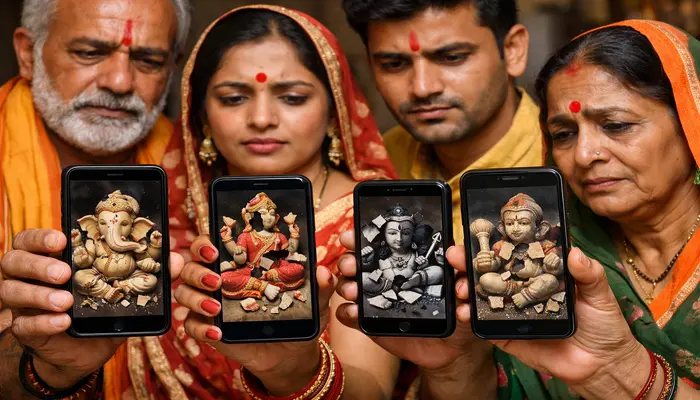
Case Summary
In the Bhadohi district of Uttar Pradesh, Hindu religious sentiments were outraged as an anonymous social media handle posted a derogatory video in which Hindu deities were abused, and a Hindu deity's idol was desecrated. According to reports, this incident came to light when the police brought this news to the media limelight on 9 April 2026. They said that on the complaint of Inspector Praveen Kumar Rai, in-charge of the district social media cell, a case was registered on 8 April 2026 at Gopiganj police station against an unknown person operating a Facebook ID named 'Garib Gautam Videos' on charges of inciting religious sentiments. He said that the Facebook account named "Gareeb Gautam Videos" had been circulating a video in which Hindu deities were abused with derogatory comments since the evening of 5 April 2026, causing public outrage. The video also showed the miscreant desecrating the idol of a Hindu deity. A Hindu user named "Ankur 46" had complained about this to Inspector Praveen Kumar Rai, in charge of the police's social media cell. Police sources also said that a case had been registered by Inspector Praveen Kumar Rai along with the screenshot of the accused's post. He said that the operator of the Facebook ID was being searched.
Why it is Hate Crime ?
This case is being added to the tracker under the first primary category- Hate Speech against Hindus. The subcategory selected is- Anti-Hindu slurs, mocking faith. Anti-Hindu slurs and the deliberate mocking of the Hindu faith owing to religious animosity involve the usage of derogatory terms, stereotypes, or offensive references to religious practices, symbols, or figures. One of the common anti-Hindu slurs used against Hindus is “cow-worshipper” and “cow piss drinker”. The intention of using this term is to demean and mock Hindus as a group and their religious beliefs since Hindus consider the cow holy. Additionally, some symbols and the slurs attached to them have a historical context that exacerbates the insult, hate, stereotyping, dehumanisation and oppression against Hindus. Cow worship has been used for centuries to denigrate Hindus, insult their faith and oppress Hindus specifically as a religious group. There has been overwhelming documentation about how cow slaughter has been used to persecute Hindus with cow meat being thrown in temples and places of worship. There has also been overwhelming documentation where cow meat (beef) has been force-fed to Hindus to either forcefully convert them to Islam or denigrate their faith. Apart from cow worship, the Swastika – which holds deep religious significance for the Hindus – has also been misinterpreted and distorted to use as a slur against Hindus. Similarly, the worship of the Shivling has been used by supremacist ideologies and religions to denigrate Hindus owing to religious animosity. Such slurs and denigration stem out of inherent animosity and hate towards Hindus and their faith, therefore, it is categorised as hate speech targeted at Hindus specifically owing to their religious identity. The second primary category selected is- Attack on Hindu religious representations. The subcategory selected is- Desecration of Hindu religious symbol. Icons and symbols or a religious representation of a spiritual ideal are widely revered in Hinduism. Iconography is of vital significance in the Hindu milieu. It helps connect people’s spiritual beliefs with the real world. Iconography within the Hindu faith takes several shapes and forms. Murtis are of most significance to Hindus, to which daily rituals, prayers and offerings are done. Besides the murtis, there are several other symbols which have deep significance in the Hindu faith – the Om and Swastika for example. Since these Hindu religious symbols hold paramount importance in Hinduism, any desecration of symbols, icons, murtis, religious representations and manifestations, is driven by animosity towards the faith itself which manifests itself through these murtis, icons and symbols. Therefore, any desecration of these Hindu religious symbols and representations is considered religiously motivated hate crimes under this category. This case exemplifies a religiously motivated hate crime, as the perpetrator deliberately posted a social media video denigrating Hindu deities and desecrating a Hindu deity's idol. The content targeted core elements of the Hindu faith with clear intent to offend religious sentiments, fitting the definition of an anti-Hindu crime. The perpetrator's first act, abusing Hindu deities, strikes at the heart of Hinduism, where deities like Shiva, Vishnu, Devi, Ganesha, and many more represent divine principles, protection, cosmic order, and moral guidance central to a Hindu's spiritual life, daily worship, and cultural identity. Therefore, any denigrating or offensive remark against them constitutes a religiously motivated hate crime, as it directly assaults these sacred figures revered across generations. Such derogatory remarks deeply hurt Hindu sentiments by mocking beliefs that billions hold dear, provoking communal disharmony through widespread outrage, social tension, and potential retaliation. Following this verbal attack, the desecration of a Hindu deity's idol reveals deep-seated religious animosity. In Hinduism, idols (murti) serve as consecrated embodiments of the divine, installed through elaborate rituals like prana pratishtha to channel worship, devotion, and divine presence; they are not mere statues but living focal points of faith invoked in temples, homes, and festivals. Hindus hold their deities' idols in high reverence as bridges to the divine. Therefore, the act of desecrating them amounts to a religiously motivated hate crime, inflicting deep pain on Hindus by violating these sacred symbols. It showcases blatant religious animosity towards Hinduism, its sacred temples and symbols, and the larger Hindu community. The perpetrator's decision to post this content on social media was deliberate, designed to amplify the hurt to Hindu sentiments and spread the offence far and wide. Abusing Hindu deities, desecrating their idol, and sharing it online, reaching thousands of Hindu users, demonstrates malicious intent to maximise emotional damage and visibility. This calculated dissemination solidifies it as a clear case of a religiously motivated hate crime. In this case, even though the perpetrator's identity is unknown, the act demonstrates religious animosity towards Hinduism and the Hindu community. Therefore, it is added to the hate crime database of the Hinduphobia Tracker.


Case Status
Complaint registered


Perpetrators Details
Perpetrators
Unknown
Perpetrators Range
One Person
Perpetrators Gender
unknown
 Sources




