Sacred Hindu symbol 'Swastika' desecrated and insulted by American singer who links it with Nazi Hakenkreuz
 United States
  10 February, 2025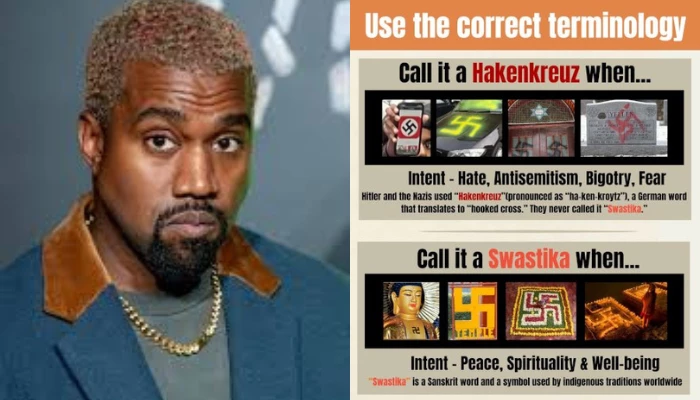
Case Summary
In the United States of America, the sacred Hindu symbol ‘Swastika’ was abused and desecrated by calling it Hitler's infamous, destructive symbol, Hakenkreuz. The incident came to light when rapper Ye, formerly known as Kanye West, used the term “swastika” in a paid apology advertisement published in The Wall Street Journal, referring to Hitler's symbol ‘Hakenkreuz’. According to reports, on 26 January 2026, Ye published a full-page open letter advertisement in The Wall Street Journal titled “To Those I’ve Hurt”, apologising for his previous antisemitic conduct. In the advertisement, he wrote, “I am not a Nazi or an antisemite. I love Jewish people.” He further stated that, while in what he described as a “fractured state” and dealing with bipolar disorder, he had gravitated “toward the most destructive symbol I could find, the swastika.” This statement led to objections from the Coalition of Hindus of North America (COHNA), which publicly called upon Ye and The Wall Street Journal to revise and correct what it described as inaccurate and offensive remarks about the swastika. COHNA stated, “This statement insults nearly two billion Hindus, Buddhists, Jains, and adherents of other indigenous faiths worldwide for whom the Swastika is a sacred symbol.” The organisation further stated, “For thousands of years, the Swastika has represented auspiciousness, good fortune, and well-being in Dharmic traditions. It remains central to our religious ceremonies, festivals, and sacred spaces.” It also asserted that Adolf Hitler did not use the word “Swastika” for the Nazi symbol and instead referred to it as “Hakenkreuz”, meaning “hooked cross” in German. Nikunj Trivedi, president of COHNA, stated that this was not the first instance in which the group had objected to Ye’s use of the term. He said, “In February 2025, when he was selling T-shirts with the Hakenkreuz, we reminded Shopify, the media, and the public that Hitler’s symbol is not the Swastika.” He further added, “It is deeply disappointing that a year later, he and esteemed institutions like the Wall Street Journal continue to perpetuate this harmful misinformation that threatens the religious freedom of billions of people to practice their faith and use their sacred symbols.” Reports further stated that COHNA had previously highlighted the same issue in a public post dated 11 February 2025, wherein it wrote: “We remind @Shopify, @charlieputh and the media covering the hateful antics of Kanye West that what he is selling is T-Shirts with the Hakenkreuz - not the Swastika.” The post further stated, “Hitler always called his hateful symbol the Hakenkreuz - a German word meaning hooked cross.” The report also noted that Japanese Buddhist priest Dr T.K. Nakagaki, in his book The Buddhist Swastika and Hitler’s Cross: Rescuing a Symbol of Peace From the Forces of Hate, had similarly stated that Hitler referred to the Nazi emblem as “Hakenkreuz” in Mein Kampf. It further recorded that state legislatures in Virginia and California, as well as the Canadian Parliament in December 2025, had formally recognised the distinction between the sacred swastika and the Nazi Hakenkreuz.
Why it is Hate Crime ?
The primary category selected for the case is- Attack on Hindu religious representations. The subcategory selected is- Desecration of a Hindu religious symbol. Icons and symbols, or a religious representation of a spiritual ideal, are widely revered in Hinduism. Iconography is of vital significance in the Hindu milieu. It helps connect people’s spiritual beliefs with the real world. Iconography within the Hindu faith takes several shapes and forms. Murtis are of most significance to Hindus, to which daily rituals, prayers and offerings are done. Besides the murtis, there are several other symbols which have deep significance in the Hindu faith – the Om and Swastika, for example. Since these Hindu religious symbols hold paramount importance in Hinduism, any desecration of symbols, icons, murtis, religious representations and manifestations, is driven by animosity towards the faith itself, which manifests itself through these murtis, icons and symbols. Therefore, any desecration of these Hindu religious symbols and representations is considered a religiously motivated hate crime under this category. Another primary category selected is- Hate Speech against Hindus. The subcategory selected is- Anti-Hindu slurs, mocking faith. Anti-Hindu slurs and the deliberate mocking of the Hindu faith owing to religious animosity involve the usage of derogatory terms, stereotypes, or offensive references to religious practices, symbols, or figures. One of the common anti-Hindu slurs used against Hindus is “cow-worshipper” and “cow piss drinker”. The intention of using this term is to demean and mock Hindus as a group and their religious beliefs since Hindus consider the cow holy. Additionally, some symbols and the slurs attached to them have a historical context that exacerbates the insult, hate, stereotyping, dehumanisation and oppression against Hindus. Cow worship has been used for centuries to denigrate Hindus, insult their faith and oppress Hindus specifically as a religious group. There has been overwhelming documentation about how cow slaughter has been used to persecute Hindus, with cow meat being thrown in temples and places of worship. There has also been overwhelming documentation where cow meat (beef) has been force-fed to Hindus to either forcefully convert them to Islam or denigrate their faith. Apart from cow worship, the Swastika – which holds deep religious significance for the Hindus – has also been misinterpreted and distorted to use as a slur against Hindus. Similarly, the worship of the Shivling has been used by supremacist ideologies and religions to denigrate Hindus owing to religious animosity. Such slurs and denigration stem from inherent animosity and hate towards Hindus and their faith; therefore, it is categorised as hate speech targeted at Hindus specifically owing to their religious identity. The second sub-category under which this instance is placed is- Anti Hindu subversion and prejudice. Hate speech is defined as any speech, gesture, conduct, writing, or display that is prejudicial against a specific individual and/or group of people, which is leading to or may lead to violence, prejudicial action or hate against that individual and/or group. Media plays a specific and overarching reach in perpetuating prejudicial attitudes towards a community owing to unfair, untrue coverage and/or misrepresentation/misinterpretation, selective coverage and/or omission of facts of/pertaining to issues affecting a specific religious group. This type of bias can dehumanise the victim group, making it easier for others to justify harmful actions against them, which aligns with the objectives of hate speech laws aimed at preventing such harm. It is often observed that the media takes a prejudicial stand against the Hindu community driven by their need to shield the aggressor community which happens to be a numeric minority, however, is the one perpetrating violence against Hindus. For example, the media is often quick to contextualise religiously motivated crimes against Hindus, omit or misrepresent facts that point towards religiously motivated hate crimes, justify and/or downplay religiously motivated hate crimes or simply present fake news to stereotype Hindus. Such media bias leads to the denial of persecution and is often used to dehumanise Hindus, leading to justification for violence against them. For example, the media covered several fake allegations of Hindus targeting Muslims and forcing them to chant Jai Shree Ram. Most of these cases were proven false and fabricated after police investigation. These fake news reports were subsequently never retracted or clarified. Such fake news led to the justification of violence and dehumanisation of Hindus based on the argument that since Hindus targeted Muslims and forced them to chant Jai Shree Ram, the dehumanisation of Hindus and violence against them was par for the course and merely a retaliation. Such media bias leads to prejudicial portrayal of Hindus and offers a justification for violence against them and therefore, is considered hate speech under this category. This incident was qualified for inclusion because it involved the continued desecration and deliberate mischaracterisation of one of the most sacred symbols in Hindu civilisation, the Swastika. For Hindus, the Swastika has for millennia symbolised auspiciousness, well-being, prosperity, divine protection, and cosmic harmony. Derived from the Sanskrit roots su and asti, it literally conveyed the idea of “well-being” or “that which is good”. It is deeply embedded in Hindu religious life and is routinely used during puja, festivals, temple rituals, account books, house entrances, and sacred ceremonies as a mark of blessing and divine grace. Its significance long predated the twentieth century and had no connection with Nazi ideology. Against this background, its repeated use as a reference to Hitler’s symbol amounted to the desecration of a sacred Hindu emblem and a direct injury to Hindu religious sentiments. The distinction between the Hindu Swastika and the Nazi Hakenkreuz is neither obscure nor newly discovered. It has been repeatedly clarified by Hindu organisations, scholars, legislators, and even Jewish advocacy groups. More importantly, this very issue had already been specifically brought to the notice of the concerned parties by COHNA on an earlier occasion. They had expressly clarified that Hitler’s symbol was the Hakenkreuz and not the Swastika. Despite that clear warning, the same terminology was used again a year later in a paid apology. Once a mistake had already been pointed out and explained, its repetition ceased to be capable of being viewed as an innocent error. A mistake repeated in a loop, despite prior correction and public notice, reasonably assumed the character of deliberate disregard and conscious insult. The repeated conflation also had a compounding effect. By continuously associating a revered Hindu symbol with hatred and genocide, the act contributed to the dehumanisation of Hindus and the delegitimisation of their faith traditions in public discourse. It stripped the symbol of its sacred meaning and replaced it with an externally imposed and hostile interpretation. Such conduct was not merely factually inaccurate; it perpetuated a broader pattern already documented in previous incidents where Hindu religious symbols were selectively distorted, mocked, or desacralised. In the present case, what made the act particularly grave was that this was not the first time such a conflation had taken place. Hinduphobia Tracker had previously recorded similar incidents where the sacred Swastika was wrongly equated with the Nazi symbol, thereby contributing to the vilification of Hindu symbolism. For instance, in December 2025, in Pennsylvania, 55-year-old Chadd Ritenbaugh was charged with criminal mischief, harassment, and disorderly conduct after he scratched a Nazi Hakenkreuz (hooked cross) onto a Tesla SUV parked at a Planet Fitness gym. The incident, which took place in broad daylight, was captured by the vehicle’s built-in camera system, a feature commonly found in Tesla cars for security surveillance. Commenting on the case, Tesla CEO Elon Musk controversially linked the Nazi Hakenkreuz with the Hindu sacred Swastika. He asserted that defacing a Tesla with a hate symbol like a Swastika clearly constituted a hate crime, stating, “Anyone who scrawls a swastika on a Tesla has obviously committed a hate crime.” Accordingly, this was not an isolated lapse but part of a continuing pattern already recorded in prior Hinduphobia cases, which strengthened the inference of deliberate prejudice. Their deliberate choice to conflate the two symbols, despite clear visual evidence and historical knowledge, exposes a deeper bias and an intent to distort Hindu symbolism, reinforcing a narrative of prejudice and subversion. Disclaimer: The Hinduphobia Tracker records incident dates based on when the victim's ordeal began, rather than when the media reported it. In this case, the date when COHNA highlighted the issue for the first time, 11 February 2025, has been recorded as the indicative incident date for documentation purposes.


Case Status
Unknown


Perpetrators Details
Perpetrators
Christian Extremists
Perpetrators Range
One Person
Perpetrators Gender
male
 Sources




