Revered Hindu deity deliberately demeaned and insulted through derogatory posts by Muslim journalist on social media
 Delhi, Delhi, India
  21 October, 2014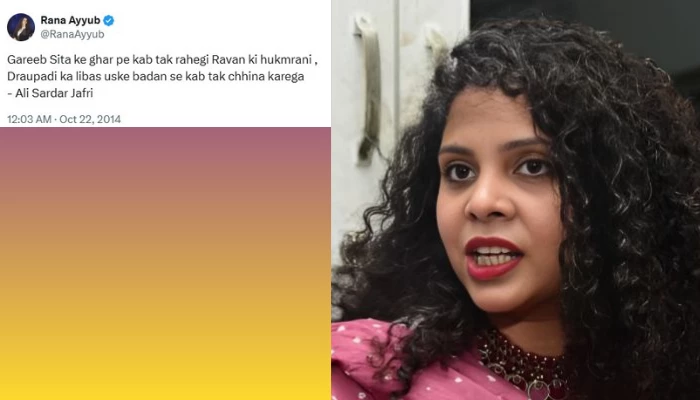
Case Summary
Hindu sentiments were insulted by leftist Muslim journalist Rana Ayyub, who made derogatory remarks against the revered Hindu deities Maa Sita and Draupadi in a tweet posted on 22nd October, 2014. On 27th January, the Cyber Police Station South, New Delhi, lodged an FIR against alleged journalist Rana Ayyub following directions from a Delhi Sessions Court. The FIR was filed based on a complaint by Advocate Amita Sachdeva under Sections 505, 295A, and 153A of the Indian Penal Code (IPC). According to the FIR, the complainant accused Rana Ayyub of using her platform to insult revered Hindu deities, malign Indian unity, and incite hostility against India, including disparaging the Indian Army. The complaint detailed a series of social media posts made between 2013 and 2017, which were insulting to Hindu religious figures and traditions, as well as derogatory towards national institutions. The complainant mentioned a series of tweets, one of which was posted on 22nd October 2014, in which the accused trivialised the ordeals of revered figures like Mata Sita and Draupadi and wrote, “Gareeb Sita ke ghar pe kab tak rahegi Ravan ki hukmrani, Draupadi ka libas uske badan se kab tak chhina karega.” The complainant argued that this statement crossed all boundaries of decency and mocked the sanctity of Hindu traditions. The tweet was cited in the complaint as showing Sita ji in a disrespectful context while portraying Ravana favourably over Lord Ram. The complainant stated that the post hurt the religious sentiments of followers of Sanatan Dharma and demeaned revered Hindu deities and sacred figures. Due to the anti-Hindu nature of the tweet, an FIR was registered against Rana Ayyub by the Cyber Police Station South in New Delhi on 27 January 2025, following directions issued by a sessions court at Saket Courts. The FIR was filed on the basis of a complaint submitted by Advocate Amita Sachdeva, invoking Sections 153A, 295A, and 505 of the Indian Penal Code, which pertain to promoting enmity between groups, deliberate acts intended to outrage religious feelings, and statements conducing to public mischief. The court, presided over by Chief Judicial Magistrate Himanshu Raman Singh, observed that the material placed before it disclosed prima facie cognisable offences and warranted police investigation. The complainant stated that earlier attempts to initiate action through the National Cyber Crime Reporting Portal in November 2024 and subsequent follow-ups with the police had not resulted in progress, prompting recourse to judicial intervention. Upon reviewing the submissions, the court held that the nature of the allegations required involvement of state machinery, noting that the complainant would not be in a position to independently gather the necessary evidence. The court directed the Station House Officer of the Cyber Police Station South to register an FIR and conduct a fair and expeditious investigation. Following these directions, the FIR was formally lodged, and the matter was listed for further hearing on 28 January 2025.
Why it is Hate Crime ?
This case has been added to the hate tracker under the primary category: Hate speech against Hindus. The first sub-category applied is Subversion of scriptures. Subverting the religious scriptures of Hindus has particularly devastating consequences. Subversion of the scriptures of Hindus is often done to justify or promote hatred, discrimination, or violence against specific individuals or groups of Hindus. Religious scriptures are often nuanced, and those who harbour religious animosity towards Hindus often misquote or misrepresent the scripture to legitimise their animosity and hate towards the faith and its adherents. Any such misquoting of scriptures or subversion to justify hate, violence and discrimination against Hindus owing to religious animosity is hate speech and is categorised as such. The second sub-category selected is 'Anti-Hindu slurs and mocking of faith'. Anti-Hindu slurs and the deliberate mocking of the Hindu faith owing to religious animosity involve the usage of derogatory terms, stereotypes, or offensive references to religious practices, symbols, or figures. One of the common anti-Hindu slurs used against Hindus is “cow-worshipper” and “cow piss drinker”. The intention of using this term is to demean and mock Hindus as a group and their religious beliefs since Hindus consider the cow holy. Additionally, some symbols and the slurs attached to them have a historical context that exacerbates the insult, hate, stereotyping, dehumanisation and oppression against Hindus. Cow worship has been used for centuries to denigrate Hindus, insult their faith and oppress Hindus specifically as a religious group. There has been overwhelming documentation about how cow slaughter has been used to persecute Hindus, with cow meat being thrown in temples and places of worship. There has also been overwhelming documentation where cow meat (beef) has been force-fed to Hindus to either forcefully convert them to Islam or denigrate their faith. Apart from cow worship, the Swastika – which holds deep religious significance for the Hindus – has also been misinterpreted and distorted to use as a slur against Hindus. Similarly, the worship of the Shivling has been used by supremacist ideologies and religions to denigrate Hindus owing to religious animosity. Such slurs and denigration stem from inherent animosity and hate towards Hindus and their faith; therefore, it is categorised as hate speech targeted at Hindus specifically owing to their religious identity. This case has been added to the tracker because the speech went beyond the bounds of commentary and entered the realm of deliberate denigration of revered Hindu figures and sacred traditions. The language used did not merely refer to revered Hindu deities and sacred figures; rather, it reduced deeply sacred and emotionally significant religious ordeals to a rhetorical device, thereby insulting the faith and the sentiments of the Hindus who worshipped and remained deeply devoted to these figures. Mata Sita and Draupadi were not simply figures from epic narratives but living spiritual realities in the religious and cultural lives of Hindus. They were worshipped with deep reverence, devotion, and emotional commitment across generations, and their presence continues to shape the moral, spiritual, and domestic life of Hindu society. They were venerated figures whose ordeals represented sacrifice, dignity, endurance, and moral strength. Their experiences occupied a sacred place in Hindu civilisational memory and were closely tied to the spiritual and emotional consciousness of Hindu society. Any reference to them, therefore, carried profound religious significance. Any attempt to invoke their suffering dismissively or mockingly, therefore, directly affronted the lived faith of the Hindu community. Moreover, the manner in which these revered figures were invoked was profoundly demeaning because it trivialised their suffering and reduced deeply sacred ordeals to a provocative rhetorical line. For Hindus, she is not merely Sita from scripture but Mata Sita, a mother figure revered with devotion, affection, and spiritual surrender across generations. Her suffering is not viewed as a distant episode from the past; it lives in the emotional and moral consciousness of Hindu households even today. To speak of the pain endured by Mata Sita and the humiliation of Draupadi in a dismissive manner was, therefore, not a simple expression of opinion but a direct affront to sentiments held sacred by millions. By invoking these moments rhetorically, the statement diminished the sanctity attached to their suffering and turned what Hindus regarded as sacred pain into a means of mockery and provocation. Further, this was not a case of reasoned criticism or legitimate discourse. The language employed conveyed a form of symbolic insult by using sacred figures as instruments to make a broader political point. In doing so, it crossed from expression into contemptuous speech directed at Hindu beliefs. The effect was not only to offend but also to normalise the ridicule of figures held sacred by millions of Hindus. The gravity of this incident was further heightened by the fact that this did not appear to be an isolated instance. The accused had been repeatedly involved in making remarks that were perceived as mocking or disrespectful towards Hindu beliefs, figures, and traditions. This continuing pattern lent greater seriousness to the present incident, as it suggested sustained hostility rather than an isolated lapse in judgment. Repeated involvement in such conduct strengthened the inference of deliberate animus and made the present speech more grave in nature. The issue became graver because Rana Ayyub chose to comment on revered Hindu deities and sacred Hindu scriptures despite having no grounding in the faith or its scriptural tradition. She had never studied Hindu scriptures, yet she chose to invoke Mata Sita and Draupadi precisely to make a provocative point, which clearly reflected inherent hostility towards Hindu beliefs. If her real concern had been women’s suffering, she could have addressed contemporary issues affecting Muslim women within her own Muslim community or spoken generally about women’s rights. Instead, she specifically chose to target Hindu deities who are worshipped as living spiritual realities by millions. This selective targeting itself exposed that the intent was not a genuine concern for women but the deliberate use of the Hindu faith and its most revered figures as objects of ridicule and attack. In conclusion, the case qualified as a hate speech incident because the content went beyond commentary and entered the realm of speech that insulted Hindu religious identity and hurt the sentiments of the community. Therefore, this case was added to the tracker.


Case Status
Perpetrator held guilty by court


Perpetrators Details
Perpetrators
Muslim Extremists
Perpetrators Range
One Person
Perpetrators Gender
female
 Sources




