Hindu idol broken and religious flags burned at ancient Hindu temple in Jashpur
 Jashpur, Chhattisgarh, India
  4 April, 2026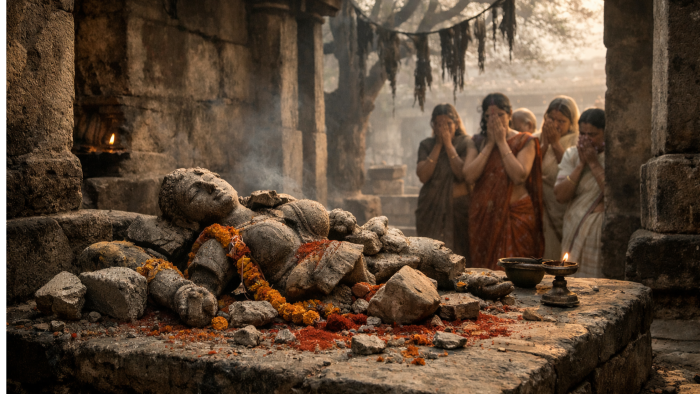
Case Summary
An ancient Hindu temple in Dhardhri village, Jashpur district, Chhattisgarh, was desecrated overnight by unidentified perpetrators who broke the idol of the presiding deity and burned religious flags tied to trees within the temple premises. Devotees who arrived for morning worship discovered the destruction and were deeply distressed. Vishwa Hindu Parishad [VHP, World Hindu Council] officials rushed to the scene and submitted a written complaint to the Superintendent of Police demanding arrests. The Bamhni Mata temple [an ancient temple dedicated to the mother goddess] in Dhardhri village, within the Asta police station area of Jashpur district, had long been a site of daily worship for the local community. On the night of April 5 (Sunday), unidentified perpetrators entered the temple premises, broke the idol of Mata [the mother goddess], and set fire to the religious flags that had been tied to trees within the temple compound. When local devotees arrived at the temple on April 6 (Monday) morning for their daily worship, they found the idol broken and the religious flags burned. The sight caused deep anguish among the gathered worshippers. Women who performed daily puja [Hindu devotional worship] at the temple were particularly affected, with several unable to contain their grief and breaking into tears. VHP officials arrived at the scene upon being informed and submitted a written complaint to Superintendent of Police Dr Lal Umed Singh, demanding the arrest of the unidentified perpetrators. Superintendent of Police Dr Lal Umed Singh confirmed that Jashpur Sub-Divisional Officer of Police [SDOP] and Asta police station personnel had been dispatched to the scene. An investigation was underway.
Why it is Hate Crime ?
The primary category for this case is "Attack on Hindu religious representations". The sub-category for this case "Desecration of Hindu religious symbols". Icons and symbols or a religious representation of a spiritual ideal are widely revered in Hinduism. Iconography is of vital significance in the Hindu milieu. It helps connect people’s spiritual beliefs with the real world. Iconography within the Hindu faith takes several shapes and forms. Murtis are of most significance to Hindus, to which daily rituals, prayers and offerings are done. Besides the murtis, there are several other symbols which have deep significance in the Hindu faith – the Om and Swastika for example. Since these Hindu religious symbols hold paramount importance in Hinduism, any desecration of symbols, icons, murtis, religious representations and manifestations, is driven by animosity towards the faith itself which manifests itself through these murtis, icons and symbols. Therefore, any desecration of these Hindu religious symbols and representations is considered religiously motivated hate crimes under this category. Another sub-category for this case is "Attack on Temples". In Hinduism, a temple is the abode of the Deity. The Deity in the Temple is consecrated, thereby, making it a real, breathing entity. Hindus believe that not just the Deity but the temple premises itself are sacred to Hindus since Hindus hold the faith that the entire Temple space is an amalgamation of the divine energy of the deity. Given the central significance of Temples in Hindu Dharma, any attack against a Hindu Temple or its peripheral premises is an attack on the faith itself and is born out of animosity towards the faith, of which, the Temple is a central tenet. Any manner of attack against a Temple and/or its premises would therefore be considered a religiously motivated hate crime. This case qualifies as a religiously motivated hate crime in which an ancient Hindu temple in Dhardhri village, Jashpur district, Chhattisgarh was deliberately targeted overnight and its most sacred elements destroyed. The perpetrators broke the presiding deity's idol and burned the religious flags within the temple compound. The act was carried out under cover of darkness with clear premeditation and caused profound religious and emotional harm to the Hindu community that depended upon the temple for their daily devotional practice. The desecration of the idol of Bamhni Mata is the primary religious marker of this case. Bamhni Mata is a manifestation of the mother goddess, one of the most ancient and deeply revered forms of the divine in the Hindu tradition. The mother goddess holds profound emotional and spiritual significance for her devotees, particularly the women who perform daily puja at her temple. A consecrated idol is not a decorative object. It is the living embodiment of divine presence for those who worship at that site. Its deliberate breaking does not merely damage a physical structure. It destroys the sacred heart of the community's devotional life and communicates absolute contempt for the faith of those who revered it. The burning of the religious flags is the second religious marker. Religious flags tied to trees within a Hindu temple compound are not decorative additions. They are markers of sacred space, devotional offerings, and expressions of faith placed by worshippers as acts of religious dedication. Their deliberate burning was an act of desecration directed not only at the physical objects but at the devotional acts they represented. The perpetrators did not merely destroy property. They erased the visible expressions of Hindu worship that the community had placed within their sacred space. The defiling of the temple's religious customs is the third religious marker. The Bamhni Mata temple was a site of daily worship, with women gathering every morning for puja. The desecration of the idol and the burning of the flags did not merely damage the physical space. It disrupted and violated the continuity of daily Hindu religious practice that the community had maintained at that site. The women who arrived for their morning puja and found the temple desecrated were not merely distressed witnesses to vandalism. They were devotees whose religious practice had been directly attacked and whose sacred space had been rendered a site of grief rather than worship. The community's emotional response confirms the religious gravity of the act. Several women broke into tears upon seeing the destroyed idol and burned flags. This response was not disproportionate. It was the natural reaction of devout Hindus who had witnessed the deliberate destruction of the deity they worshipped daily and the sacred space they had tended with devotion. It is important to mention here that though the last update was that the miscreants were unknown, regardless, the action stemmed out of hatred against Hinduism and resulted in the desecration of the sacred temple and would therefore be considered a religiously motivated hate crime.


Case Status
Complaint filed


Perpetrators Details
Perpetrators
Unknown
Perpetrators Range
Unknown
Perpetrators Gender
unknown
 Sources




