Hindu procession brutally attacked over chanting of religious slogans, pandal vandalised by Muslim mob; police side with assailants and assault Hindu devotees
 Mumbai, Maharashtra, India
  4 April, 2026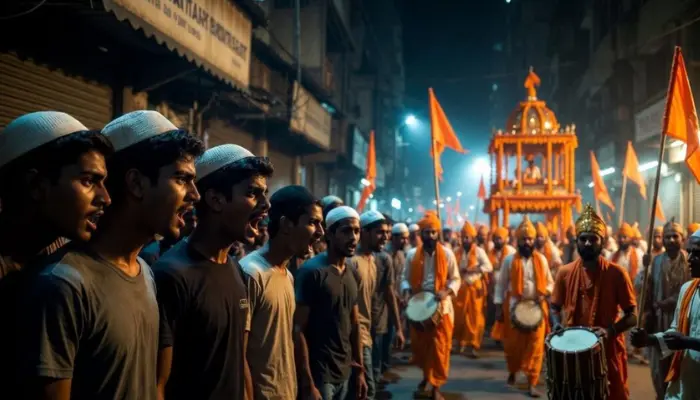
Case Summary
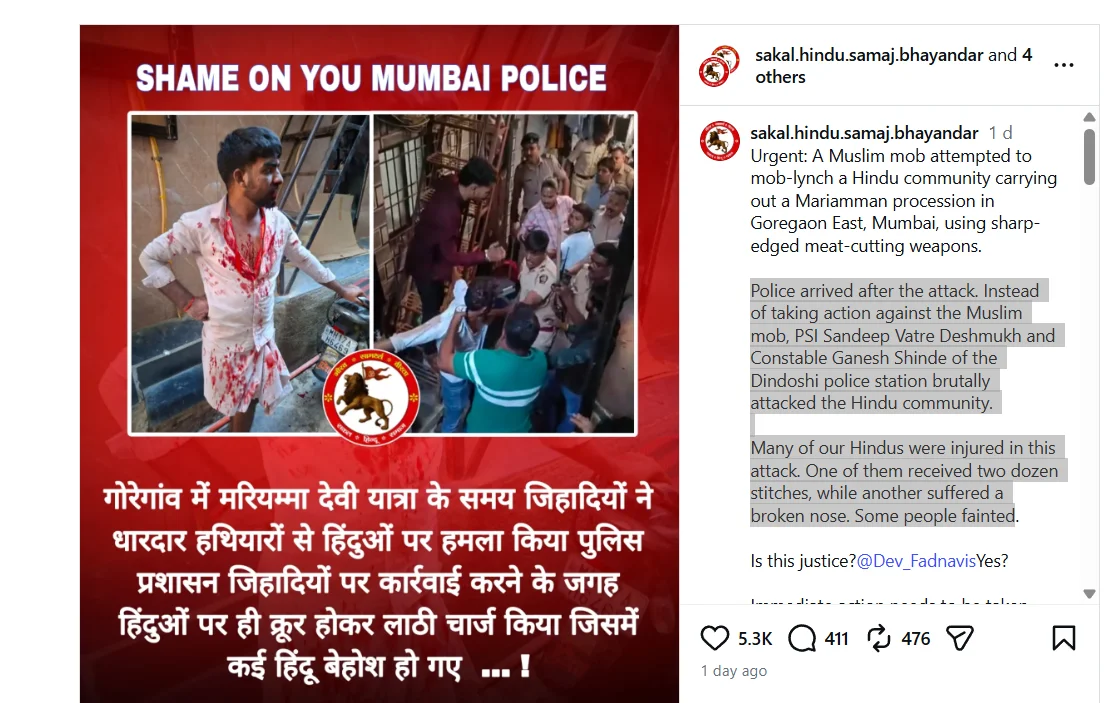
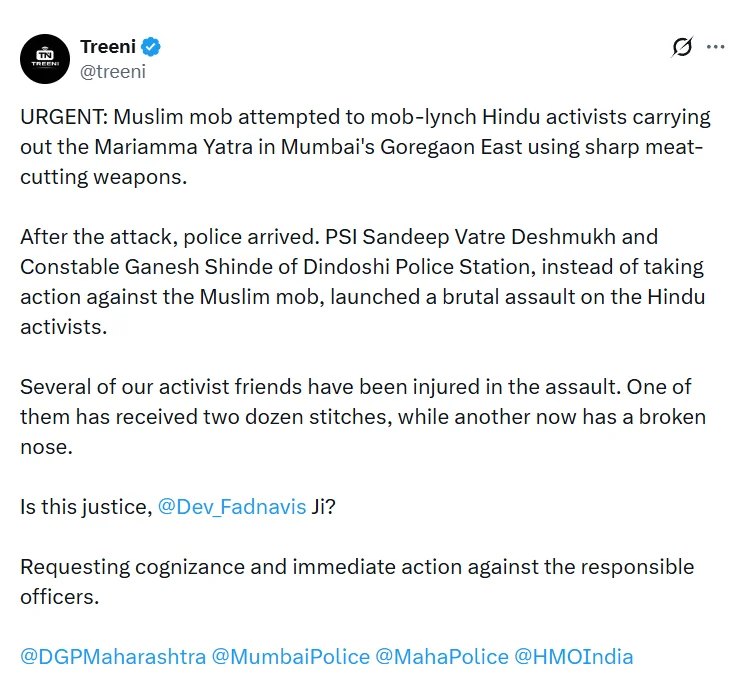
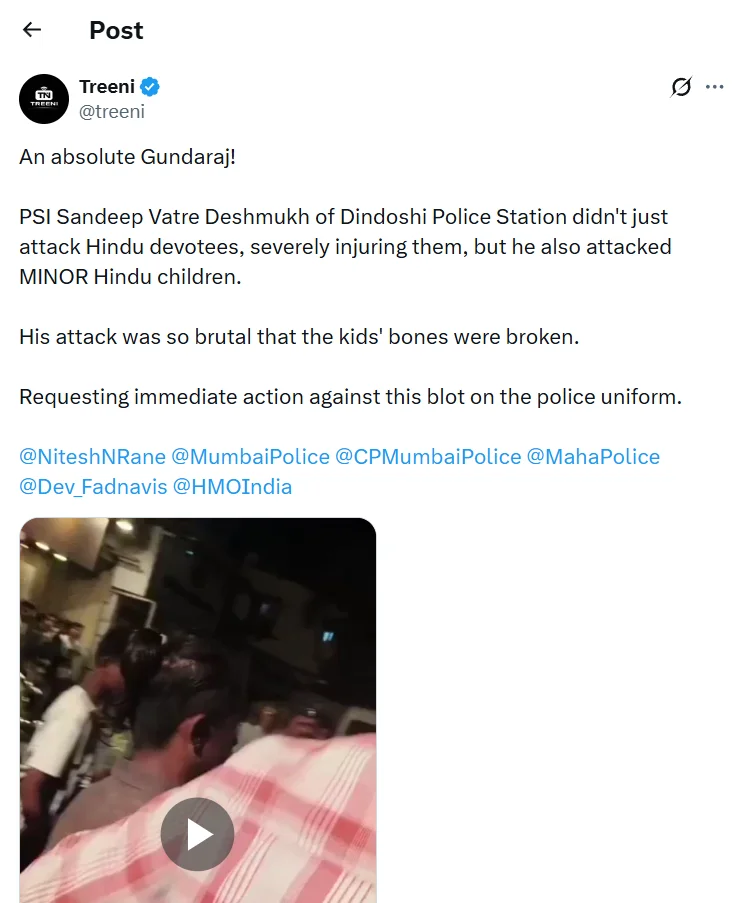
In Mumbai’s Goregaon (Dindoshi area), a Hindu religious procession of Goddess Mariamma was attacked by an armed Muslim mob. The attack happened after Muslims objected to the playing and chanting of Hindu religious songs and slogans. Subsequently, the Muslim mob assaulted Hindu devotees and vandalised a sacred Hindu pandal. The Muslim mob also chanted Islamic slogans while carrying out the attack. The police also sided with the Muslim assailants and assaulted Hindu devotees instead. According to media reports, this occurred on the night of 5 April 2026. The incident occurred in the Santosh Nagar Market area during a Mariamma Mata Shobha Yatra (religious procession). During this, tensions escalated when Muslims objected to the religious procession. This led to a verbal altercation, which later escalated as the Muslim mob began vandalising the Hindu pandal and assaulting Hindu participants, including Bajrang Dal members. The Hindu victims were attacked with sharp weapons like lathis, swords and rods. Eyewitness accounts stated that Islamic slogans were raised during the attack, further aggravating the situation. The police rushed to the spot upon receiving information and brought the situation under control. Closed-circuit television footage helped identify the accused, leading to the prompt arrests. A lathi charge was carried out to disperse the crowd as violence intensified. Three Bajrang Dal workers were injured and underwent treatment at a trauma care hospital in Jogeshwari. In a significant follow-up action, authorities found that several accused resided in illegal constructions. Following this, the accused's illegal constructions were bulldozed by the authorities. At the time of writing this report, a total of eight Muslims had been arrested thus far, and efforts continued to nab others involved in the incident. A Hindu organisation named "Sakal Hindu Samaj" also put out a post on their official Instagram handle regarding this incident. In the post, the organisation stated that police arrived after the attack. Instead of taking action against the Muslim mob, Police Sub-Inspector Sandeep Vatre Deshmukh and Constable Ganesh Shinde of the Dindoshi police station brutally attacked the Hindu community. Many Hindus were injured in this attack. One of them received two dozen stitches, while another suffered a broken nose. Some people fainted as a result of the attack. In this attack, two minor Hindu boys were also severely injured. Videos of a minor Hindu boy sustaining injuries went viral on X, where Hindus were heard stating Police Sub-Inspector Sandeep Vatre Deshmukh favoured the Muslim perpetrators and instead assaulted Hindu devotees. The police attack left the boy severely injured, with a fractured hand, and he fainted from the brutality.
Case Images
Why it is Hate Crime ?
The first primary category selected in this case is- Attack not resulting in death. The subcategory selected is- Attack on religious procession. The outward celebration and display of religious symbols in an intrinsic part of Hinduism. Religious processions on various festivals are age-old traditions and a way to manifest faith and form a part of the religious practices of Hindus. On several occasions, such religious processions come under attack by non-Hindu mobs, in a manifestation of their animosity towards Hinduism and their practices. The reasons cited for such violent attacks are many and range from crossing a non-Hindu resident-dominated area to playing loud music, crossing from an area where there is a religious structure of another faith etc. The violent attacks are triggered by the outward display of religiosity by Hindus. The attacks are mainly a manifestation of religious supremacist doctrine which believes that idolatry, essentially the Hindu faith, is one that deserves to be annihilated since the very tenets of Hinduism, its practices and traditions are considered a sin in those doctrines. Since these attacks emanate from intrinsic and doctrinal animosity towards Hindus and Hinduism, it is considered a religiously motivated hate crime under this category. The other subcategory selected is- Attack against Hindu devotees. Hindu devotees are a few of the easiest targets of religiously motivated hate crimes because during the festival/procession/puja etc, for non-Hindus it is easy to profile their victims on the basis of religion. Hindu devotees come under attack on several occasions by individual non-Hindus or mobs of non-Hindus owing to their animosity against Hinduism, its symbols and tradition/practices. There are several instances of Hindu devotees being attacked while they worship in temples or temporary religious structures, during religious processions, doing bhajan/kirtan/puja in their own homes, in the residential society etc. These attacks are perpetrated by non-Hindus primarily because of their animosity towards Hindus and their faith. In some cases, the trigger for the violence may be non-religious, however, there are two elements that make these hate crimes. First, the Hindus who come under attack are attacked violently while indulging in religious activity. Whether they are in a place of worship or not is immaterial to the crime. When individuals are attacked while indulging in religious practices, the attack in itself is a hindrance to their freedom to practice religion and therefore constitutes a hate crime. Secondly, religious supremacist doctrines and ideologies deem religious practices of Hindus to be offensive ab initio since they are considered “sinful” by these ideologies, worthy to be annihilated by force or coercion. Driven by these religious supremacist ideologies and doctrines, the attacks against Hindu devotees stem from intrinsic animosity towards Hinduism. In some cases, the trigger for the violence may be non-religious, however, it develops into a religiously motivated crime during the course of the violence. Since these attacks stem from animosity towards Hindus and Hinduism, they are considered religiously motivated hate crimes under this category. The other subcategory selected is- Attacked for Hindu identity. In several cases, Hindus are attacked merely for their Hindu identity without any perceived provocation. A classic example of this category of religiously motivated hate crime is a murder in 2016. 7 ISIS terrorists were convicted for shooting a school principal in Kanpur because they got ‘triggered’ seeing the Kalava on his wrist and tilak that he had put. In this, the Hindu victim had offered no provocation except for his Hindu religious identity. The motivation for the murder was purely religious, driven by religious supremacy. Such cases where Hindus are targeted merely for their religious identity would be documented as a hate crime under this category. The other subcategory selected is- Communal Clash/Attack. Communal clash is a form of collective violence that involves clashes between groups belonging to different religious identities. For a communal clash between Hindus and non-Hindus to qualify as a religiously motivated hate crime, the trigger of the violence itself would have to be anti-Hindu in essence. For example, if there is a Hindu religious procession that comes under attack from a non-Hindu mob and after the initial attack, Hindus retaliate in self-defence, leading to a communal clash between the two religious communities. While at a later stage, both communities are involved in the clash/violence, the initial trigger of the violence was by the non-Hindu mob against the Hindus and therefore, it could safely be termed as an anti-Hindu violence. Further, the trigger would also have to be religiously motivated. In the cited example, the attack by the non-Hindu mob was against religious processions and therefore, can be concluded to be religiously motivated. In some cases, the trigger may be non-religious, however, it develops into religious violence against Hindus at a later stage. In such cases too, the foundational animosity towards Hindus becomes the motivating factor of the crime and therefore, it would be classified as a religiously motivated hate crime against Hindus under this category. The second primary category selected is- Attack on Hindu religious representations. The subcategory selected is- Desecration of Hindu religious symbol. Icons and symbols or a religious representation of a spiritual ideal are widely revered in Hinduism. Iconography is of vital significance in the Hindu milieu. It helps connect people’s spiritual beliefs with the real world. Iconography within the Hindu faith takes several shapes and forms. Murtis are of most significance to Hindus, to which daily rituals, prayers and offerings are done. Besides the murtis, there are several other symbols which have deep significance in the Hindu faith – the Om and Swastika for example. Since these Hindu religious symbols hold paramount importance in Hinduism, any desecration of symbols, icons, murtis, religious representations and manifestations, is driven by animosity towards the faith itself which manifests itself through these murtis, icons and symbols. Therefore, any desecration of these Hindu religious symbols and representations is considered religiously motivated hate crimes under this category. The other subcategory selected is- Violence against religious structures or centres. In Hinduism, a religious structure is also considered divine. Hindus believe that not just the Deity but the religious structure itself is sacred. In this sub-category, we would document attacks against religious structures which are not consecrated temple spaces. Such religious spaces could be temporary in nature – for example – the religious spaces erected specifically for festivals like Durga Puja etc. This category would also document cases of attacks against religious centres. These spaces in their own right may not be ‘sacred’ per se, however, are often spaces where religious gurus live, religious teaching is imparted, or belong to religious institutions. Any attack against religious structures is a result of animosity towards the religion itself, which manifests itself through the religious spaces and therefore, such attacks are considered religiously motivated hate crimes. Religious centres are also manifestations of the religion, its teachings or gurus and therefore, attacks against such centres would be considered religiously motivated hate crimes. The third primary category selected is- Hate Speech against Hindus. The subcategory selected is- Violent Threats. Violent threats, explicit, implicit or implied, is the most dangerous form of hate speech since it goes beyond discriminatory and prejudicial language to express the intent of causing harm to an individual or a group of people based on their religious identity and faith. There could be several different kinds of threats that are issued to Hindus based on religious animosity. An explicit threat would mean the direct threat of violence towards an individual Hindu, a group of Hindus or Hindus at large. Physical violence, death threats, threats of destruction of property belonging to Hindus and threats of genocide would mean explicit threats against Hindus for their religious identity. Implicit threats may not be a direct threat but implied through the use of symbols of actions – for example – in the Nupur Sharma case, other than explicit threats, there were also implicit threats when Islamists took to the streets to burn and beat her effigies. It implies that they want to do the same to Nupur Sharma – thereby is considered an implicit threat. Violent threats can be delivered in person, through letters, phone calls, graffiti, or increasingly through social media and other online platforms. It would be important to understand that a threat – explicit or implicit, online or offline – to an individual who happens to be a Hindu does not qualify as a religiously motivated threat. Such a threat, while vile and dangerous, could be owing to non-religious reasons and/or personal animosity. To qualify as a religiously motivated threat, it would need to exhibit an indication that the individual is being targeted for religious reasons and/or owing to his/her religious identity as a Hindu. This incident stands as a stark example of an anti-Hindu hate crime, as the Muslim perpetrators unleashed a brutal attack on a peaceful Hindu religious procession dedicated to Goddess Mariamma. They assaulted innocent Hindu devotees, vandalised the sacred pandal, and raised Islamic slogans, all triggered solely by the playing and chanting of Hindu religious songs and slogans. Such targeted violence against the open expression of the Hindu faith transforms this into a textbook case of religiously motivated hatred, where Hindus faced aggression simply for practising their faith and expressing their devotion. The Muslim perpetrators' direct assault on the Mariamma procession itself equates to a profound religious hate crime. The Mariamma Mata Shobha Yatra holds deep cultural and spiritual significance in Hindu tradition, honouring Goddess Mariamma, a fierce protector deity revered in various Hindu communities for warding off diseases and evil. Hindu families and devotees pour their hearts into this vibrant procession, carrying their idol amidst religious music and chants as an act of collective worship and community bonding. Any attack on such a sacred procession wounds the sentiments of the entire Hindu community, desecrating their sacred celebration. It represents a direct affront to the Hindu faith, stripping away the joy of devotion and instilling fear, marking it unmistakably as an anti-Hindu hate crime that challenges the Hindu community's right to practise its beliefs freely. Beyond the procession, the Muslim perpetrators savagely assaulted Hindu devotees with lathis, rods, and sharp weapons like swords, all because they dared to play, chant Hindu slogans, and sing devotional songs. This unprovoked fury reveals a hate crime driven by raw religious animosity: the Hindu devotees had done nothing to provoke or insult anyone; they simply expressed their Hindu identity and devotion publicly. Yet, this mere act of faith triggered the Muslim attackers into a frenzy, exposing their deep-seated hatred for Hindus and their faith. Such assaults on Hindus simply for their religious identity demonstrate religious bigotry, where the perpetrators' zeal to suppress Hindu expression turns violence into a tool of religious domination. The sheer brutality underscores their contempt for Hindu lives, making this a clear anti-Hindu hate crime that dehumanises the entire Hindu community over nothing but their faith identity. Such communal attacks on Hindus leave them terrified and too scared to celebrate their festivals publicly, marking such incidents as clear hate crimes. Compounding the brutal violence, the Muslim perpetrators vandalised the sacred pandal, a revered Hindu symbol and temporary temple-like structure that serves as the pulsating spiritual heart of the religious procession. Lovingly erected by devotees, this vibrant centrepiece is meticulously adorned with fresh garlands, flickering oil lamps, colourful rangoli patterns, and ornate idols of Goddess Mariamma, transforming it into a holy sanctuary where worshippers gather to offer prayers, sing bhajans, and seek divine blessings. Desecrating this pandal deeply wounds the religious sentiments of Hindus, as it amounts to desecration of a sacred Hindu symbol; vandalising such a consecrated space equates to sacrilege, deliberately profaning what believers hold as divine and untouchable, which elevates the act to a clear hate crime fuelled by religious intolerance. Therefore, destroying this pandal is no mere act of vandalism; it is a calculated desecration that callously tramples Hindu sanctity underfoot, demonstrating utter disdain for Hindu sacred spaces and traditions. By targeting this focal point of Hindu devotion, the Muslim attackers aimed not just to disrupt but to humiliate, demoralise, and erase any visible Hindu presence, forever cementing this outrage as a brazenly religiously motivated hate crime. While perpetrating the attack, the Muslim mob chanted Islamic slogans, amplifying the religious hatred at play. The aggressive chanting of Abrahamic slogans during acts of violence underscores how religiously motivated aggression is justified in the name of Islam. This pattern is evident in numerous incidents where Muslim mobs launch attacks against ‘Kafirs’ or non-Muslims, more specifically Hindus, using religious slogans as both a battle cry and a means of legitimising their actions. The invocation of such slogans amidst brutal attacks on Hindus reflects the deeply ingrained belief among Muslims that their violent actions align with divine will. By framing their aggression as a religious duty, they not only dehumanise their victims but also incite further violence, creating an atmosphere where hatred against non-Muslims is normalised. This dangerous mindset fuels unprovoked attacks, as seen in cases where Hindus are targeted for practising their faith, celebrating their festivals, or even demanding historical accountability. The deliberate and systematic nature of such attacks exposes an underlying pattern of religious intolerance, where violence is sanctified under the guise of faith-driven retaliation. Chanting these slogans while assaulting Hindus for their own religious songs and chants reveals a brazen push for Islamic supremacy, aiming to terrorise and subdue the Hindu faith and its adherents, turning the violence into a tool to instil fear in Hindu hearts and assert dominance over their public worship. In this case, the police also blatantly sided with the Muslim perpetrators by brutally assaulting Hindu devotees instead of apprehending those who ignited the violence, leaving two minor Hindu boys severely injured, one with a fractured hand who fainted from the ferocity of the attack. Rather than upholding justice and protecting the Hindu victims of the initial assault, officers like Police Sub-Inspector Sandeep Vatre Deshmukh and Constable Ganesh Shinde chose to align with the aggressors, unleashing lathis on helpless Hindus who had already endured brutal violence and vandalism. This inversion, where the state machinery turns against the wronged Hindu community, exposes deep institutionalised bias and Hinduphobia within the police force, as they prioritise shielding Muslim attackers over safeguarding Hindu lives and sentiments. Such actions perpetuate a culture of impunity for anti-Hindu violence, erode trust in law enforcement among Hindus, and signal that religious bigotry has infiltrated official institutions, allowing Muslim perpetrators of communal attacks to evade accountability while Hindu victims face further state-sponsored brutality. This overall makes this incident an anti-Hindu hate crime. Given that this case meets several parameters of a religiously driven hate crime, it is being added to the hate crime database of the Hinduphobia Tracker. Disclaimer: In this case, the total number of victims has not been fully specified, with only select injuries documented. For instance, three Bajrang Dal workers sustained injuries requiring hospitalisation. Additionally, one Hindu victim received two dozen stitches and suffered a broken nose, while two minor Hindu boys were severely injured. Therefore, a conservative victim count of 6 has been recorded for documentation purposes. Similarly, the total number of Muslim perpetrators remains unspecified in reports, which confirm only eight arrests so far, with police pursuing additional suspects. The two involved policemen, Police Sub-Inspector Sandeep Vatre Deshmukh and Constable Ganesh Shinde, also stand out for siding with the attackers and assaulting Hindu victims. While this tracker acknowledges that two police officers have been named as accused in this case, for documentation purposes, the religion of the perpetrators has been recorded as Muslim since the primary accused (8 perpetrators) are confirmed to be Muslim. The religious identity of the policemen has not been independently verified at the time of documentation. However, given that they were also complicit in the acts of siding with the Muslim mob and assaulting the Hindu victims, the case is recorded under a single perpetrator religion for consistency in categorisation. This approach ensures clarity in data representation without overlooking the involvement of other accused individuals. For documentation purposes, this yields a conservative perpetrator count of ten (eight Muslim assailants plus two complicit officers). Therefore, we are recording a conservative perpetrator count of 10.
Victim Details
Total Victim
6
Deceased
0
Gender
- Male 3
- Female 0
- Third Gender 0
- Unknown 3
Caste
- SC/ST 0
- OBC 0
- General 0
- Unknown 6
Age Group
- Minor 2
- Adult 4
- Senior Citizen 0
- Unknown 0


Case Status
Case sub-judice


Perpetrators Details
Perpetrators
Muslim Extremists
Perpetrators Range
From 5 to 10
Perpetrators Gender
male
 Sources




