Revered Hindu temple falsely vilified and slandered as exploitative towards Dalit workers by western media outlet
 United Kingdom
  1 April, 2026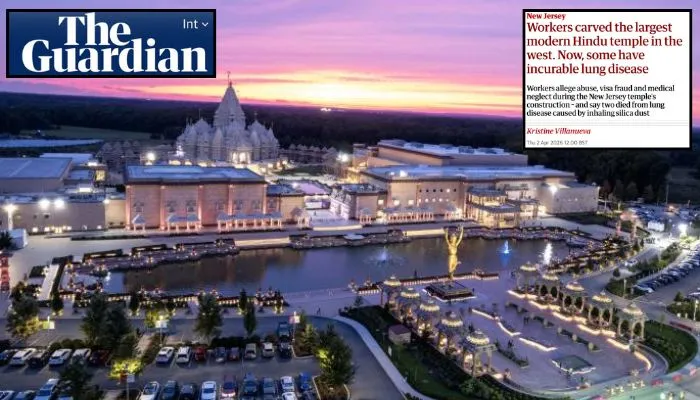
Case Summary
The Hindu Temple, BAPS (Bochasanwasi Akshar Purushottam Swaminarayan Sanstha), faced targeting, false vilification, and slander from The Guardian, a British leftist news outlet. On 2 April 2026, it published a report reviving claims already settled by the United States state authorities, reiterating that the construction of the temple involved abuse of Dalit workers and medical negligence. BAPS (Bochasanwasi Akshar Purushottam Swaminarayan Sanstha) Swaminarayan Akshardham in Robbinsville, New Jersey, United States, stands as one of the largest Hindu temples in the Western Hemisphere. BAPS is a global, volunteer-driven socio-spiritual Hindu organisation within the Swaminarayan Sampradaya, founded in 1907 by Shastriji Maharaj. Media reports stated that the temple, constructed over nearly twelve years and inaugurated in 2023, received contributions from over 12,500 volunteers from North America and other countries. The temple earned a description as a major Hindu place of worship and cultural landmark. In its article, The Guardian claimed that the construction of the temple involved the exploitation of workers, visa fraud, medical neglect, and unsafe working conditions during the period from 2015 to 2023. The report stated that around 200 Dalit workers from Rajasthan travelled to the United States for construction work and received lower wages. The article further made false claims, saying that workers belonged exclusively to communities at the lower end of India’s caste hierarchy, Dalits. It further claimed that these workers received no permission to worship in the temple owing to caste-based considerations. The Guardian article also claimed that some workers believed that at least two labourers, Ramesh Meena and Devi Lal, died due to silicosis, a lung disease caused by inhaling fine silica dust during stone carving. The report also mentioned claims of workers suffering from respiratory illnesses like tuberculosis and chronic bronchitis. Quoting anonymous workers, the article described harsh working conditions, including long working hours of up to 90 hours a week and wages as low as 1.20 United States dollars per hour. It further claimed that workers’ passports were confiscated and that they maintained limited contact with their families. The report also raised false claims about safety practices, stating that workers received no proper protective equipment. It claimed that some workers used cloth or surgical masks instead of the recommended N95 masks while working in dusty conditions. Additionally, the article claimed that medical facilities proved inadequate and that workers faced discouragement from seeking treatment outside the temple’s internal system. Notably, this controversy began in May 2021, when a group of Indian artisans and labourers filed a lawsuit in the United States raising claims of forced labour, human trafficking, low wages, and immigration-related violations in relation to the construction of the BAPS temple complex in New Jersey. On the same day as the filing of the complaint in 2021, federal agents raided the Robbinsville temple construction site as part of an investigation into the matter. According to reports, the investigation by United States authorities continued for nearly four years. On 18 September 2025, the United States Department of Justice and the United States Attorney’s Office for the District of New Jersey officially closed the investigation. It was stated that the investigation concluded without criminal charges filed against BAPS or its office-bearers in relation to the claims concerning forced labour and trafficking. Following the closure of the investigation, BAPS issued a statement welcoming the decision and stated that the temple had been built through devotion, volunteerism, and seva, describing the participation as religious service. The report also referred to statements made by BAPS representatives that the workers had been volunteers engaged in spiritual service rather than conventional employees. Importantly, it was further stated that some plaintiffs later withdrew from the lawsuit, saying that they had been misled into joining the legal proceedings. In July 2023, more than a dozen artisans who had initially been part of the lawsuit withdrew their names from the case. It was stated in a press release issued on behalf of the artisans that they had faced pressure to participate in a larger conspiracy aimed at halting construction of the temple.
Why it is Hate Crime ?
This case has been added to the tracker under the prime category of- Hate speech against Hindus. Under this, the sub-category selected is- Anti-Hindu subversion and prejudice. The tertiary category selected is- Anti-Hindu Fake News or Downplaying. Hate speech is defined as any speech, gesture, conduct, writing, or display that is prejudicial against a specific individual and/or group of people, which leads to or may lead to violence, prejudicial action or hate against that individual and/or group. Media plays a specific and overarching role in perpetuating prejudicial attitudes towards a community owing to unfair, untrue coverage and/or misrepresentation/misinterpretation, selective coverage and/or omission of facts of/about issues affecting a specific religious group. This type of bias can dehumanise the victim group, making it easier for others to justify harmful actions against them, which aligns with the objectives of hate speech laws aimed at preventing such harm. It is often observed that the media takes a prejudicial stand against the Hindu community, driven by their need to shield the aggressor community, which happens to be a numeric minority; however, that is the one perpetrating violence against Hindus. For example, the media is often quick to contextualise religiously motivated crimes against Hindus, omit or misrepresent facts that point towards religiously motivated hate crimes, justify and/or downplay religiously motivated hate crimes, or simply present fake news to stereotype Hindus. Such media bias leads to the denial of persecution and is often used to dehumanise Hindus, leading to justification for violence against them. For example, the media covered several fake allegations of Hindus targeting Muslims and forcing them to chant Jai Shree Ram. Most of these cases were proved false and fabricated after police investigation. These fake news reports were subsequently never retracted or clarified. Such fake news led to the justification of violence and dehumanisation of Hindus based on the argument that since Hindus targeted Muslims and forced them to chant Jai Shree Ram, the dehumanisation of Hindus and violence against them was par for the course and merely a retaliation. Such media bias leads to prejudicial portrayals of Hindus and offers a justification for violence against them and, therefore, is considered hate speech under this category. This case stands as a blatant example of a religiously motivated hate crime, where The Guardian, a British leftist news outlet, falsely slandered and maliciously portrayed BAPS, a sacred Hindu temple and revered community organisation. By dredging up debunked allegations against this global symbol of Hindu devotion, BAPS, The Guardian waged a calculated assault on Hindu institutions, reviving settled claims of worker exploitation purely to tarnish the faith's image. This was no journalistic oversight but a deliberate act of vilification, striking at the heart of Hindu spiritual life and exposing raw animosity towards Hindus worldwide. BAPS, or Bochasanwasi Akshar Purushottam Swaminarayan Sanstha, embodies the living spirit of Hindu devotion through its vast network of temples, humanitarian service, and volunteer culture rooted in the Swaminarayan Sampradaya tradition. From disaster relief to education and cultural preservation, BAPS devotees selflessly pour their lives into seva (selfless service), building architectural marvels like the Robbinsville Akshardham temple through collective spiritual labour rather than hired workforces. This organisation unites millions across continents, fostering Hindu pride and global harmony, which makes any attack on it feel like a personal wound to every Hindu devotee who sees it as family and holds it in high reverence. The Guardian's choice to zero in on this particular Hindu temple for targeting and malicious slander lays bare their deep-seated religious animosity towards the Hindu community. Countless global construction projects face labour disputes, yet The Guardian fixated on BAPS, amplifying discredited claims to demonise a Hindu institution while ignoring similar issues elsewhere. This selective outrage signals not impartial reporting but a vendetta against Hindu success, aiming to shame and isolate the community by portraying its sacred spaces as exploitative. Critically, claims of worker exploitation, low wages, health hazards, and unsafe conditions at the BAPS temple construction site were thoroughly cleared by United States authorities, including courts and investigative agencies. They issued a clean chit to BAPS, finding no criminal charges or evidence of Dalit workers receiving less pay, barred temple worship, or neglected safety, dismissing every accusation levelled by the outlet. Many original plaintiffs withdrew their lawsuit, admitting they had been misled into a conspiracy to halt temple construction. Yet The Guardian published these falsehoods anyway, in a brazen bid to denigrate BAPS and vilify Hindus, turning public exoneration into ammunition for anti-Hindu propaganda. This deliberate omission cements it as religiously motivated hate, weaponising lies to erode trust in Hindu organisations. The Guardian's repeated emphasis on "Dalit workers" went far beyond facts, hammering home their supposed lowly caste status to craft a toxic narrative of Hindu oppression. This tactic mirrors how leftist outlets peddle the false dichotomy of upper-caste versus lower-caste Hindus, eternally victimising Dalits to paint Hinduism as inherently regressive and divisive. By invoking caste at every turn, The Guardian sought to shatter Hindu unity, disguising religious bigotry as anti-caste activism while targeting the faith itself. None of it held true here, yet they pressed on, exposing their agenda to fracture Hindus and caricature their temples as caste-ridden bastions. The Guardian also peddled the lie that Dalit workers could not worship inside the BAPS temple, a baseless trope long used to smear Hinduism as discriminatory. No evidence supported this; BAPS temples welcome all devotees equally, embodying Swaminarayan ideals of universal access. Still, The Guardian revived this canard, knowing it stings Hindu sentiments and reinforces stereotypes of exclusion. Such fabrications reveal not curiosity but entrenched religious animosity, bent on dehumanising Hindu sacred spaces. Overall, The Guardian utterly failed to grasp the essence of BAPS, which thrives on selfless seva, spiritual charity, and volunteer devotion rather than formal employment contracts. Devotees offer their labour as a sacred duty, not wage work, a profound Hindu principle that the article twisted into exploitation. This ignorance, or wilful blindness, fuelled their malicious portrayal, unmasking a deeper contempt for Hindu religious spaces and the faith as a whole. Given that this case meets the parameters of a religiously motivated hate crime, it has been added to the Hate Crime Database of the Hinduphobia Tracker.


Case Status
Unknown


Perpetrators Details
Perpetrators
Others
Perpetrators Range
Unknown
Perpetrators Gender
unknown
 Sources




