Ancient Hindu temple illegally encroached, Hindu devotees denied access to their place of worship for decades
 Hapur, Uttar Pradesh, India
  4 April, 2026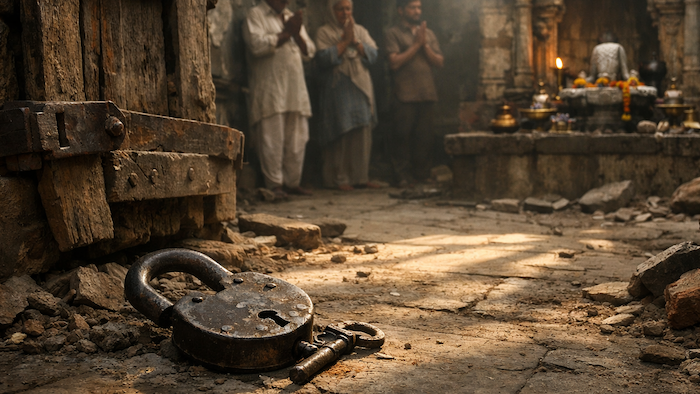
Case Summary
Hindu devotees in Garhmukteshwar, Hapur district, Uttar Pradesh, were denied access to the ancient Kal Bhairav temple for nearly 45 years after it was locked and occupied. The temple, a site of deep religious significance, remained inaccessible due to illegal encroachment, preventing worship. Devotees were unable to offer prayers or perform rituals at the temple for decades. The ancient Kal Bhairav temple, located in the Nakka Kuan area of Garhmukteshwar, had been illegally occupied by local land grabbers for several decades. The structure was damaged, and a lock was placed on the temple premises. This act prevented Hindu devotees from entering the temple or continuing traditional worship practices. Over a prolonged period of four to five decades, the temple remained shut. Religious activities ceased completely. Devotees were cut off from a site that held longstanding spiritual importance within the local religious landscape. The temple was part of a larger religious cluster in Garhmukteshwar, alongside the Mukteshwar Mahadev temple and the Ganga temple. Despite its importance, the Kal Bhairav temple remained inaccessible, creating a sustained disruption in religious practice for the Hindu community in the area. During an inspection visit, District Magistrate Abhishek Pandey noticed the temple was locked and ordered immediate action. The administration broke the lock and removed the encroachment. The site was cleared, and steps were initiated to restore the temple. Plans were made to reinstall the idol of Kal Bhairav through proper religious rituals.
Why it is Hate Crime ?
This case has been added to the tracker under the primary category - Attack on Hindu religious representations. Within this, the subcategory selected is - Encroachment or illicit takeover of temple land/land near temple. In Hinduism, a temple is the abode of the Deity. The Deity in the Temple is consecrated, thereby, making it a real, breathing entity. Hindus believe that not just the Deity but the temple premises itself are sacred to Hindus since Hindus hold the faith that the entire Temple space is an amalgamation of the divine energy of the deity. Not only the Temple but the Temple premises in its entirety are considered sacred by Hindus. In several cases, the premises of the Temple and/or religious centre are illicitly taken over by institutions belonging to other faiths – like the Waqf board or the Church. Other times, the temple property, land or the property of religious centres are illicitly encroached by non-Hindu groups. Any illicit take over or encroachment is a crime an initio, however, when non-Hindu groups illicitly take over or encroach the sacred land of Hindus, it is an affront to the Hindu community and is therefore classified as a religiously motivated hate crime under this category. The other subcategory selected is- Desecration of Hindu religious symbol. Icons and symbols or a religious representation of a spiritual ideal are widely revered in Hinduism. Iconography is of vital significance in the Hindu milieu. It helps connect people’s spiritual beliefs with the real world. Iconography within the Hindu faith takes several shapes and forms. Murtis are of most significance to Hindus, to which daily rituals, prayers and offerings are done. Besides the murtis, there are several other symbols which have deep significance in the Hindu faith – the Om and Swastika for example. Since these Hindu religious symbols hold paramount importance in Hinduism, any desecration of symbols, icons, murtis, religious representations and manifestations, is driven by animosity towards the faith itself which manifests itself through these murtis, icons and symbols. Therefore, any desecration of these Hindu religious symbols and representations is considered religiously motivated hate crimes under this category. This case qualified as a religiously motivated hate crime because Hindu devotees were deliberately denied access to a place of worship for decades. The perpetrators unlawfully occupied a Hindu temple and prevented religious practices from continuing. The act directly targeted a sacred Hindu religious site. The prolonged nature of the restriction showed sustained interference with Hindu religious rights. The temple was illegally occupied and locked for nearly 45 years. This act was religiously significant because temples are central to Hindu worship and community life. By shutting the temple and preventing entry, the perpetrators ensured that Hindu devotees could not perform prayers or rituals. This directly targeted Hindus by cutting off access to their place of worship. The structure of the temple was damaged and left in a neglected state. This carried religious significance because Hindu temples are treated as sacred spaces that must be preserved with respect. Damaging and abandoning the temple showed disregard for its sanctity. This act harmed Hindu religious identity by degrading a site of spiritual importance. The long-term nature of the encroachment reflected sustained control over a Hindu religious space. This was significant because it prevented not just individuals but an entire community from practising their faith over generations. By maintaining control for decades, the perpetrators ensured that Hindu religious continuity in that space was disrupted. This demonstrated targeted suppression of Hindu religious expression. The temple formed part of a recognised religious cluster in Garhmukteshwar. Its closure affected the broader religious ecosystem of the area. This was significant because it disrupted the interconnected practice of worship across multiple temples. The selective denial of access to this temple showed how a specific Hindu religious institution was targeted within a larger sacred geography. The fact that devotees were unable to access the temple for decades created a climate of exclusion. This was significant because it normalised the absence of Hindu worship in that space. The continued restriction reinforced the idea that Hindu religious rights could be suppressed without consequence. This contributed to a broader sense of insecurity among the Hindu community. Given that this case met the parameters of a religiously motivated hate crime, it was added to the hate crime database of the tracker. Disclaimer: The exact date of the incident was not specified because the unlawful occupation and restriction of temple access continued for approximately 45 years. The tracker records incident dates based on when the crime occurred; however, in this case, a precise start or end date was not available. Therefore, 5 April 2026, the date of publication of the report, has been used as the indicative incident date. This has been recorded for documentation purposes only.


Case Status
Complaint not filed


Perpetrators Details
Perpetrators
Unknown
Perpetrators Range
Unknown
Perpetrators Gender
unknown
 Sources




