Hindu sentiments outraged as Muslim men enter a temple and make derogatory remarks against Hindu deities
 Shahjahanpur, Uttar Pradesh, India
  4 April, 2026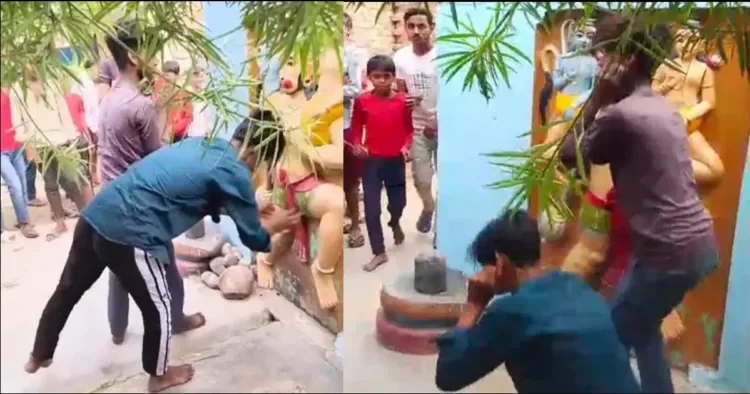
Case Summary
In Chaudhera village, under the Nigohi police station area of the Shahjahanpur district of Uttar Pradesh, Hindu sentiments were deliberately outraged by a Muslim man, Sahil, and his other Muslim accomplice. The accused entered a Hindu temple and denigrated Hindu gods and goddesses. According to media reports, this incident occurred on 5 April 2026. The accused, Sahil, a resident of the same village, entered the temple with one of his Muslim friends, and they made a video reel in which Sahil made offensive remarks against Hindu deities. The accused stood in front of the idol, made objectionable remarks and obscene gestures. They created a reel on their mobile phone and shared it on Facebook. Sahil and his Muslim friend were fond of making reels on social media. They had previously made and posted vulgar and offensive videos, but this time they chose a temple to denigrate the Hindu faith. When the reel reached the villagers that afternoon, anger erupted. Hindu organisation activists and dozens of villagers immediately gathered. They apprehended the two Muslim perpetrators. They were then taken back to the temple and made to stand before the idol. There, they were forced to apologise. Both pledged, "We will never make reels that hurt anyone's sentiments again." The crowd then made them do sit-ups to teach them a lesson. The villagers attributed this to their addiction to making reels, which seemed like an attempt to disrupt the atmosphere. However, the Muslim youths were released with a warning. When the police received the videos, they immediately took action. The videos were removed from the account containing the reels. On the evening of 5 April 2026, a Hindu villager named Devra Pratap Singh filed a complaint. Sahil was prominently named in the complaint, as the reel was shared from his social media account. The police registered a First Information Report against Sahil, charging him with spreading hatred. At the time of writing this report, the current information states that Sahil's friend's name may be added during the investigation if his role is proven. Nigohi Circle Officer Prayank Jain said the videos had been removed and the entire incident was under investigation. The people who conducted the sit-ups would also be questioned.
Why it is Hate Crime ?
The first primary category selected is- Hate Speech against Hindus. The subcategory selected is- Anti-Hindu slurs, mocking faith. Anti-Hindu slurs and the deliberate mocking of the Hindu faith owing to religious animosity involve the usage of derogatory terms, stereotypes, or offensive references to religious practices, symbols, or figures. One of the common anti-Hindu slurs used against Hindus is “cow-worshipper” and “cow piss drinker”. The intention of using this term is to demean and mock Hindus as a group and their religious beliefs since Hindus consider the cow holy. Additionally, some symbols and the slurs attached to them have a historical context that exacerbates the insult, hate, stereotyping, dehumanisation and oppression against Hindus. Cow worship has been used for centuries to denigrate Hindus, insult their faith and oppress Hindus specifically as a religious group. There has been overwhelming documentation about how cow slaughter has been used to persecute Hindus with cow meat being thrown in temples and places of worship. There has also been overwhelming documentation where cow meat (beef) has been force-fed to Hindus to either forcefully convert them to Islam or denigrate their faith. Apart from cow worship, the Swastika – which holds deep religious significance for the Hindus – has also been misinterpreted and distorted to use as a slur against Hindus. Similarly, the worship of the Shivling has been used by supremacist ideologies and religions to denigrate Hindus owing to religious animosity. Such slurs and denigration stem out of inherent animosity and hate towards Hindus and their faith, therefore, it is categorised as hate speech targeted at Hindus specifically owing to their religious identity. The second primary category selected is- Attack on Hindu religious representations. The subcategory selected is- Breaking rules of place of worship. Sanatan Dharma is not a religion of one book, which is to say that while it has religious scriptures that form the central tenets of the faith, there are several traditions followed through thousands of years, mostly passed from generation to generation orally. One of these oral traditions or written traditions is the rules of specific temples. Certain temples have rules which are traditional rules, dependent on the worship of the presiding deities. These rules and traditions have been followed for thousands of years whether they find scriptural mention or not. Such traditions are based on the nature and rules of worship of the presiding deity of that temple. Any non-compliance of these traditions owing to animosity towards the faith or for the sake of activism stems not only from the lack of faith in the presiding deity but also disregard for the faith of the devotees of that deity/temple and implicit bias against the faith, the tradition and the deity itself. Since these specific traditions are central to the faith of the devotees of that specific temple and presiding deity, any non-compliance with these traditional rules would be considered a religiously motivated hate crime. This case is a clear example of a religiously motivated offence as the two Muslim youths entered a Hindu temple, made derogatory remarks against Hindu deities, and recorded it as a social media reel, which they uploaded on social media. This caused severe outrage and religious tensions in Shahjahanpur. Overall, this case showcases a clear instance of anti-Hindu animosity. The deliberate choice of a sacred Hindu space for such provocation reveals a targeted attack on the Hindu community, igniting deep emotional wounds that ripple through villages and beyond. Families in Chaudhera felt not just anger, but a profound betrayal of their shared faith, turning a place of peace into one of division. The act of abusing Hindu deities itself showcases religious animosity towards Hindus and their faith. Hindus revere their deities with immense devotion, viewing them as living embodiments of divine grace that guide daily lives, festivals, and personal struggles. Temples overflow with heartfelt prayers, offerings of flowers and sweets, and songs that express unwavering love and surrender. Henceforth, making any denigrating remarks against these deities amounts to a direct affront to the Hindu faith and the sentiments of the Hindu community, making it a clear case of religiously motivated hate speech. Such words strike at the heart of what binds millions of Hindus together, reducing sacred symbols to objects of mockery and leaving devotees feeling violated in their most intimate beliefs. The perpetrators' actions inside the temple, right beside a Hindu idol, where they made derogatory remarks against Hindu deities while filming a video, reveal a clear intent to desecrate the temple's sanctity. Hindu temples uphold strict codes of conduct, drawn from age-old traditions that insist on purity, reverence, and quiet contemplation in the divine presence. Insulting Hindu deities is strictly forbidden within temple grounds, as it destroys the peaceful vibe intended for prayer and introspection. This kind of denigration inside a Hindu temple breaks the fundamental rules of a worship site, breaching the holy limits where believers find comfort and peace. It turns a spiritual refuge into a platform for aggression, ridiculing the beloved deities and rituals that anchor Hindu identity and foster community unity. This entire sequence of entering the temple premises, denigrating Hindu deities, and recording it paints a picture of calculated provocation designed to wound the collective soul of the Hindu community. The perpetrators' act of putting the derogatory video on social media showcases malicious intent. The perpetrators wanted the denigration to reach far and wide to the Hindu audience, hurt maximum Hindu sentiments, and cause religious tensions and outrage. By sharing the reel on platforms like Facebook, they ensured that the insult spread virally, piercing the hearts of Hindu devotees across Shahjahanpur and beyond, stirring a storm of grief and fury among ordinary Hindus scrolling their feeds. This was no private lapse; it was a public assault, engineered to maximise humiliation and division, turning devotion into widespread communal distress. The perpetrators had made such derogatory and offensive videos in the past as well, but this time they entered a Hindu temple. This reveals a repeated pattern of abusing the Hindu faith and its beloved deities to hurt the Hindu community. Their history of posting vulgar content online shows they were no strangers to provocation, yet choosing a temple for this latest act escalates it into a bold invasion of sacred space. Each instance chips away at the dignity of devotees, who pour their hearts into worshipping these deities as sources of protection and joy. This ongoing pattern cements it as a clear case of a hate crime, driven by persistent animosity rather than a one-off mistake. Given that this case meets the parameters of a religiously motivated hate crime, it is being added to the hate crime database of the Hinduphobia Tracker.


Case Status
Complaint registered


Perpetrators Details
Perpetrators
Muslim Extremists
Perpetrators Range
From 2 To 5
Perpetrators Gender
male
 Sources




