Hindu man subjected to brutal assault and casteist slurs by Muslims over minor dispute in Amroha, Uttar Pradesh
 Amroha, Uttar Pradesh, India
  4 April, 2026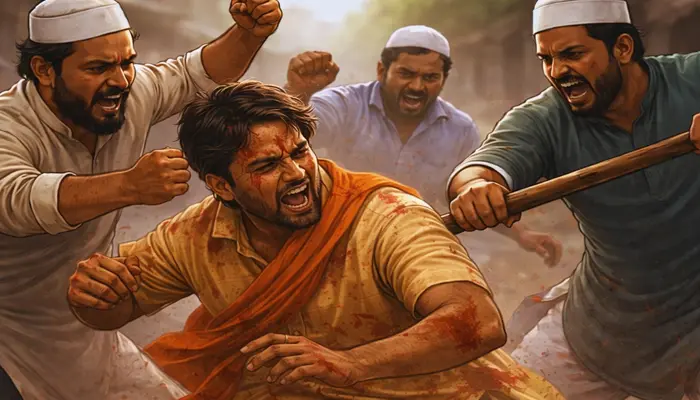
Case Summary
In Amroha, Uttar Pradesh, a Hindu man named Sachin, who belonged to the Dalit community, was brutally assaulted by Muslim men over a minor monetary dispute. The accused also subjected the Hindu victim to casteist slurs and death threats. According to media reports, Sachin, son of Chaman Singh, a resident of the town, had a dispute over money with Muslim persons, namely Naushad, his brother Samiuddin and father Haseen. On the morning of 5 April 2026, Sachin went to the locality of the accused to settle the matter. During this, the Muslim perpetrators started brutally assaulting Sachin in public. The attack resulted in his shirt being torn. Sachin was chased, beaten badly, and abused with casteist slurs by the perpetrators. During the attack, someone made a video and made it viral on social media. As soon as the matter of the beating of the victim came to notice, Adampur police registered a case against Naushad, Samiuddin and Haseen under relevant sections of the Bharatiya Nyaya Sanhita (BNS). A case was registered under sections related to assault with abusive language, casteist slurs and death threats. At the time of writing this report, the accused were absconding from their homes. The police station in charge, Komal Chaudhary, said that a case was registered on the basis of a complaint. The Circle Officer would investigate the case. Efforts were being made to arrest the accused. Reports also confirmed that Sachin had suffered an open injury under his eye in the assault. His medical examination was done at Rahra Community Health Centre. After this, the matter became a topic of discussion in the entire town.
Why it is Hate Crime ?
The first primary category selected in this case is- Attack not resulting in death. The subcategory selected is- Communal Clash/Attack. Communal clash is a form of collective violence that involves clashes between groups belonging to different religious identities. For a communal clash between Hindus and non-Hindus to qualify as a religiously motivated hate crime, the trigger of the violence itself would have to be anti-Hindu in essence. For example, if there is a Hindu religious procession that comes under attack from a non-Hindu mob and after the initial attack, Hindus retaliate in self-defence, leading to a communal clash between the two religious communities. While at a later stage, both communities are involved in the clash/violence, the initial trigger of the violence was by the non-Hindu mob against the Hindus and therefore, it could safely be termed as an anti-Hindu violence. Further, the trigger would also have to be religiously motivated. In the cited example, the attack by the non-Hindu mob was against religious processions and therefore, can be concluded to be religiously motivated. In some cases, the trigger may be non-religious, however, it develops into religious violence against Hindus at a later stage. In such cases too, the foundational animosity towards Hindus becomes the motivating factor of the crime and therefore, it would be classified as a religiously motivated hate crime against Hindus under this category. The second primary category selected is- Hate speech against Hindus. The subcategory selected is- Anti-Hindu slurs, mocking faith. Anti-Hindu slurs and the deliberate mocking of the Hindu faith owing to religious animosity involve the usage of derogatory terms, stereotypes, or offensive references to religious practices, symbols, or figures. One of the common anti-Hindu slurs used against Hindus is “cow-worshipper” and “cow piss drinker”. The intention of using this term is to demean and mock Hindus as a group and their religious beliefs since Hindus consider the cow holy. Additionally, some symbols and the slurs attached to them have a historical context that exacerbates the insult, hate, stereotyping, dehumanisation and oppression against Hindus. Cow worship has been used for centuries to denigrate Hindus, insult their faith and oppress Hindus specifically as a religious group. There has been overwhelming documentation about how cow slaughter has been used to persecute Hindus, with cow meat being thrown in temples and places of worship. There has also been overwhelming documentation where cow meat (beef) has been force-fed to Hindus to either forcefully convert them to Islam or denigrate their faith. Apart from cow worship, the Swastika – which holds deep religious significance for the Hindus – has also been misinterpreted and distorted to use as a slur against Hindus. Similarly, the worship of the Shivling has been used by supremacist ideologies and religions to denigrate Hindus owing to religious animosity. Such slurs and denigration stem from inherent animosity and hate towards Hindus and their faith; therefore, it is categorised as hate speech targeted at Hindus specifically owing to their religious identity. This case represented a clear instance of a religiously motivated attack where a Hindu Dalit man, Sachin, was singled out, abused, and violently assaulted by Muslim men, who also subjected him to caste-based slurs. He was not targeted merely over a minor money dispute but because of his identity and social position. The assault did not arise out of any proportionate trigger. Sachin's attempt to settle the money matter became the immediate pretext for a violent communal assault on him. Primarily, the use of caste-based slurs was aimed at demeaning his entire identity, reducing him to a position of inferiority and stripping him of dignity. It can be argued that a caste-specific slur is aimed at the victim's micro identity of belonging to the Dalit section of the Hindu community and not his Hindu identity itself. However, in the context of Abrahamic religions, the micro-identities of caste, region, and language are secondary. It is the religious identity that drives the animosity of the perpetrators against the Hindu victim. In this case, while the accused hurled caste abuses at the victim, the animosity was driven by their animosity towards Hinduism and Hindus. While the immediate trigger of the violence could be the monetary dispute, as mentioned in reports, the fact that caste slurs were hurled at the victim by the perpetrator makes it a religiously motivated hate crime against the victim. Furthermore, the violence inflicted on the victim was deliberate, excessive, and intended to enforce religious dominance. Chasing him, brutally beating him in public, tearing his shirt, and repeatedly assaulting him constituted not a momentary outburst but a calculated act of punishment. This unfolded openly in the locality, with the assault captured on video and shared widely on social media. The victim's pursuit and public humiliation demonstrated that the attack aimed to break his resolve and deny him the ability to assert his rights. Such communal attacks on Hindus due to their religious identity serve as stark examples of rampant Hinduphobia, rendering this incident a hate crime. The abuses and the threat to kill the victim further escalated the gravity of the incident. These constituted direct and explicit intimidation, not casual remarks made in anger. When such threats accompanied an identity-based assault, they served to instil fear not only in the victim but also in the wider Hindu community sharing his identity. The fact that the assault occurred in public reinforced an atmosphere of intimidation, ensuring that resistance would be suppressed through fear. Overall, the sequence of caste-based abuse, physical assault over a minor dispute, public chasing, and explicit threats established a pattern of targeted hostility. The incident went beyond a personal disagreement and reflected a broader attempt to assert religious dominance, humiliate, and silence a Hindu Dalit man who sought to resolve a financial matter. These elements collectively demonstrated a hate-driven offence marked by violence, degrading slurs, and threats designed to terrorise and control. Given that this case meets the parameters of an anti-Hindu hate crime, it is being added to the hate crime database of the Hinduphobia Tracker.
Victim Details
Total Victim
1
Deceased
0
Gender
- Male 1
- Female 0
- Third Gender 0
- Unknown 0
Caste
- SC/ST 1
- OBC 0
- General 0
- Unknown 0
Age Group
- Minor 0
- Adult 1
- Senior Citizen 0
- Unknown 0


Case Status
Complaint registered


Perpetrators Details
Perpetrators
Muslim Extremists
Perpetrators Range
From 2 To 5
Perpetrators Gender
male
 Sources




