Hindu woman and her family assaulted, blackmailed and faced death threats for pursuing legal recourse against Muslim accused in Budaun, Uttar Pradesh
 Budaun, Uttar Pradesh, India
  31 March, 2026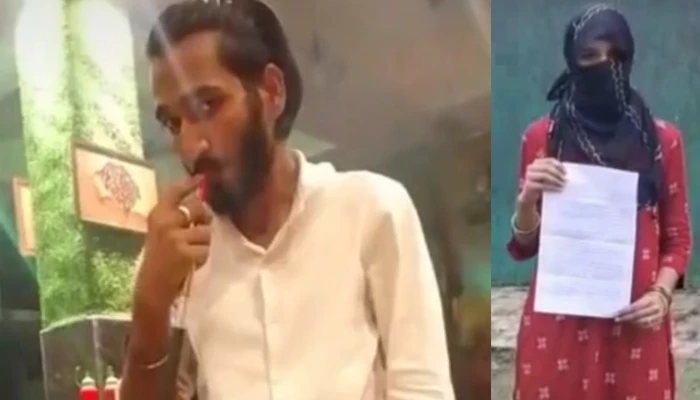
Case Summary
In Budaun, Uttar Pradesh, a Hindu woman and her family faced death threats and assault for withdrawing the case filed against the Muslim accused Arbaaz. The accused was released on bail in an earlier case filed by the victim, who was a minor at the time. In her complaint, she stated that she was befriended by the Muslim man named Arbaaz, who pretended to be a Hindu man named Shivam. The accused wore a Kalava and a Tilak, both Hindu symbols, to impersonate himself. The victim was drugged, and obscene photographs and videos were taken of her, which were then used to blackmail her into converting to Islam. She was also force-fed meat and made to read Islamic scriptures. The accused’s intention was to convert her to Islam and marry her in a Nikah ceremony. According to the recent complaint submitted before the local police, the accused Arbaaz repeatedly threatened to kill the victim and her husband. He also warned that the victims' photographs and videos would be made viral if the case was not withdrawn. The victim stated that these threats created an atmosphere of fear and intimidation within the household and that the accused was continuously coercing the family to compromise. Following this, on 1 April 2026, when the victim’s husband was returning home from work, he was intercepted near Durga Basti by Arbaaz along with two unidentified associates. The accused abused him, demanded that the case be withdrawn, and, upon resistance, slapped him and threatened to kill him. After the incident, the family immediately approached the police and submitted a fresh complaint. Based on the complaint, the police registered a case against Arbaaz and two unknown persons and initiated an investigation into the threats, intimidation, and assault. Notably, the Hinduphobia Tracker had recorded the earlier case against the same accused in connection with a serious pattern of deception and coercion. As recorded earlier, the victim, who was a minor then, had stated that beginning in July 2022, Arbaaz befriended her by falsely introducing himself as Shivam/Bobby and by wearing Hindu symbols such as a Kalava and Tilak to present himself as a Hindu. He drugged the victim, recorded obscene photographs and videos, blackmailed her, sexually exploited her, and repeatedly pressured her to convert to Islam and marry through Nikah. The victim further stated that on 14 September 2022, she was taken to Delhi, where she was intoxicated, raped multiple times, taken to shrines in Nizamuddin, and forced to read Islamic scriptures, visit dargahs, and consume meat. The accused was later arrested on 6 August 2025. This fresh incident arose after the accused obtained bail in the previously recorded case and then began threatening the victim’s family to force the withdrawal of the proceedings.
Why it is Hate Crime ?
The incident has been added to the tracker under the primary category- Attack not resulting in death. The selected subcategory is: Attacked for opposing radicals or for trying to save victims. In several cases, Hindus are attacked for opposing religiously motivated crimes being committed against a fellow Hindu or simply for voicing an opinion opposing radical elements, who either have in the past or continue to persecute Hindus. In such cases, the initial attack against the victim, against which the Hindu was trying to defend the victim, would also need to be classified as a religiously motivated hate crime. Since the initial crime itself was religiously motivated and the subsequent crime of attempting to save the victim or speaking against the radical elements ends up inviting a violent attack, it would also be classified as a religiously motivated hate crime under this category. Another primary category selected is- Hate Speech against Hindus. The subcategory selected is Violent Threats. Violent threats, explicit, implicit or implied, are the most dangerous form of hate speech since they go beyond discriminatory and prejudicial language to express the intent of causing harm to an individual or a group of people based on their religious identity and faith. There could be several different kinds of threats that are issued to Hindus based on religious animosity. An explicit threat would mean the direct threat of violence towards an individual Hindu, a group of Hindus or Hindus at large. Physical violence, death threats, threats of destruction of property belonging to Hindus and threats of genocide would mean explicit threats against Hindus for their religious identity. Implicit threats may not be a direct threat but implied through the use of symbols of actions – for example, in the Nupur Sharma case, other than explicit threats, there were also implicit threats when Islamists took to the streets to burn and beat her effigies. It implies that they want to do the same to Nupur Sharma, which is considered an implicit threat. Violent threats can be delivered in person, via letters, phone calls, graffiti, or, increasingly, through social media and other online platforms. It would be important to understand that a threat – explicit or implicit, online or offline – to an individual who happens to be a Hindu does not qualify as a religiously motivated threat. Such a threat, while vile and dangerous, could be owing to non-religious reasons and/or personal animosity. To qualify as a religiously motivated threat, it would need to exhibit an indication that the individual is being targeted for religious reasons and/or owing to his/her religious identity as a Hindu. This case clearly met the threshold of a religiously motivated hate crime because the subsequent intimidation and violence flowed directly from the family's decision to resist an already recorded offence, rooted in a religiously motivated hate crime targeting a Hindu victim. Once the underlying act itself carried a clear religious dimension, any retaliatory act aimed at silencing the victim or those supporting her naturally formed part of the same chain of hostility. Further, the targeting of the family for pursuing legal recourse demonstrated that the violence was not incidental but retaliatory in nature. The harm arose because they chose to oppose the earlier wrongdoing and support the victim in seeking justice. Where a Hindu family is attacked for resisting such persecution, the latter act acquires the same religiously motivated character as the original offence. Additionally, the intimidation was intended to instil fear, break resistance, and prevent the continuation of legal proceedings. Such conduct went beyond personal animosity and reflected a deliberate attempt to suppress the victim's voice through coercion and fear. Further, the repeated death threats and threats to circulate obscene videos were aimed at terrorising the Hindu victim and her family into silence. These were not stray threats arising out of a personal dispute. Rather, they were directly tied to the earlier case in which a Hindu girl had been targeted through identity concealment and religious coercion. The threats were intended to obstruct justice, force withdrawal of the complaint, and continue the pressure that had already been exerted upon the victim. Moreover, the assault on the husband after he refused to yield to such pressure demonstrated that the hostility had escalated from intimidation to physical violence. This showed a sustained pattern of targeting, where first the Hindu victim was allegedly trapped and coerced, and thereafter her family was attacked for resisting and supporting her. The use of threats in this context carried the clear purpose of forcing submission and ensuring that the earlier targeting remained unchallenged. Viewed holistically, this is not a series of disconnected incidents but a pattern of hostility. The subsequent attack and threats were a direct extension of the earlier victimisation and were aimed at those who opposed it. For that reason, the incident squarely qualified as a hate crime and merited inclusion in the tracker database. Disclaimer: Media reports do not specify the exact date when the victim's ordeal began. The media reported the case on 5 April 2026; however, the accused threatened the victim's husband on 1 April 2026. Therefore, for documentation, we are using 1 April 2026 as the indicative date. Hinduphobia Tracker records the date the victim's ordeal begins, rather than the date the media reports it.
Victim Details
Total Victim
2
Deceased
0
Gender
- Male 1
- Female 1
- Third Gender 0
- Unknown 0
Caste
- SC/ST 0
- OBC 0
- General 0
- Unknown 2
Age Group
- Minor 0
- Adult 0
- Senior Citizen 0
- Unknown 2


Case Status
Case sub-judice


Perpetrators Details
Perpetrators
Muslim Extremists
Perpetrators Range
From 2 To 5
Perpetrators Gender
male
 Sources




