Hindu villagers lured to convert to Christianity under guise of prayer meeting; feast offered and Hindu deities denigrated
 Budaun, Uttar Pradesh, India
  4 April, 2026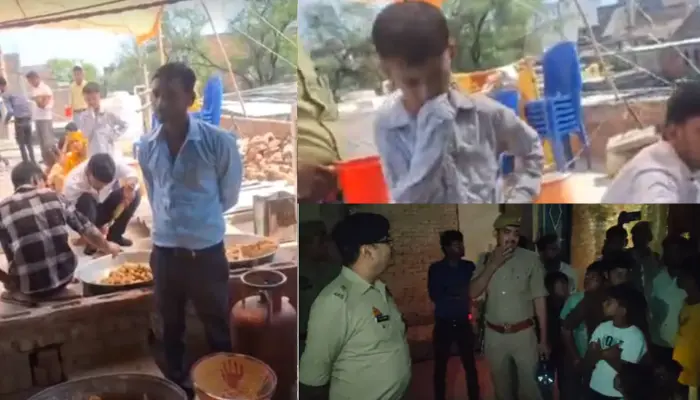
Case Summary
In Budaun, Uttar Pradesh, Hindus, including children, were targeted for forced Christian conversion under the pretext of attending a prayer meeting and religious feast. During the event, a Christian pastor made abusive remarks against Hindu deities. The matter came to light on 5 April 2026 when police received information from Bajrang Dal workers about a Christian priest conducting forced religious conversions by offering a religious feast at the home of a Christian man named Sarvesh, son of Ramchandra, a resident of Ward No. 2. During the event, Hindus were first made to offer prayers to Jesus Christ and then offered food. During the event the pastor even made abusive remarks against Hindu deities. A total of nearly 50-60 Hindus had gathered for the prayer meeting, which included men, women and children. Upon receiving the information, Sub-Inspector Vipin Kumar from the Usawan police station arrived at the scene with his team. The police team found a community feast underway at the home, where Hindus were eating. During questioning, Sarvesh revealed that he had converted to Christianity about two years ago (2024) and had invited relatives and acquaintances for a feast after Good Friday, a Christian festival. Upon learning of the incident, Circle Officer Rahul Pandey arrived at the scene and took stock of the situation. As soon as the police arrived, some people, including the pastor, left. As a precaution, the police arrested Sarvesh, suspecting a breach of peace, and presented him before a magistrate. At night, Superintendent of Police City Vijendra Dwivedi also arrived at the scene and gathered detailed information from people. He also inquired whether any inducements were offered or whether any priest or other individuals were involved. After investigating several aspects, the officers returned and increased surveillance on the accused. The police also said no pastor was found at the scene, but Bajrang Dal workers stated that after the police arrived, the pastor fled. Superintendent of Police City Vijendra Dwivedi interviewed the organiser, Sarvesh, a mason by profession. He said he organised a prayer meeting, followed by a feast. He said his wife had fallen ill. A family in the neighbourhood of the hospital where she was admitted suggested he watch a YouTube channel. After this, he began organising prayer meetings. Superintendent of Police City also gathered information from the Hindu residents of the locality and the women who ate at the feast here. Police investigated the bank accounts of Sarvesh. They also investigated the accounts of other family members. The police questioned, despite being a mason, how Sarvesh organised money for the feasts for 50-60 people. Where did this money come from? At the time of writing this report, the investigation into the entire matter was ongoing, and further action will be taken based on that.
Why it is Hate Crime ?
This case is added to the tracker under the primary category- Predatory Proselytisation. The subcategory selected is- Conversion/attempts to convert by inducements. Predatory Proselytisation is not just limited to threat, harassment, force and violence, but it also has contours of stealth. In several cases, the Hindu victim is exploited to convert, with non-Hindus taking advantage of their poverty. In such cases, the Hindu victim who is suffering financially is offered monetary benefits, including lucrative offers for jobs, health treatment, education, etc, to induce the victim into changing his/her religion. In such cases, the religious identity of the victim and the aim to disenfranchise him from his faith form the heart of the crime. Also, taking advantage of and exploiting an individual’s economic vulnerabilities is widely acknowledged as exploitation, forms of which are often penalised by law. Such cases therefore are considered religiously motivated hate crimes since the victim’s religious identity forms the very heart of the crime itself. The other subcategory selected is- Attempting to convert/converting by denigrating Hinduism. In several cases, Hindus are converted or an attempt is made to convert Hindus by denigrating their faith, Hinduism. In such cases, the Hindus associate with the non-Hindu perpetrators often by choice and then, the attempt to convert them by insulting their faith, showing the faith down etc begins. An example of this would be a non-Hindu gathering where the Hindus are attending the gathering of their own free will. However, once they attend the gathering, there is an explicit attempt to convert them by abusing their faith and hailing the faith of the perpetrator. The denigration of the Hindu faith is often based on misrepresentation of the Hindu faith, its doctrine and scriptures and insult to espoused traditions if not blatant lies about Hindu beliefs and ways. Such conversions or attempts at conversions are driven by animosity towards the Hindu faith and are therefore documented as religiously motivated hate crimes. The other subcategory selected is- Proselytisation by grooming, brainwashing, manipulation or subtle indoctrination. The tertiary category selected is- Conversion of minor. Religious brainwashing essentially means the often subtle and forcible indoctrination to induce someone to give up their religious beliefs to accept contrasting regimented ideas. Religious grooming or brainwashing also involves propaganda and manipulation. It involves the systematic effort, driven by religious malice and indoctrination, to persuade “non-believers’ to accept allegiance, command, or doctrine to and of a contrasting faith. Cases of such grooming or brainwashing are far more nuanced than direct threats, coercion, inducement and violence. In such cases, it is often seen that there is repeated, subtle and continual manipulation of the victim to induce disaffection towards their own faith and acceptance of the contrasting faith of the perpetrator. While subtle indoctrination is widely acknowledged as predatory, an element which is often understated in such conversions or the attempts of such conversion is the role of loyalty and trust which might develop between the perpetrator and the victim. Fiduciary relationships are often abused to affect such religious conversion. For example, an educator transmitting religious doctrine of a competing faith to a Hindu student. The Hindu student is likely to accept what the teacher is transmitting owing to existence of the fiduciary relationship. The exploitation of the fiduciary relationship to religiously indoctrinate victims would also be included in this category. Since the underlying animosity towards the victim’s faith forms the basis of predatory proselytization, such cases are considered religiously motivated hate crimes. This case is a clear instance of an anti-Hindu hate crime because Hindus, including men, women and children, were deliberately targeted for religious conversion by the Christian perpetrators under the false pretext of attending prayer meetings and a religious feast. While the term prayer meeting generally implies a spiritual gathering meant for sincere worship and reflection, it was exploited here as a deceptive tool to lure Hindu victims into a controlled environment. Instead of genuine spiritual engagement, the Christian organisers manipulated the event to indoctrinate Hindus with Christian theology, aiming to dismantle their existing Hindu beliefs. This deliberate exploitation and targeting of Hindus underline the religiously motivated nature of this crime, showcasing religious animosity where the Christian perpetrators viewed the victims' faith as something to be systematically replaced through deception. The Hindu victims were further lured with the inducement of a religious feast, a tactic that showcases deep-seated religious animosity towards the Hindu community. The use of food and communal gatherings as incentives to encourage conversion demonstrates that these actions were not motivated by kindness or charity but were calculated attempts to exploit vulnerable Hindus. By providing such inducements, the perpetrators effectively engaged in emotional blackmail against those Hindus who were socially or economically desperate for assistance. This form of coercion strips Hindus of their agency and dignity, enforcing conversion through necessity rather than conviction. These are not isolated incidents but premeditated efforts to undermine the Hindu faith and persuade Hindus to discard their faith identity, rooted in an animosity that views the Hindu faith as a target for eradication. During the prayer meeting, the pastor engaged in the deliberate denigration of Hindu deities, an act that serves as a definitive marker of a religiously motivated hate crime because, for the Hindu community, deities represent the sacred core of their spiritual, cultural, and ancestral existence. Subjecting these divine figures to verbal abuse is a direct attempt to humiliate the victims for their religious identity, as this vitriol was not accidental but was a central component of the conversion attempt designed to degrade the victims' self-worth and their connection to their heritage. By insulting these deities while simultaneously forcing the gathered Hindus to recite prayers to Jesus Christ as a prerequisite for receiving food, the perpetrators employed predatory and manipulative tactics designed to assert the absolute supremacy of Christianity over Hinduism and its adherents. These actions were specifically intended to strip the victims of their faith and identity by creating a profound sense of shame and inadequacy regarding their ancestral traditions and deities. The requirement to participate in Christian worship before being allowed to partake in the religious feast functions as a form of psychological conditioning where the basic human need for food is leveraged to secure a performative abandonment of the victims' own religion. This systematic abuse of Hindu deities, combined with the enforced participation in an alien faith practices, makes it clear that the ultimate objective was the total subjugation of the victims' religious conscience through a deep-seated animosity that seeks to erase the Hindu identity of the vulnerable victims by portraying their sacred beliefs as inferior, thereby confirming the status of this incident as a calculated hate crime. It is also important to note that the victims included Hindu children, meaning the element of consent and genuine change of conscience was missing ab initio. Minors are particularly vulnerable to manipulation and coercion due to their age and lack of maturity. They cannot fully understand the complex implications of changing their religion, and the perpetrators purposely exploited this vulnerability to further their agenda. Since this case exemplifies the use of coercion and the psychological targeting of minors to achieve religious conversion, it represents a blatant act of a religiously motivated hate crime against the Hindu community. These instances of targeted proselytisation activities stem from an inherent hostility towards the victims' professed faith. Such actions are driven by an ideological framework that dehumanises non-adherents until they convert, making this a clear religiously motivated crime against Hindus. The systematic use of deception, inducement, the denigration of sacred deities, and the targeting of Hindu children all point to a singular goal of religious erasure. Consequently, this case is being added to the hate crime database of the Hinduphobia Tracker to document this calculated assault on Hindu religious freedom and identity. Disclaimer: Media reports stated that nearly 60 Hindus, including men, women and children, gathered for the prayer meeting and religious feast in Budaun, Uttar Pradesh, but no gender-wise or age-wise breakdown was provided. For documentation clarity, the Hinduphobia Tracker has applied a proportional demographic estimate based on India’s Census 2011 and NFHS-5 (2019–21) rural population data. Accordingly, the 60 participants are estimated as 30 men (50%) and 30 women (50%), reflecting an equal gender distribution consistent with typical rural demographics. As the age-wise segregation was also not specified in the media report, the Hinduphopia Tracker has used a proportional demographic estimate derived from the same data sources. Accordingly, the 60 participants are estimated as 42 adults (70%) and 18 children (30%).
Victim Details
Total Victim
60
Deceased
0
Gender
- Male 30
- Female 30
- Third Gender 0
- Unknown 0
Caste
- SC/ST 0
- OBC 0
- General 0
- Unknown 60
Age Group
- Minor 18
- Adult 42
- Senior Citizen 0
- Unknown 0


Case Status
Case sub-judice


Perpetrators Details
Perpetrators
Christian Extremists
Perpetrators Range
From 2 To 5
Perpetrators Gender
male
 Sources




