Hindu temple premises targeted for illegal encroachment in Vidisha, Madhya Pradesh
 Vidisha, Madhya Pradesh, India
  30 March, 2026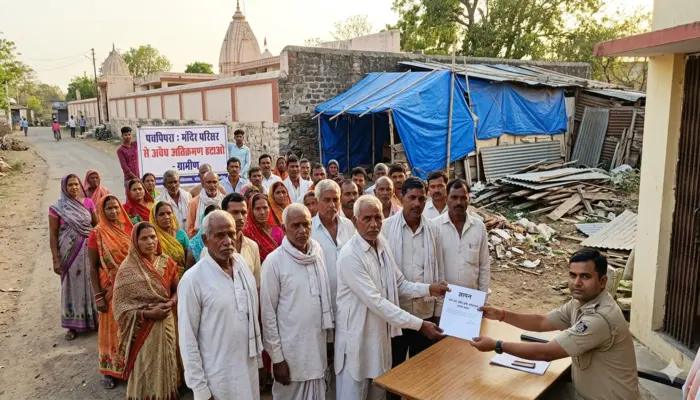
Case Summary
In Pachpipra village of Tehsil Tyonda, in Vidisha, Madhya Pradesh, a Hindu temple was targeted for illegal occupation by a few encroachers. The temple premises were being illegally taken over by the perpetrators, causing a threat to temple security and issues of cleanliness. This incident came to light when, on 31 March 2026, a large number of villagers gathered and submitted a memorandum to the Tehsildar. They demanded the removal of the encroachment. The villagers said that encroachment was being done adjacent to the temple wall. This affected the security of the temple premises. The cleanliness system of the temple also deteriorated due to this encroachment. According to the Hindu villagers, earlier, the perpetrators had kept a small kiosk. Now it had been enlarged three times. This increased the problem for Hindu devotees worshipping at the temple. The villagers said they had complained to the administration several times, but no concrete action was taken. This emboldened the encroachers. They said the temple was a centre of faith for the entire village. The security of the temple complex was everyone's responsibility.
Why it is Hate Crime ?
This case has been added to the tracker under the primary category- Attack on Hindu religious representations. Within this, the subcategory selected is- Encroachment or illicit takeover of temple land/ land near temple. In Hinduism, a temple is the abode of the Deity. The Deity in the Temple is consecrated, thereby, making it a real, breathing entity. Hindus believe that not just the Deity but the temple premises itself are sacred to Hindus since Hindus hold the faith that the entire Temple space is an amalgamation of the divine energy of the deity. Not only the Temple but the Temple premises in its entirety are considered sacred by Hindus. In several cases, the premises of the Temple and/or religious centre are illicitly taken over by institutions belonging to other faiths – like the Waqf board or the Church. Other times, the temple property, land or the property of religious centres are illicitly encroached by non-Hindu groups. Any illicit take over or encroachment is a crime an initio, however, when non-Hindu groups illicitly take over or encroach the sacred land of Hindus, it is an affront to the Hindu community and is therefore classified as a religiously motivated hate crime under this category. In this case, a Hindu temple's premises were targeted for illegal encroachment. The targeting of a sacred Hindu institution and its premises made this incident a clear case of a hate crime. Here, it is important to state that for Hindus, temples are not merely structures of worship but sacred institutions embodying the living presence of the divine. A Hindu temple is revered as the abode of the deity, and the idol within is considered a physical manifestation of that deity. Every part of the temple, from its sanctum to its outer premises and the land surrounding it, is consecrated ground, symbolising purity, devotion, and spiritual heritage. The temple, therefore, holds immense emotional and religious significance for the Hindu community, forming the very heart of their collective faith and daily worship. In this context, the illegal encroachment upon the temple premises in Vidisha, by the perpetrators, fully aware of its sanctity, was a grave act of disrespect towards Hindu sentiments. It reflected a deliberate attempt to undermine the Hindu faith and to hurt the religious feelings of the Hindu community. Such actions not only caused deep distress among devotees but also instilled fear and insecurity. This conscious violation of a sacred space constituted a deliberate attempt to hurt religious sentiments and was clearly a religiously motivated act. The encroachers targeted the temple premises adjacent to the wall, illegally expanding a small kiosk three times larger, which directly threatened temple security. This invasion compromised the physical barriers protecting the deity's abode, heightening risks to the idols and worship areas from theft, damage, or desecration. Simultaneously, it caused severe cleanliness problems as the encroachers' activities generated waste and debris spilling onto consecrated ground, polluting the sacred space essential for pure rituals and defiling the atmosphere of devotion. These combined threats to security and sanctity transformed the encroachment into a hate crime, as it weaponised impurity and vulnerability against the core of Hindu worship, intentionally inflicting spiritual desecration and communal intimidation on devotees. When acts such as these are committed, they disrupt the spiritual lives of Hindus by preventing them from performing their daily rituals and prayers with the required purity and peace. Villagers expressed that this encroachment caused immense trouble to devotees, as the regular conduct of worship and prayers was hindered. Temples by their very nature require an atmosphere of purity, respect, and serenity for proper worship. Any interference with these practices causes more than a physical obstruction. It inflicts emotional anguish and spiritual distress. Villagers stated that they had complained to the administration several times earlier, but no concrete action was taken despite the growing threat. This repeated inaction emboldened the encroachers, allowing the kiosk to expand unchecked and the security and cleanliness crises to worsen. Such institutional neglect showcased clear administrative and institutional bias against Hindus, as authorities prioritised inaction over protecting a sacred Hindu site, thereby enabling religiously motivated aggression and eroding trust in governance among the Hindu community. Although the precise identity of the perpetrators remains unspecified in available media reports, the nature of the act, the selective targeting of a Hindu temple, and repeated encroachment clearly establish its communal and religiously motivated character. This incident exemplified a hate crime directed against Hindus and their places of worship. Accordingly, this case was added to the hate crime database of the Hinduphobia Tracker. Disclaimer: The Hinduphobia Tracker records the dates of incidents based on when the crime occurred, rather than when it was reported by the media. In this case, media reports did not state the exact date when the crime occurred; the only date stated was 31 March 2026, when villagers gathered and submitted a memorandum to the Tehsildar. Henceforth, this date is selected as the indicative incident date for documentation purposes only.


Case Status
Complaint filed


Perpetrators Details
Perpetrators
Unknown
Perpetrators Range
Unknown
Perpetrators Gender
unknown
 Sources




