Hindu minor boy converted to Islam during Ramzan, coreced to participate in Eid namaz
 Muzaffarnagar, Uttar Pradesh, India
  3 April, 2026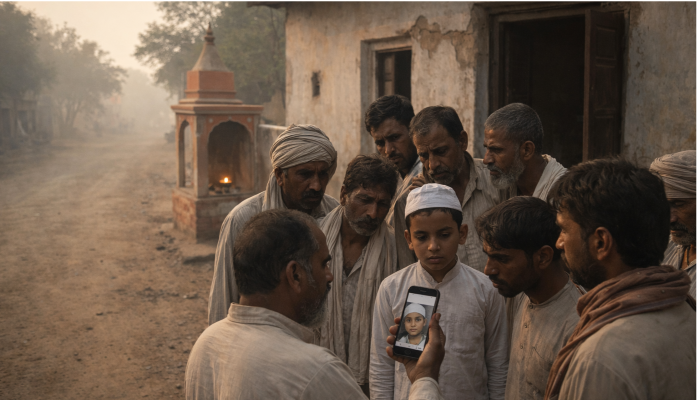
Case Summary
A Hindu minor boy in Kasauli village, Charthawal area of Muzaffarnagar district, Uttar Pradesh, was converted to Islam during the month of Ramzan [the Islamic holy month of fasting] by three individuals from the Muslim community. The conversion of the minor was confirmed when a photograph of him wearing a topi [Islamic prayer cap] at Eid namaz [Islamic festival prayer] circulated on social media. The conversion of the minor took place, reportedly, after his aunt was converted to Islam. Villagers filed a written complaint with the police, demanding immediate action, and a Hindu religious leader gave the authorities a five-day ultimatum to arrest the accused. The three accused, identified as belonging to the Muslim community, targeted a Hindu woman from the Punjabi community in Kasauli village. They first converted her to Islam. Following her conversion, they proceeded to convert her minor nephew as well, drawing him into the process under the influence of the converted aunt. The minor's conversion was not kept private. He was brought to participate in Eid namaz as part of the conversion process. A photograph of the Hindu minor boy wearing a topi (Islamic skull cap) circulated on social media, bringing the conversion to the attention of the wider community and confirming what had taken place. The photograph's circulation triggered widespread anger among the villagers of Kasauli. Dozens of residents arrived at the police station late on Saturday evening and submitted a written complaint against the three accused, demanding that a First Information Report [FIR] be registered and immediate action taken. Swami Yashveer of Baghra Ashram condemned the incident publicly, describing it as a shameful attack on Sanatan Dharma [the Hindu religious tradition]. He issued a five-day ultimatum to the police administration to arrest the accused and take strict action, accusing the perpetrators of carrying out a premeditated conspiracy to convert members of the Hindu Punjabi community.
Why it is Hate Crime ?
The primary category for this case is "Predatory Proselytisation". The sub-category for this case is "Proselytisation by grooming, brainwashing, manipulation and subtle indoctrination". The tertiary category here is "Conversion of minor". Religious brainwashing essentially means the often subtle and forcible indoctrination to induce someone to give up their religious beliefs to accept contrasting regimented ideas. Religious grooming or brainwashing also involves propaganda and manipulation. It involves the systematic effort, driven by religious malice and indoctrination, to persuade “non-believers’ to accept allegiance, command, or doctrine to and of a contrasting faith. Cases of such grooming or brainwashing are far more nuanced than direct threats, coercion, inducement and violence. In such cases, it is often seen that there is repeated, subtle and continual manipulation of the victim to induce disaffection towards their own faith and acceptance of the contrasting faith of the perpetrator. While subtle indoctrination is widely acknowledged as predatory, an element which is often understated in such conversions or the attempts of such conversion is the role of loyalty and trust which might develop between the perpetrator and the victim. Fiduciary relationships are often abused to affect such religious conversion. For example, an educator transmitting religious doctrine of a competing faith to a Hindu student. The Hindu student is likely to accept what the teacher is transmitting owing to existence of the fiduciary relationship. The exploitation of the fiduciary relationship to religiously indoctrinate victims would also be included in this category. Since the underlying animosity towards the victim’s faith forms the basis of predatory proselytization, such cases are considered religiously motivated hate crimes. Another sub-category for this case is "Harassment, threat, coercion for conversion". Harassment covers a wide range of behaviours of an offensive nature. It is commonly understood as behaviour that demeans, humiliates, and intimidates a person, including threats and coercion. Harassment and threats, in this case, find their root on discriminatory grounds which has the effect of nullifying a person’s rights or infringing upon his freedom to exercise his right specifically owing to the victim’s religious identity. Verbal and physical threats and psychological or physical harassment are often used against Hindu victims because they choose to practice their professed religion. Religious harassment also includes forced and involuntary conversions by harassment, threats or coercion. Coercion includes intimidatory tactics like force-feeding a Hindu victim beef to convert to another religion, forceful circumcision etc. In several cases documented, non-Hindu perpetrators or those who harbour specific animosity towards Hinduism, harass victims simply based on their religious identity. Such cases often also include harassment to ensure the Hindu victim abandons his/her professed religion and adopts the religion of the perpetrator. Such cases where Hindu victims are harassed to convert to the perpetrator’s religion are rooted in animosity towards the victim’s religious identity and are therefore documented as religiously motivated hate crimes. The incident in Kasauli village reflects elements of a religiously motivated hate crime, with a necessary distinction based on the age and agency of those involved. At the outset, it is important to note that the Hindu woman involved was an adult. In the absence of clear information indicating coercion, force, or deception in her case, her conversion cannot be definitively classified as a hate crime. Adults possess legal and moral agency, and without evidence to the contrary, the possibility of voluntary conversion cannot be ruled out. However, the situation is materially different in the case of her minor nephew, whose conversion constitutes the central religious marker in this incident. Minors, by definition, lack the legal and cognitive capacity to provide informed and independent consent in matters as consequential as religious conversion. Their decision-making is inherently shaped by external authority figures and immediate surroundings, making them particularly susceptible to influence, pressure, and manipulation. The sequence of events is critical. The minor was drawn into the conversion process following the conversion of his aunt, an adult figure likely to hold influence over him. This reflects a pattern where an adult intermediary is used to facilitate access to and control over a minor. The minor’s subsequent participation in Eid namaz, and the public display of his altered religious identity, indicates that the conversion was not merely symbolic but actively imposed and reinforced. In such circumstances, the element of genuine consent is absent ab initio. The minor’s age and dependency make it impossible to establish that the conversion was the result of a free and informed change of conscience. Instead, it reflects the exploitation of vulnerability inherent to childhood. By drawing a minor into a religious transformation through influence and environment rather than informed choice, the perpetrators effectively override the minor’s autonomy. Taken together, while the adult conversion remains indeterminate in the absence of evidence of coercion, the conversion of the minor—facilitated through influence, proximity, and authority—constitutes a religiously motivated act targeting a vulnerable Hindu individual. The deliberate inclusion of a minor in the conversion process, and its subsequent public affirmation, underscores the exploitative and targeted nature of the act. Disclaimer: The Hinduphobia Tracker records incident dates based on when the crime occurred rather than when it was reported or published. The source confirms the conversions took place during the month of Ramzan but provides no specific calendar date for when the acts occurred. The publication date of 4 April 2026 has been used as the indicative incident date for documentation purposes. This was recorded for documentation purposes only. Disclaimer: The victim count in this case has been recorded as 1. While both an adult Hindu woman and her minor nephew underwent religious conversion, the adult has not been classified as a victim due to the absence of evidence indicating coercion, force, or deception. As an adult, her agency cannot be discounted without clear proof of compulsion. The minor, however, has been counted as the sole victim. Given his age, the capacity for informed consent and an independent change of conscience is inherently absent. His conversion occurred in a context shaped by adult influence and authority, making him particularly vulnerable to manipulation. As such, the minor’s conversion is treated as a religiously motivated act targeting a vulnerable individual, and the victim count reflects this distinction.
Victim Details
Total Victim
1
Deceased
0
Gender
- Male 1
- Female 0
- Third Gender 0
- Unknown 0
Caste
- SC/ST 0
- OBC 0
- General 1
- Unknown 0
Age Group
- Minor 1
- Adult 0
- Senior Citizen 0
- Unknown 0


Case Status
Complaint filed


Perpetrators Details
Perpetrators
Muslim Extremists
Perpetrators Range
From 2 To 5
Perpetrators Gender
unknown
 Sources




