Hindu family targeted by inducement and threats for conversion to Islam in Siddharthnagar
 Siddharthnagar, Uttar Pradesh, India
  2 April, 2026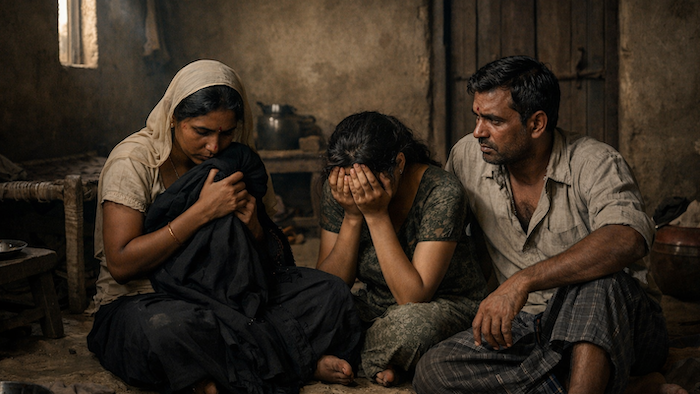
Case Summary
A Hindu man and his family in Dhobahi village, Siddharthnagar, Uttar Pradesh, were subjected to sustained pressure and coercion to convert to Islam. The Hindu victim and his family faced threats and inducements over several months. The situation escalated when Islamic practices were imposed on them against their will. The Hindu victim, identified as Babulal Vishwakarma, reported that three Muslim men from the same village, Farooq, Ghulam Hussain, and Hadisullah, were actively targeting Hindu families. They used financial inducements and persuasion to pressure families into converting to Islam. Their actions were described as organised and sustained over time. Under this pressure, one Hindu family in the village underwent religious conversion. Following this, three daughters from that family were taken to a mosque and made to offer prayers. They were also made to wear a burqa (a full-body veil worn by Muslim women) while attending school. These actions indicated continued influence over the family after conversion. The Hindu victim stated that he and his wife were also pressured for months to convert to Islam. They were threatened with being denied the right to live peacefully in the village if they refused. The intimidation created an atmosphere of fear and social exclusion. The pressure extended beyond persuasion and included warnings about consequences for non-compliance. The Hindu victim described the situation as severe and ongoing. The actions of the perpetrators reflected a pattern of targeting Hindu families within the village. A written complaint was submitted by the Hindu victim, following which a formal First Information Report was registered against the three named perpetrators. The case was filed under the relevant provisions on unlawful religious conversion. Police initiated an investigation into the matter. Efforts to locate and arrest the perpetrators were ongoing at the time of documentation. A public representative visited the Hindu victim’s home and assured that strict action would be taken.
Why it is Hate Crime ?
This case has been added to the tracker under the primary category - Predatory Proselytisation. Within this, the subcategory selected is - Conversion/ attempts to convert by inducement. Predatory Proselytisation is not just limited to threat, harassment, force and violence, but it also has contours of stealth. In several cases, the Hindu victim is exploited to convert, with non-Hindus taking advantage of their poverty. In such cases, the Hindu victim who is suffering financially is offered monetary benefits, including lucrative offers for jobs, health treatment, education, etc, to induce the victim into changing his/her religion. In such cases, the religious identity of the victim and the aim to disenfranchise him from his faith form the heart of the crime. Also, taking advantage of and exploiting an individual’s economic vulnerabilities is widely acknowledged as exploitation, forms of which are often penalised by law. Such cases therefore are considered religiously motivated hate crimes since the victim’s religious identity forms the very heart of the crime itself. The other subcategory selected in this case is - Harassment, threats, coercion for conversion. Harassment covers a wide range of behaviours of an offensive nature. It is commonly understood as behaviour that demeans, humiliates, and intimidates a person, including threats and coercion. Harassment and threats, in this case, find their root on discriminatory grounds which has the effect of nullifying a person’s rights or infringing upon his freedom to exercise his right specifically owing to the victim’s religious identity. Verbal and physical threats and psychological or physical harassment are often used against Hindu victims because they choose to practice their professed religion. Religious harassment also includes forced and involuntary conversions by harassment, threats or coercion. Coercion includes intimidatory tactics like force-feeding a Hindu victim beef to convert to another religion, forceful circumcision etc. In several cases documented, non-Hindu perpetrators or those who harbour specific animosity towards Hinduism, harass victims simply based on their religious identity. Such cases often also include harassment to ensure the Hindu victim abandons his/her professed religion and adopts the religion of the perpetrator. Such cases where Hindu victims are harassed to convert to the perpetrator’s religion are rooted in animosity towards the victim’s religious identity and are therefore documented as religiously motivated hate crimes. Another subcategory selected in this case is - Proselytisation by grooming, brainwashing, manipulation or subtle indoctrination. The tertiary category selected is - Pattern of targeting Hindus. Religious brainwashing essentially means the often subtle and forcible indoctrination to induce someone to give up their religious beliefs to accept contrasting regimented ideas. Religious grooming or brainwashing also involves propaganda and manipulation. It involves the systematic effort, driven by religious malice and indoctrination, to persuade “non-believers’ to accept allegiance, command, or doctrine to and of a contrasting faith. Cases of such grooming or brainwashing are far more nuanced than direct threats, coercion, inducement and violence. In such cases, it is often seen that there is repeated, subtle and continual manipulation of the victim to induce disaffection towards their own faith and acceptance of the contrasting faith of the perpetrator. While subtle indoctrination is widely acknowledged as predatory, an element which is often understated in such conversions or the attempts of such conversion is the role of loyalty and trust which might develop between the perpetrator and the victim. Fiduciary relationships are often abused to affect such religious conversion. For example, an educator transmitting religious doctrine of a competing faith to a Hindu student. The Hindu student is likely to accept what the teacher is transmitting owing to existence of the fiduciary relationship. The exploitation of the fiduciary relationship to religiously indoctrinate victims would also be included in this category. Since the underlying animosity towards the victim’s faith forms the basis of predatory proselytization, such cases are considered religiously motivated hate crimes. This case qualified as a religiously motivated hate crime because Hindu families were systematically targeted by Muslim perpetrators through inducement, coercion, and sustained pressure to convert to Islam. The actions were organised and directed specifically at Hindus within the village. The use of financial incentives and threats showed a deliberate attempt to alter the religious identity of the victims. Religion was central to both the method and objective of the acts. The perpetrators approached Hindu families with financial inducements and persuasion. This was significant because it showed intentional targeting based on religious identity. The inducements were not random but directed at Hindus to influence their beliefs. This demonstrated that the victims were chosen specifically because they were Hindu. The use of inducements to convert individuals is indeed a common tactic in efforts to influence or manipulate vulnerable individuals into changing their faith. This approach often targets economically disadvantaged groups, offering material benefits such as food, money, or livestock in exchange for conversion. It creates a form of dependency that can alienate individuals from their original faith, as they may feel compelled to convert not out of genuine belief but due to immediate needs or financial pressures. Further, the perpetrators applied sustained pressure over several months on the Hindu victim and his family. This was significant because it moved beyond persuasion into coercion. The continued pressure created an environment where refusal became difficult. This directly targeted the Hindu family by attempting to break their religious autonomy. The perpetrators threatened the Hindu victim and his family with social exclusion if they refused to convert. This was significant because it weaponised their position within the village. The threat of being denied the right to live peacefully created fear and insecurity. This showed that the Hindu identity of the victims was being used as a basis for intimidation. Such acts stem from inherent hostility towards the victim's professed faith since Abrahamic faiths believe that any non-adherent to the faith is subject to being dehumanised till they convert. Since such predatory actions stem from doctrinal animosity towards the Hindu faith and its adherents, this case is being documented as a religiously motivated hate crime. Moreover, the conversion of another Hindu family in the village further reinforced the pattern of targeting. This was significant because it indicated that the acts were not isolated. The continued influence over that family, including the imposition of religious practices, demonstrated sustained control. This demonstrated a broader pattern of targeting Hindu families within the community. The reported acts of taking young girls to a mosque and enforcing religious practices highlighted the depth of influence. This was significant because it showed continued intervention in personal and cultural identity. The imposition of new practices reflected a shift forced upon the victims. This reinforced that the targeting was aimed at altering Hindu identity at a family level. The fact that these victims were minors, the element of consent, and a genuine change of conscience were missing ab initio. Minors, due to their young age and lack of maturity, are particularly vulnerable to manipulation and coercion. They may not have the ability to fully understand the implications of converting to another religion, and the perpetrators purposely targeted and exploited this vulnerability of the victim and imposed Islamic practices on them. The organised nature of the actions pointed to a structured effort rather than isolated incidents. This was significant because it suggested coordination and repeated targeting. The consistent method of inducement, pressure, and threat indicated a deliberate approach. This showed that Hindu families as a group were being targeted within the village. Given that this case met the parameters of a religiously motivated hate crime, it was added to the hate crime database of the tracker. Disclaimers: The exact number of affected Hindu victims was not specified in the source material. The reports indicated that multiple Hindu families in the village were targeted; nonetheless, at least five individuals were clearly identified as confirmed victims and have been recorded accordingly. The tracker records incident dates based on when the crime occurred rather than when it was reported. In this case, the exact day and month of the incident were not specified in the source. Therefore, 3 April 2026, the article’s publication date, has been used as the indicative incident date.
Victim Details
Total Victim
5
Deceased
0
Gender
- Male 1
- Female 4
- Third Gender 0
- Unknown 0
Caste
- SC/ST 0
- OBC 0
- General 0
- Unknown 5
Age Group
- Minor 3
- Adult 2
- Senior Citizen 0
- Unknown 0


Case Status
Complaint filed


Perpetrators Details
Perpetrators
Muslim Extremists
Perpetrators Range
From 2 To 5
Perpetrators Gender
male
 Sources




