Hindu minor girl stalked, pressured for religious conversion and marriage by Muslim man and his family
 Ahmadnagar, Maharashtra, India
  21 February, 2026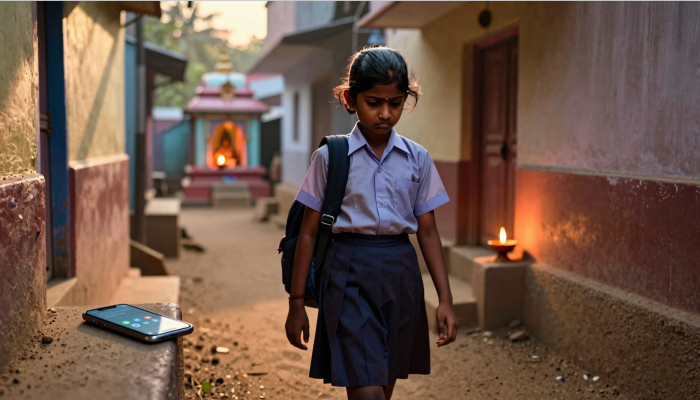
Case Summary
A 15-year-old Hindu minor girl in Shirdi, Ahmadnagar district, Maharashtra was stalked, harassed on social media, and subjected to sustained pressure to convert to Islam and marry her perpetrator. The campaign was carried out not by one individual but by three members of the same family working in coordination. The primary perpetrator was arrested, while his brother and sister-in-law remained at large. Irfan Sheikh had been harassing the minor girl for several days prior to the complaint. He followed her repeatedly in person and simultaneously sent her a continuous stream of messages through Instagram, attempting to draw her into a romantic entanglement. He pressed her persistently to agree to marriage. Irfan Sheikh was not acting alone. His brother Arbaz Sheikh and his sister-in-law Ayesha Sheikh actively participated in the campaign alongside him. All three together applied sustained and severe mental pressure on the minor girl to abandon her Hindu faith, convert to Islam, and marry Irfan through nikah [Islamic marriage ceremony]. After Irfan Sheikh molested her, the victim gathered the courage to disclose what had been happening to her family. Her father approached workers of Bajrang Dal, a Hindu organisation, for assistance. With their support, a complaint was filed at Shirdi police station. Police acted swiftly and arrested the primary accused Irfan Sheikh. A case was registered against him under the Bharatiya Nyaya Sanhita [Indian Penal Code replacement legislation] and the Protection of Children from Sexual Offences [POCSO] Act. His brother Arbaz Sheikh and sister-in-law Ayesha Sheikh, both named in the case, fled and remained at large. Police teams were conducting raids to locate them. The investigation was being conducted by a sub-inspector level officer and was ongoing.
Why it is Hate Crime ?
The primary category for this case is "Predatory Proselytisation". The sub-category for this category is "Harassment, threats, coersion for conversion". Harassment covers a wide range of behaviours of an offensive nature. It is commonly understood as behaviour that demeans, humiliates, and intimidates a person, including threats and coercion. Harassment and threats, in this case, find their root on discriminatory grounds which has the effect of nullifying a person’s rights or infringing upon his freedom to exercise his right specifically owing to the victim’s religious identity. Verbal and physical threats and psychological or physical harassment are often used against Hindu victims because they choose to practice their professed religion. Religious harassment also includes forced and involuntary conversions by harassment, threats or coercion. Coercion includes intimidatory tactics like force-feeding a Hindu victim beef to convert to another religion, forceful circumcision etc. In several cases documented, non-Hindu perpetrators or those who harbour specific animosity towards Hinduism, harass victims simply based on their religious identity. Such cases often also include harassment to ensure the Hindu victim abandons his/her professed religion and adopts the religion of the perpetrator. Such cases, where Hindu victims are harassed to convert to the perpetrator’s religion, are rooted in animosity towards the victim’s religious identity and are therefore documented as religiously motivated hate crimes. Another sub-category for this case is "Proselytisation by grooming, brainwashing, manipulation and subtle indoctrination". The tertiary categories are "Conversion of minor", "Rape and sexual assault/harassment", and Victim says was brainwashed/groomed". Religious brainwashing essentially means the often subtle and forcible indoctrination to induce someone to give up their religious beliefs to accept contrasting, regimented ideas. Religious grooming or brainwashing also involves propaganda and manipulation. It involves the systematic effort, driven by religious malice and indoctrination, to persuade “non-believers’ to accept allegiance, command, or doctrine to and of a contrasting faith. Cases of such grooming or brainwashing are far more nuanced than direct threats, coercion, inducement and violence. In such cases, it is often seen that there is repeated, subtle and continual manipulation of the victim to induce disaffection towards their own faith and acceptance of the contrasting faith of the perpetrator. While subtle indoctrination is widely acknowledged as predatory, an element which is often understated in such conversions or the attempts of such conversion is the role of loyalty and trust which might develop between the perpetrator and the victim. Fiduciary relationships are often abused to affect such religious conversion. For example, an educator transmitting religious doctrine of a competing faith to a Hindu student. The Hindu student is likely to accept what the teacher is transmitting owing to existence of the fiduciary relationship. The exploitation of the fiduciary relationship to religiously indoctrinate victims would also be included in this category. Since the underlying animosity towards the victim’s faith forms the basis of predatory proselytization, such cases are considered religiously motivated hate crimes. This case qualifies as a religiously motivated hate crime in which a Hindu minor girl in Shirdi, Maharashtra, was stalked, molested, and subjected to a coordinated campaign of conversion pressure orchestrated by three members of the same Muslim family. The perpetrators did not act impulsively. They identified a Hindu minor, pursued her through multiple channels simultaneously, and worked together to break down her resistance to abandoning her faith. The targeting of a Hindu minor is the first and most significant religious marker in this case. The victim was 15-years-old. She was not an adult capable of navigating sustained harassment from multiple perpetrators. She was a child, and her age made her a more viable target for a grooming and conversion campaign precisely because she was less equipped to resist, less likely to be believed, and more susceptible to the psychological pressure that was being applied. The deliberate selection of a minor Hindu girl as the subject of this campaign reflects a predatory calculation. The use of social media as a grooming tool is the second religious marker. Irfan Sheikh pursued the victim simultaneously across digital and physical spaces, sending her a continuous stream of messages through Instagram in an attempt to manufacture emotional dependency. The online grooming was the mechanism through which he attempted to normalise the relationship before introducing the conversion and marriage demands. The coordination of three family members in applying conversion pressure is the third religious marker. Irfan Sheikh, his brother Arbaz Sheikh, and his sister-in-law Ayesha Sheikh all participated actively in pressuring the minor to convert to Islam and marry through nikah. This was not one individual acting on personal impulse. It was a family-level operation in which multiple adults coordinated their efforts to overwhelm a 15-year-old Hindu girl's resistance. The involvement of Ayesha Sheikh, a woman, in the campaign is particularly significant. Her participation would have been intended to lend social legitimacy to the conversion pressure and to access the minor in contexts where a male perpetrator could not. The victim's own recognition that she had been subjected to grooming and manipulation is the final religious marker. The source confirms that the victim herself understood that she had been drawn into a trap. Her awareness of the grooming process and her courage in disclosing it despite the social difficulty of doing so gave the case the evidential foundation it needed to proceed. Her testimony was the basis on which Irfan Sheikh was arrested, and charges were brought under the Protection of Children from Sexual Offences [POCSO] Act. Given that this case met the parameters of a religiously motivated hate crime, it was added to the hate crime database of the tracker. Disclaimer: The Hinduphobia Tracker records incident dates based on when the crime occurred, not when it was reported or published. The source does not specify the exact date on which the stalking and harassment began, noting only that it had been ongoing for several days prior to the complaint being filed. The publication date of 22 February 2026 has, therefore, been used as the indicative incident date for documentation purposes.
Victim Details
Total Victim
1
Deceased
0
Gender
- Male 0
- Female 1
- Third Gender 0
- Unknown 0
Caste
- SC/ST 0
- OBC 0
- General 0
- Unknown 1
Age Group
- Minor 1
- Adult 0
- Senior Citizen 0
- Unknown 0


Case Status
Case sub-judice


Perpetrators Details
Perpetrators
Muslim Extremists
Perpetrators Range
From 2 To 5
Perpetrators Gender
both
 Sources




