Anti-Hindu communal attack by Christians on Ram Navami misrepresented by leftist media; falsely portrayed it as 'conflict with Dalits'
 India
India  30 March, 2026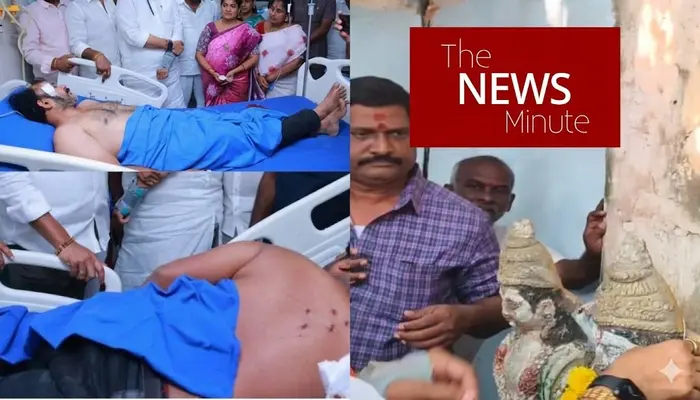
Case Summary
An anti-Hindu, left-leaning media portal, The News Minute (TNM), deliberately misrepresented a violent communal attack on Hindu devotees by a Christian mob during Ram Navami in Pedapeta, Andhra Pradesh. It portrayed the attack on Hindus as “tensions with Dalits,” recasting the incident as a caste conflict between Hindus and obscuring its true religious nature and severity. In the Pedapetam village of West Godavari District, Andhra Pradesh, a Hindu politician, his party workers and devotees were attacked by a Christian mob after he expressed his intent to rebuild a Hindu temple in the village. However, the media portal 'The News Minute' misrepresented it and portrayed the incident as “tensions with Dalits” linked to calls for constructing a Rama temple, thereby reframing a violent attack on Hindu devotees during a religious festival as a broader caste conflict between Hindus and diminishing its targeted nature and severity. Contrary to TNM claims, the attackers were not “Dalits”; they were identified as Christians. Deputy Speaker Raghu Rama Krishna Raju stated clearly to the media: “Christians in the guise of Dalits, while I was having darshan of Bhagwan Rama, shouted, and immediately after I left from there, they attacked the Rama devotees present at the temple with knives and made an attempt to murder many people.” The Deccan Chronicle reported that one of the persons involved in the attack was named Ismail, a fact which the TNM completely ignored. TNM also downplayed the organised and premeditated character of the assault, including the reported presence of individuals from outside the village prior to the incident. It also inverted the sequence of events by implying a law-and-order response directed at the marginalised group (Dalits), whereas police action followed the attack and focused on individuals booked under serious criminal charges. The report almost exclusively relied on a fact-finding report by the left-leaning Human Rights Forum (HRF), a Hyderabad-based civil liberties group, as its primary source while giving less weight to the statements of the Deputy Speaker, the Andhra Pradesh Chief Minister, Deputy CM Pawan Kalyan, police FIR details, and the injured victim; thereby creating an asymmetrical narrative that shifted focus away from the Christian mob, documented violence and its immediate circumstances.
Why it is Hate Crime ?
This case has been added to the tracker under the prime category of- Hate speech against Hindus. Under this, the sub-category selected is- Anti-Hindu subversion and prejudice. The tertiary categories selected are- Anti-Hindu Fake News or Downplaying and Mislabelling/Misrepresentation of perpetrator's religion as Hindu. Hate speech is defined as any speech, gesture, conduct, writing, or display that is prejudicial against a specific individual and/or group of people, which leads to or may lead to violence, prejudicial action or hate against that individual and/or group. Media plays a specific and overarching role in perpetuating prejudicial attitudes towards a community owing to unfair, untrue coverage and/or misrepresentation/misinterpretation, selective coverage and/or omission of facts of/about issues affecting a specific religious group. This type of bias can dehumanise the victim group, making it easier for others to justify harmful actions against them, which aligns with the objectives of hate speech laws aimed at preventing such harm. It is often observed that the media takes a prejudicial stand against the Hindu community, driven by their need to shield the aggressor community, which happens to be a numeric minority; however, that is the one perpetrating violence against Hindus. For example, the media is often quick to contextualise religiously motivated crimes against Hindus, omit or misrepresent facts that point towards religiously motivated hate crimes, justify and/or downplay religiously motivated hate crimes, or simply present fake news to stereotype Hindus. Such media bias leads to the denial of persecution and is often used to dehumanise Hindus, leading to justification for violence against them. For example, the media covered several fake allegations of Hindus targeting Muslims and forcing them to chant Jai Shree Ram. Most of these cases were proved false and fabricated after police investigation. These fake news reports were subsequently never retracted or clarified. Such fake news led to the justification of violence and dehumanisation of Hindus based on the argument that since Hindus targeted Muslims and forced them to chant Jai Shree Ram, the dehumanisation of Hindus and violence against them was par for the course and merely a retaliation. Such media bias leads to prejudicial portrayals of Hindus and offers a justification for violence against them and, therefore, is considered hate speech under this category. This case has been added to the Hinduphobia Tracker as it involved the misrepresentation and dilution of a violent attack on Hindu devotees by a Christian mob, thereby obscuring its targeted religious nature. The incident occurred in Pedapeta village of West Godavari district during the festival of Sri Rama Navami, when a Hindu politician, his party workers, and devotees were attacked by an armed Christian mob during a temple visit connected to the renovation of a Ramalayam temple. However, the media portal The News Minute portrayed the incident as “tensions with Dalits” linked to calls for constructing a Rama temple, thereby reframing a violent attack on Hindu devotees as a caste-based conflict and diminishing its targeted religious nature and severity. At the core of the misrepresentation was the recasting of a violent assault on Hindu devotees as "tensions with Dalits." By describing the incident using terms such as “tensions” and linking it to caste dynamics, the TNM report shifted focus away from the fact that Hindu devotees at a place of worship were attacked by a Christian mob. This framing not only diluted the severity of the violence but also obscured the religious identity of the perpetrators. By labelling the attackers as “Dalits,” the report introduced a caste-based characterisation that implicitly situated the incident within intra-Hindu dynamics, thereby altering the nature of the conflict as understood by the audience. Such a portrayal created the impression of a bilateral or socially rooted dispute rather than a targeted act of violence against Hindu devotees. In doing so, it weakened the perception of the incident as a serious criminal assault rooted in religious animosity and detached it from its immediate religious context, ultimately reshaping public understanding of both the victims and the perpetrators. Furthermore, the report reduced the identity of the attackers to a generic caste-based classification, presenting them as “Dalits,” while omitting references to their identified religious background. Statements by K. Raghu Rama Krishna Raju indicated that the assailants were Christians, and additional reporting noted the involvement of individuals such as Ismail. The absence of these details in the coverage resulted in a narrative that masked the religious identity of the perpetrators and instead framed the conflict in intra-Hindu caste terms, thereby altering the nature of the incident as understood by the public. The TNM coverage also downplayed indications of prior organisation and intent. Accounts of individuals arriving in the village from outside prior to the incident demonstrated premeditation; however, the portrayal of the violence as arising from “repeated confrontations” or spontaneous tensions diluted this aspect. This omission reduced the perception of the attack as a coordinated act and instead positioned it as an outcome of localised friction. Additionally, the sequence of events was presented in a manner that suggested a law-and-order response affecting a marginalised group, whereas available information indicated that police action followed the attack and involved the registration of serious criminal charges against multiple accused, specifically 59 individuals. This inversion of sequence shifted attention from the victims of the violence to the consequences faced by those accused, thereby redirecting sympathy and altering the moral framing of the incident. The report relied predominantly on a fact-finding account by the Human Rights Forum, while giving comparatively limited prominence to police records, official statements, and accounts from the injured. This selective reliance created an imbalance in the presentation of facts, where one interpretative narrative was elevated over contemporaneous evidence and official documentation. This showcases the anti-Hindu bias of the TNM report, making it a clear case of anti-Hindu reporting. Taken together, the selective omission of key details, the reframing of a violent attack as a caste-based tension, and the dilution of the incident’s religious context amounted to a misrepresentation that obscured the religious nature of the violence against Hindus. Such portrayals contribute to a broader pattern where acts targeting Hindus are contextualised in ways that minimise their severity and shift focus away from the victims. This, in turn, influences public perception and risks normalising the whitewashing and downplaying of violence against Hindus, thereby reinforcing prejudice and misrepresentation in discourse. Given that this case meets the parameters of a religiously motivated offence, it is added to the hate crime database of the Hinduphobia Tracker.


Case Status
Unknown


Perpetrators Details
Perpetrators
Others
Perpetrators Range
One Person
Perpetrators Gender
unknown
 Sources




