Tribal Hindus targeted for forced religious conversion under pretext of curing illnesses in Kondagaon, Chhattisgarh
 Kondagaon, Chhattisgarh, India
  30 March, 2023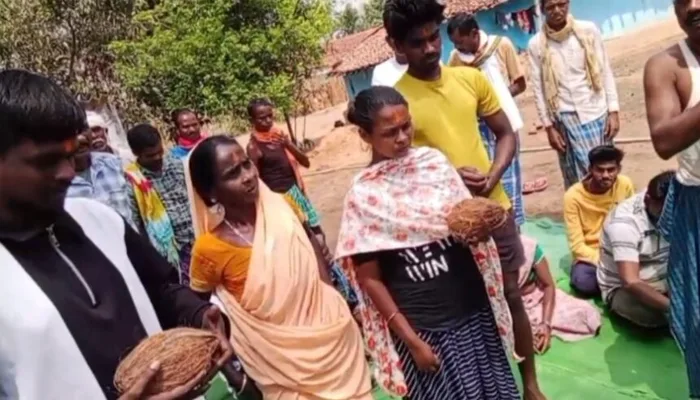
Case Summary
In Bangoli Gram Panchayat, located in the Farasgaon block of the Keshkal Assembly constituency of Kondagaon district in Chhattisgarh, six tribal Hindus belonging to two families were forcibly converted to a non-Hindu religion. The accused targeted the victims under the pretext of curing their illnesses if they converted. According to reports, the Hindu families had converted to another religion a few years ago. The first family consisted of Satvan Shori and his wife, Binita Shori, who converted about three years ago (2023). The second family consisted of Sanjay, his mother Sukhbati, sister Kaushalya, and brother Govind, who converted about a year ago (2025). During a social meeting held in the village on 31 March 2026, the families publicly announced that they wanted to return to their original religion, Hinduism. Following this, the villagers welcomed all the members back home with traditional rituals during a Gharwapsi ceremony, a religious ceremony where Hindus who had previously converted to other faiths could revert to Hinduism. Villagers stated that the Hindu victims were initially misled into converting to another faith under the pretext of curing illnesses. However, the families voluntarily decided to return to their original faith, Hinduism. Village Sarpanch Heera Singh stated that the villagers were united in preserving their traditions and culture. He said, "We all want to carry forward our traditions together, so this Gharwapsi was organised with everyone's consent." During the Gharwapsi ceremony, both families were welcomed by sprinkling water on them and presenting them with coconuts, as is the tradition of the tribal community. At the time of writing this report, the situation in the village was completely peaceful, and the villagers talked about moving forward with social harmony and unity.
Why it is Hate Crime ?
The primary category selected is- Predatory Proselytisation. The subcategory selected is- Conversion/attempts to convert by inducement. Predatory Proselytisation is not just limited to threat, harassment, force and violence, but it also has contours of stealth. In several cases, the Hindu victim is exploited to convert, with non-Hindus taking advantage of their poverty. In such cases, the Hindu victim who is suffering financially is offered monetary benefits, including lucrative offers for jobs, health treatment, education, etc, to induce the victim into changing his/her religion. In such cases, the religious identity of the victim and the aim to disenfranchise him from his faith form the heart of the crime. Also, taking advantage of and exploiting an individual’s economic vulnerabilities is widely acknowledged as exploitation, forms of which are often penalised by law. Such cases therefore are considered religiously motivated hate crimes since the victim’s religious identity forms the very heart of the crime itself. The subcategory selected is- Proselytisation by grooming, brainwashing, manipulation or subtle indoctrination. The tertiary categories selected are- Pattern of targeting Hindus, Victim says was brainwashed/groomed. Religious brainwashing essentially means the often subtle and forcible indoctrination to induce someone to give up their religious beliefs to accept contrasting regimented ideas. Religious grooming or brainwashing also involves propaganda and manipulation. It involves the systematic effort, driven by religious malice and indoctrination, to persuade “non-believers’ to accept allegiance, command, or doctrine to and of a contrasting faith. Cases of such grooming or brainwashing are far more nuanced than direct threats, coercion, inducement and violence. In such cases, it is often seen that there is repeated, subtle and continual manipulation of the victim to induce disaffection towards their own faith and acceptance of the contrasting faith of the perpetrator. While subtle indoctrination is widely acknowledged as predatory, an element which is often understated in such conversions or the attempts of such conversion is the role of loyalty and trust which might develop between the perpetrator and the victim. Fiduciary relationships are often abused to affect such religious conversion. For example, an educator transmitting religious doctrine of a competing faith to a Hindu student. The Hindu student is likely to accept what the teacher is transmitting owing to existence of the fiduciary relationship. The exploitation of the fiduciary relationship to religiously indoctrinate victims would also be included in this category. Since the underlying animosity towards the victim’s faith forms the basis of predatory proselytization, such cases are considered religiously motivated hate crimes. This case stands as a clear example of a religiously motivated hate crime, as the perpetrators forcibly converted Hindu families to another faith under the pretext of curing their illnesses. This amounted to coercion and manipulation aimed at stripping Hindu victims of their religious identity, far beyond mere persuasion. The targeted nature of these conversion efforts, preying on vulnerable families in Kondagaon, Chhattisgarh, inflicted lasting emotional scars, eroding their sense of self and community. When individuals or groups single out members of a specific religion like Hinduism, it demonstrates profound disregard for that faith, with the perpetrators here demonstrating utter contempt for Hindu beliefs and their followers. Such actions sought to erase Hindu identity entirely, marking this as a blatant, religiously motivated hate crime. Offering conversion as a cure for illnesses amounted not just to manipulation but to calculated inducements, exploiting desperate Hindus at their most fragile moments. Perpetrators dangled false promises of health recovery if victims abandoned their Hindu faith, revealing these as predatory tactics rather than acts of compassion. Anti-Hindu groups routinely target socially and economically vulnerable Hindu families, emotionally blackmailing them into submission by weaponising illness against their faith identity. This stripped victims of their agency and religious autonomy, enforcing a foreign faith through deceit. Far from isolated, these premeditated efforts undermined Hinduism itself, rooted in deep religious animosity and qualifying unequivocally as a hate crime. The perpetrators, claiming that converting to another faith could cure illnesses, also amounted to insidious manipulation, preying on the raw desperation of sick Hindu families in Kondagaon who sought any glimmer of hope. Perpetrators dangled these false promises not as genuine aid but as bait to lure vulnerable souls away from Hinduism, exploiting physical suffering to shatter spiritual loyalty. Such manipulative tactics showcased blatant religious animosity, dismissing Hindu faith and devotion as inferior and worthless. By tying health to religious conversion, the perpetrators dehumanised Hindus, treating their faith as a disease to be eradicated, which underscores the hate crime's calculated malice. The fact that the Hindu victims embraced Gharwapsi, returning to their ancestral faith during a heartfelt village ceremony on 31 March 2026, underscores the profound psychological and social torment they endured. Forced conversions tore at their souls, leaving a gaping spiritual void that no amount of external pressure could fill, as families like Satvan Shori's and Sanjay's rediscovered peace only upon reclaiming their original faith, Hinduism. This Gharwapsi highlighted the immense suffering inflicted on Hindu victims, with villagers rallying through traditional rituals to heal wounds that no true faith change could mask, cementing the incident's status as a hate crime born of coercion. In this case, even though the perpetrators' religious identities are unknown, their actions are a result of animosity towards the Hindu faith and community. Therefore, this case is being added to the Hate Crime database of the Hinduphobia Tracker. Disclaimer: The Hinduphobia Tracker records the dates of incidents based on when the crime occurs, rather than when it is reported by the media. However, in this case, media reports did not clearly state the exact date from when the victims' ordeal began; they noted one family converted in 2023 and another in 2025, without precise dates. The Gharwapsi event occurred on 31 March 2026. Based on this information, 31 March 2023 is selected as the indicative incident date; this is recorded for documentation purposes only.
Victim Details
Total Victim
6
Deceased
0
Gender
- Male 3
- Female 3
- Third Gender 0
- Unknown 0
Caste
- SC/ST 6
- OBC 0
- General 0
- Unknown 0
Age Group
- Minor 0
- Adult 6
- Senior Citizen 0
- Unknown 0


Case Status
Unknown


Perpetrators Details
Perpetrators
Unknown
Perpetrators Range
Unknown
Perpetrators Gender
unknown
 Sources




