Hindu family offered inducements and pressured to convert by their Muslim neighbours; assaulted upon refusal
 Agra, Uttar Pradesh, India
  24 January, 2026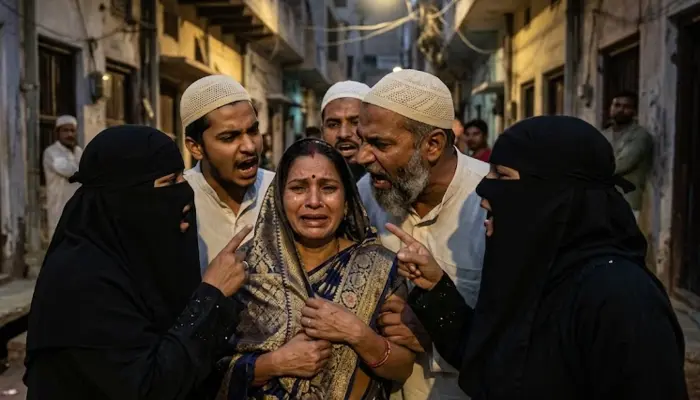
Case Summary
In the Gautam Nagar area of Nagla Dhani, Agra, Uttar Pradesh, a Hindu woman named Mohini Devi and her family were offered inducements and pressured to convert to Islam by their Muslim neighbours. According to the victim, who filed a petition in court in this regard, several individuals living in the locality had already converted to Islam. The Muslim neighbours then began coercing the victim and her family into converting to Islam, including offering them money. The neighbours also intimidated the victim's family and subjected them to death threats when they refused to convert. The situation escalated on the night of 25 January 2026, when the victim's husband and son confronted the Muslim neighbours over this matter. In response, the perpetrators gathered outside her residence and physically assaulted her with sticks. The attack caused alarm in the neighbourhood, drawing the attention of nearby residents, after which the perpetrators fled the scene while hurling abuses. Despite submitting a complaint to the Police Commissioner’s office on 27 January 2026, no immediate action followed. Subsequently, Mohini Devi approached the court, which directed the police to register a case. Acting on these orders, the Hariparvat police filed an FIR against multiple accused individuals, identified as Ramesh, Jitesh, Captain, Lalit, Siddharth, Dheeraj, Vinod Kumar, and Ranjeet Sagar, all residents of the same locality, and initiated an investigation into the incident.
Why it is Hate Crime ?
This case has been added to the tracker under the primary category- Predatory Proselytisation. Within this, the subcategory selected is- Conversion/ attempts to convert by inducement. Predatory Proselytisation is not just limited to threat, harassment, force and violence, but it also has contours of stealth. In several cases, the Hindu victim is exploited to convert, with non-Hindus taking advantage of their poverty. In such cases, the Hindu victim who is suffering financially is offered monetary benefits, including lucrative offers for jobs, health treatment, education, etc, to induce the victim into changing his/her religion. In such cases, the religious identity of the victim and the aim to disenfranchise him from his faith form the heart of the crime. Also, taking advantage of and exploiting an individual’s economic vulnerabilities is widely acknowledged as exploitation, forms of which are often penalised by law. Such cases therefore are considered religiously motivated hate crimes since the victim’s religious identity forms the very heart of the crime itself. The other sub-category selected is - Harassment, threats, coercion for conversion. Harassment covers a wide range of behaviours of an offensive nature. It is commonly understood as behaviour that demeans, humiliates, and intimidates a person, including threats and coercion. Harassment and threats, in this case, find their root on discriminatory grounds, which has the effect of nullifying a person’s rights or infringing upon his freedom to exercise his right specifically owing to the victim’s religious identity. Verbal and physical threats and psychological or physical harassment are often used against Hindu victims because they choose to practice their professed religion. Religious harassment also includes forced and involuntary conversions by harassment, threats or coercion. Coercion includes intimidatory tactics like force-feeding a Hindu victim beef to convert to another religion, forceful circumcision, etc. In several cases documented, non-Hindu perpetrators or those who harbour specific animosity towards Hinduism, harass victims simply based on their religious identity. Such cases often also include harassment to ensure the Hindu victim abandons his/her professed religion and adopts the religion of the perpetrator. Such cases, where Hindu victims are harassed to convert to the perpetrator’s religion, are rooted in animosity towards the victim’s religious identity and are therefore documented as religiously motivated hate crimes. The second primary category selected here is - Attack not resulting in death. Within it, the sub-category selected is - Attacked for refusal to convert. When there is pressure, threat or coercion employed upon the Hindu victim to convert to a different religion, in several cases, the victim refuses to succumb to the pressure/threats. Once the victim refuses, the perpetrator proceeds to attack/assault the victim owing to his/her refusal to convert. In such cases, the pressure/threat/intimidation/coercion/violence itself is driven by animosity towards the victim’s Hindu faith. The violence then is another hate crime driven by the victim’s refusal to abandon his professed faith, Hinduism, and convert to the religion of a non-Hindu perpetrator. Since the victim’s faith is at the heart of the pressure to convert and the ensuing violence towards the victim, such cases are considered religiously motivated hate crimes. The other sub-category selected here is - Attacked for opposing radicals or trying to save victim. In several cases, Hindus are attacked for opposing religiously motivated crimes being committed against a fellow Hindu or simply for voicing an opinion opposing radical elements, who either have in the past or continue to persecute Hindus. In such cases, the initial attack against the victim, against which the Hindu was trying to defend the victim, would also need to be classified as a religiously motivated hate crime. Since the initial crime itself was religiously motivated and the subsequent crime of attempting to save the victim or speaking against the radical elements ends up inviting a violent attack, it would also be classified as a religiously motivated hate crime under this category. This case has been added to the tracker because a Hindu woman named Mohini Devi and her family were offered inducements and pressured to convert to Islam by their Muslim neighbours. Firstly, the Muslim neighbours attempted to convert the victim and her family by offering them monetary inducements. Offering incentives or making false promises, especially when directed at vulnerable individuals in need, shows that these incentives are not acts of kindness or charity. Instead, they are calculated moves to exploit vulnerable Hindus because of religion. By providing inducements in exchange for conversion, the accused were effectively blackmailing those who might have been desperate for assistance or hope. This form of coercion strips people of their agency and dignity and results in coerced conversions. These are not random or isolated incidents, but rather cases deeply rooted in religious animosity towards Hindu victims. Secondly, when the inducements failed, the perpetrators shifted their tactics to intimidation and death threats. Pressuring or threatening a Hindu family to discard their religious faith and embrace another was a direct attack on their religious identity and dignity. It was not a matter of personal choice; it was coercion rooted in hostility towards the victim's Hindu identity. Such an attempt reflects religious animosity because the act was not simply about personal differences but about erasing the victim’s Hindu faith, making it a religiously motivated crime. Thirdly, when the victim's husband and son confronted the Muslim neighbours over the conversion matter, they were physically assaulted with sticks by the perpetrators. The violence occurred directly as a consequence of their refusal to abandon Hinduism and confronting the accused, indicating that the assault functioned as punishment for resisting conversion. It was a deliberate attempt to punish and intimidate the victim for adhering to his religion and not converting. Attacking a Hindu individual just for refusing conversion showcases the intensity with which the perpetrators would go to enforce conversions, making it a religiously motivated offence. The violence also functioned as a statement for other Hindus in the locality that if they resisted, they would also be subjected to similar violence. Such actions stem from inherent hostility towards the victim's professed faith since Abrahamic faiths believe that any non-adherent to the faith is subject to being dehumanised till they convert. Such acts were not merely personal crimes; they were rooted in a desire to dominate and erase the religious identity of the victim. Since such predatory actions stem from doctrinal animosity towards the Hindu faith and its adherents, this case is being documented as a religiously motivated hate crime. Disclaimer: It is important to clarify that none of the media sources covering this case has specified the exact date when the victim's ordeal began. The earliest date mentioned is 25 January 2026, when the victim's family was assaulted. Since Hinduphobia Tracker records the incident based on when the victim’s ordeal began and not when it was reported, we have considered the date of the incident as 25 January 2026, though the media reported the incident on 2 April 2026.
Victim Details
Total Victim
3
Deceased
0
Gender
- Male 2
- Female 1
- Third Gender 0
- Unknown 0
Caste
- SC/ST 0
- OBC 0
- General 0
- Unknown 3
Age Group
- Minor 0
- Adult 2
- Senior Citizen 0
- Unknown 1


Case Status
Complaint registered


Perpetrators Details
Perpetrators
Muslim Extremists
Perpetrators Range
From 5 to 10
Perpetrators Gender
male
 Sources




