Statues of Hindu deities beheaded by miscreants at historic building in Karachi, Pakistan
 Karachi, Sindh, Pakistan
  31 March, 2026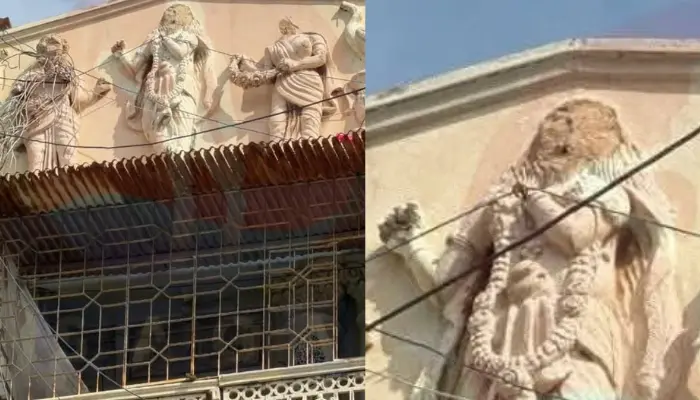
Case Summary
In Mohammad Ali Jinnah Road in Karachi, Pakistan, statues of Lord Krishna and the Gopis at the historic Sagan Mason Building were vandalised by a few unidentified miscreants. The accused beheaded the deities' statues, causing outrage among local Hindus. According to media reports, the Sagan Mason Building was built in 1937 and displayed the richness of Hindu cultural history. After the vandalism of the sacred statues, the Hindus were outraged, but the Pakistani authorities maintained silence and inaction. Shiva Kachhi, a Hindu activist from Pakistan, spoke out against this incident. He made a Twitter post on 1 April 2026 in which he said, "The desecration of the statues of Bhagwan Krishna and the Gopis at the historic Sagan Mason Building in Karachi is deeply and strongly condemnable. This is not just damage to a structure, but an attack on Pakistan’s multicultural heritage, religious harmony, and the sentiments of minority communities." He further stated, “We strongly condemn this shameful act. The historic building located on M.A. Jinnah Road in Karachi was constructed in 1937 and reflects the rich presence of Hindu religious symbols. The beheading of the statues of Bhagwan Krishna and the Gopis is not only an act of religious disrespect but also destruction of our shared heritage.” Shiva Kachhi further tagged various authorities in Pakistan and demanded strict action against the perpetrators. He demanded a transparent investigation into the incident and the immediate arrest of those involved. He also asked for security for the Sagan Mason building and other minority religious and historical sites, and urgent restoration of the damaged statues. This case highlights the persecution faced by the Hindu minorities in Pakistan, marked by systemic discrimination, violence, and forced conversions. Hindu women, particularly young girls, are often abducted, forcibly converted to Islam, and married off to Muslim men with little to no legal recourse. Temples are frequently vandalised or destroyed, and Hindu communities are subjected to social and economic marginalisation. Blasphemy laws are disproportionately used against Hindus, leading to false accusations and severe punishments. Many Hindu families are forced to flee their homes due to religious intolerance, living in constant fear of attacks. This sustained persecution highlights the dire conditions for Hindus in Pakistan, where their religious identity makes them targets of oppression.
Why it is Hate Crime ?
This case is being added to the tracker under the primary category- Attack on Hindu religious representations. The subcategory selected is- Desecration of Hindu religious symbols. Icons and symbols or a religious representation of a spiritual ideal are widely revered in Hinduism. Iconography is of vital significance in the Hindu milieu. It helps connect people’s spiritual beliefs with the real world. Iconography within the Hindu faith takes several shapes and forms. Murtis are of most significance to Hindus, to which daily rituals, prayers and offerings are done. Besides the murtis, there are several other symbols which have deep significance in the Hindu faith – the Om and Swastika for example. Since these Hindu religious symbols hold paramount importance in Hinduism, any desecration of symbols, icons, murtis, religious representations and manifestations, is driven by animosity towards the faith itself which manifests itself through these murtis, icons and symbols. Therefore, any desecration of these Hindu religious symbols and representations is considered religiously motivated hate crimes under this category. This case is a clear instance of an anti-Hindu hate crime, as the perpetrators vandalised and beheaded the sacred statues of Lord Krishna and the Gopis at a historic building in Karachi, Pakistan. Such a deliberate act strikes at the heart of Hindu devotion, where these statues stand as living embodiments of faith for Hindu families who have cherished them for generations. The brutality of beheading them evokes the pain felt by every Hindu who sees their gods humiliated, turning a site of shared heritage into a scene of profound violation. The presence of such statues of Hindu deities on historic buildings holds immense significance for the local Hindu minority community, both culturally and religiously. These figures of Lord Krishna and the Gopis, playfully eternal in their divine love, represented the rich tapestry of pre-partition India, reminding Hindus in Pakistan of their deep roots amidst a sea of change in religious demography. For Hindu families who light diyas and sing bhajans before them, the statues were not mere stone but pulsating symbols of resilience, spiritual solace, and cultural pride, fostering a sense of belonging for a community often pushed to the margins of society. The act of vandalising and beheading the statues of Lord Krishna and the Gopis caused deep hurt to Hindu sentiments worldwide. Hindu statues, just like consecrated idols, hold deep religious significance to Hindus; they are powerful symbols of faith, invoking the divine presence that devotees honour daily. The fact that the perpetrators specifically targeted and vandalised the heads of the statues showcases deep-seated religious animosity towards the Hindu community, making it a clear case of a religiously motivated hate crime. This was no random destruction but a vicious intent to decapitate the very essence of Hindu worship and desecrate sacred Hindu symbols. Such acts are a result of religious bigotry and intolerance towards Hindus, their faith and sacred religious sites and symbols, making it a clear example of an anti-Hindu hate crime. The Pakistani authorities' resounding silence and inaction following the beheading of Hindu statues starkly showcase institutionalised bias against Hindus in Pakistan. While prompt investigations swiftly follow attacks on Islamic sites, incidents like this targeting minority religious symbols provoke no arrests, no official statements, and no security measures, leaving Hindu voices echoing unanswered. This entrenched pattern of neglect not only fuels religious animosity but also systematically erodes the rights of the Hindu community, emboldening perpetrators to strike with impunity. An important point to highlight is that Hindus have endured systematic persecution in Pakistan since the partition of India, with over 400 Hindu temples vandalised or demolished by anti-Hindu extremists, often from the Muslim majority community, as documented by human rights groups like the Human Rights Commission of Pakistan. In this case of sacred statues at the Sagan Mason building, the vandalism echoes similar patterns of attacks on Hindu cultural and religious symbols, revealing entrenched religious animosity. Local Hindus and their symbols, from roadside shrines to ancient murtis, confront relentless threats, including forced conversions of Hindu women and land grabs, positioning this incident within a grim continuum of targeted oppression of Hindus rather than a one-off lapse. In this case, even though the perpetrators' identities remain unknown, the act clearly showcases religious hatred towards Hindus. Therefore, it is being added to the hate crime database of the Hinduphobia Tracker, documenting yet another assault on Hindu rights in Pakistan. Disclaimer: The Hinduphobia Tracker records the dates of incidents based on when the crime occurs, rather than when it is reported by the media. In this case, media reports did not state the exact date when the crime occurred. The incident first came to light through Shiva Kachhi, a Hindu activist from Pakistan, through his Twitter post on 1 April 2026. Therefore, this date, 1 April 2026, is selected as the indicative incident date. This is recorded for documentation purposes only.


Case Status
Unknown


Perpetrators Details
Perpetrators
Unknown
Perpetrators Range
Unknown
Perpetrators Gender
unknown
 Sources




