Hindu idol thrown into well by railway officials during demolition drive in Khandwa, temples demolished without notice
 Khandwa, Madhya Pradesh, India
  31 March, 2026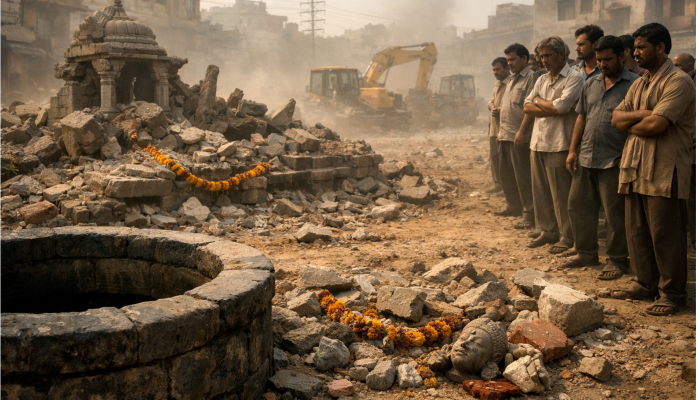
Case Summary
A Hindu idol was thrown into a well by railway officials during a demolition drive in Khandwa, Madhya Pradesh. What followed revealed not just a single act of desecration but a systematic pattern of discriminatory treatment of Hindu religious sites by the railway administration. Railway authorities had been conducting a demolition drive in the Surajkund Ward of Khandwa for over a week in connection with ongoing railway construction work. More than 100 structures had been demolished in the area during this period. It was in the course of this operation that railway officials removed a Hindu idol from a temple in the demolition zone and threw it into a well. A video of the act was captured and circulated rapidly on social media, bringing the desecration to wider attention. The footage showed the idol being picked up and discarded into the well without ceremony or sensitivity. No prior notice had been given to the Hindu community before the temple was demolished and the idol removed. Hindu Jagran Manch leader Madhav Jha confirmed that this was not an isolated act of insensitivity but part of a broader pattern. Hindu temples in the affected area were being demolished without prior notice or permission, while mazars [Islamic shrines] in the same demolition zone were being issued formal notices before any action was taken against them. The railway administration was applying two distinct standards, one for Hindu religious sites and another for Islamic ones, within the same operation and the same area. The idol was not relocated to another temple or handed to the community for safekeeping. It was thrown into a well. Railway officials, when confronted, stated that greater sensitivity would be exercised in future operations.
Why it is Hate Crime ?
The primary category for this case is "Attack on Hindu religious representations". The sub-category here is "Desecration of Hindu religious representations". Icons and symbols or a religious representation of a spiritual ideal are widely revered in Hinduism. Iconography is of vital significance in the Hindu milieu. It helps connect people’s spiritual beliefs with the real world. Iconography within the Hindu faith takes several shapes and forms. Murtis are of most significance to Hindus, to which daily rituals, prayers and offerings are done. Besides the murtis, there are several other symbols which have deep significance in the Hindu faith – the Om and Swastika for example. Since these Hindu religious symbols hold paramount importance in Hinduism, any desecration of symbols, icons, murtis, religious representations and manifestations, is driven by animosity towards the faith itself which manifests itself through these murtis, icons and symbols. Therefore, any desecration of these Hindu religious symbols and representations is considered religiously motivated hate crimes under this category. Another sub-category for this case is "Attack on temples". In Hinduism, a temple is the abode of the Deity. The Deity in the Temple is consecrated, thereby, making it a real, breathing entity. Hindus believe that not just the Deity but the temple premises itself are sacred to Hindus since Hindus hold the faith that the entire Temple space is an amalgamation of the divine energy of the deity. Given the central significance of Temples in Hindu Dharma, any attack against a Hindu Temple or its peripheral premises is an attack on the faith itself and is born out of animosity towards the faith, of which, the Temple is a central tenet. Any manner of attack against a Temple and/or its premises would therefore be considered a religiously motivated hate crime. This case qualifies as a religiously motivated hate crime in which Hindu religious property was deliberately desecrated and destroyed by railway officials in Khandwa, Madhya Pradesh. The act of throwing a consecrated Hindu idol into a well was not an administrative oversight. It was carried out within a broader operational context that treated Hindu religious sites with contempt while affording formal procedural protections to Islamic ones. The desecration of the Hindu idol is the central religious marker of this case. A consecrated idol in a Hindu temple is not a decorative object or a piece of civic infrastructure to be cleared away during a demolition. It is the living embodiment of divine presence for the devotees who worship at that site. The act of removing an idol from its consecrated space and discarding it into a well is among the most severe forms of religious desecration that can be committed against a Hindu community. It does not merely destroy an object. It extinguishes a site of active worship and communicates that the faith of those who worshipped there is of no consequence. The demolition of the temple without prior notice is the second religious marker in this case. Hindu temples, even modest ones in urban encroachment zones, are consecrated spaces that require specific religious protocols before they can be disturbed or dismantled. The removal of a deity from a temple requires ritual preparation, community consultation, and the relocation of the idol to another consecrated site. None of these steps were taken. The temple was demolished as if it were an ordinary structure, and its idol was disposed of as if it were rubble. The differential treatment of Hindu and Islamic religious sites within the same operation is the most significant religious marker of this case. Railway officials demolished Hindu temples without notice while issuing formal advance notices to mazars [Islamic shrines] before taking any action against them. This distinction was applied consistently across the same demolition zone, under the same administration, in the same week. It was not a procedural accident. It was a deliberate policy of unequal treatment that placed Hindu religious sites below Islamic ones in the hierarchy of institutional protection. This differential treatment is direct evidence of religiously motivated discrimination. Given that this case met the parameters of a religiously motivated hate crime, it was added to the hate crime database of the tracker. Disclaimer: The Hinduphobia Tracker records incident dates based on when the crime occurred rather than when it was reported or published. The source confirms the idol desecration took place during an ongoing demolition drive, but provides no specific calendar date for the incident. Therefore, the publication date of 1 April 2026 has been used as the indicative incident date for documentation purposes. This was recorded for documentation purposes only.


Case Status
Unknown


Perpetrators Details
Perpetrators
State and Establishment
Perpetrators Range
Unknown
Perpetrators Gender
unknown
 Sources




