Tribal Hindu families forcibly converted to Christianity through inducements in Katihar, Bihar
 Katihar, Bihar, India
  22 March, 2026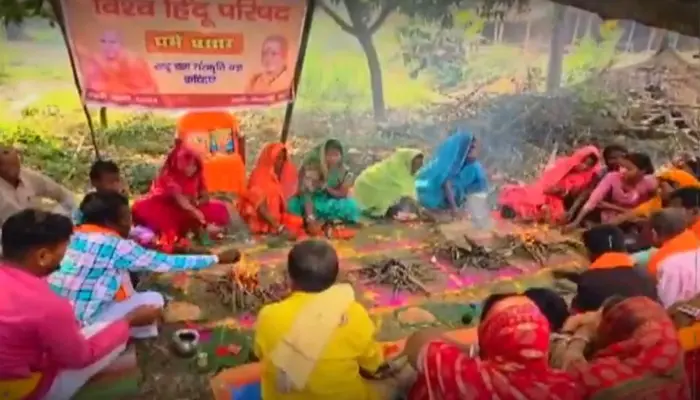
Case Summary
In the Manihari area of Katihar, Bihar, six tribal Hindu families were forcibly converted to Christianity by offering inducements. This conversion was carried out by a Christian conversion racket. According to reports, a total of 29 individuals from six Hindu families, belonging to Scheduled Tribe communities, had been converted to Christianity through inducements such as promises of employment, better medical treatment, and free education for their children. These inducements specifically targeted the conditions of poverty, illiteracy, and social marginalisation within the tribal Hindu families. Over time, when these assurances failed to materialise, and the families experienced a stark contrast between the promises made and their lived reality, disillusionment set in, leading them to reassess their situation. Consequently, they decided to distance themselves from the conversion racket and return to their original religion, Hinduism, through a coordinated ‘ghar wapsi’ process facilitated by local Hindu organisations. The reconversion was carried out through customary rituals, marking their formal return to the Hindu community. The incident triggered widespread discussion across the Seemanchal region, with indications that similar patterns of inducement-based conversions had occurred in the past, particularly in the Manihari Assembly constituency, a seat reserved for Scheduled Tribes. Following this development, there were reports of other families in the area preparing to follow a similar path of reverting to Hinduism, suggesting the broader presence of an organised conversion network operating in the region.
Why it is Hate Crime ?
This case has been added to the tracker under the primary category - Predatory Proselytisation. Within this, the sub-category selected is- Conversion/attempts to convert by inducement. Predatory Proselytisation is not just limited to threat, harassment, force and violence, but it also has contours of stealth. In several cases, the Hindu victim is exploited to convert, with non-Hindus taking advantage of their poverty. In such cases, the Hindu victim who is suffering financially is offered monetary benefits, including lucrative offers for jobs, health treatment, education, etc, to induce the victim into changing his/her religion. In such cases, the religious identity of the victim and the aim to disenfranchise him from his faith form the heart of the crime. Also, taking advantage of and exploiting an individual’s economic vulnerabilities is widely acknowledged as exploitation, forms of which are often penalised by law. Such cases, therefore, are considered religiously motivated hate crimes since the victim’s religious identity forms the very heart of the crime itself. This case has been added to the tracker because tribal Hindu families were forcibly converted to Christianity by offering inducements by a Christian conversion racket. Firstly, the victims were targeted for conversion through inducements such as promises of employment, better medical treatment, and free education for their children. Offering incentives or making false promises, especially when directed at vulnerable individuals in need, shows that these incentives are not acts of kindness or charity. Instead, they are calculated moves to exploit vulnerable Hindus because of their religion. By providing inducements or promising healing in exchange for conversion, the accused were effectively blackmailing those who might have been desperate for assistance or hope. Such instances are seen in many cases where members of Christian missionary groups target socially and economically vulnerable Hindus to further their agenda of religious conversions. This form of coercion strips people of their agency and dignity and results in coerced conversions. These are not random or isolated incidents, but rather cases deeply rooted in religious animosity towards Hindu victims. Secondly, the conversion racket targeted the conditions of poverty, illiteracy, and social marginalisation within the tribal Hindu families in an effort to convert them. There was also a broader pattern across Katihar in the larger Seemanchal region, where inducement-based conversions had occurred in the past, particularly in the Manihari Assembly constituency. Therefore, the nature of the conversion efforts and the wider impact on the Hindu community all demonstrated a targeted action against Hindus as a collectivity. When individuals or groups focus their efforts on converting members of a particular religion, in this case, Hindus, then it demonstrates a fundamental disregard for the Hindu faith. Conversion, especially when not based on personal conviction but rather on external persuasion or pressure, is not simply about sharing a different belief system. It is an attempt to undermine the values, traditions, and identity of the Hindu community. In this context, the Christian perpetrators specifically targeted Hindus, which demonstrates a lack of respect for Hinduism and its followers. Such actions are carried out to strip Hindu victims of their faith, making it a religiously motivated crime. The Christian faith, by its very theological foundations, places a strong emphasis on proselytisation. In pursuit of conversion objectives, Christian evangelists often employ unethical means, ranging from psychological pressure and misinformation to inducements such as money or jobs. These tactics are designed not as acts of charity but as tools to engineer religious change under the guise of social upliftment, particularly among vulnerable and underprivileged Hindu communities. This systematic attempt to erode the religious foundation of individuals and replace it with allegiance to another faith reflects deep religious malice and animus against the Hindu identity. Because the core motivation of the act stems from hostility toward the victim’s religion, it meets the threshold of a hate crime. Hence, it is categorised as a hate crime in the Hinduphobia Tracker. Disclaimer: The Hinduphobia Tracker records incidents based on when an event occurred or when the victim's ordeal began. It is important to clarify that none of the media sources covering this case has specified the exact date when the victims were converted to Christianity. Therefore, for documentation purposes, we have recorded the date based on when the incident was reported in the media, 23 March 2026.
Victim Details
Total Victim
29
Deceased
0
Gender
- Male 0
- Female 0
- Third Gender 0
- Unknown 29
Caste
- SC/ST 29
- OBC 0
- General 0
- Unknown 0
Age Group
- Minor 0
- Adult 0
- Senior Citizen 0
- Unknown 29


Case Status
Unknown


Perpetrators Details
Perpetrators
Christian Extremists
Perpetrators Range
Unknown
Perpetrators Gender
unknown
 Sources




