Hindu deity's idol vandalised in Kota ahead of Hanuman Jayanti festival; devotee brutally assaulted for opposing desecration
 Kota, Rajasthan, India
  27 March, 2026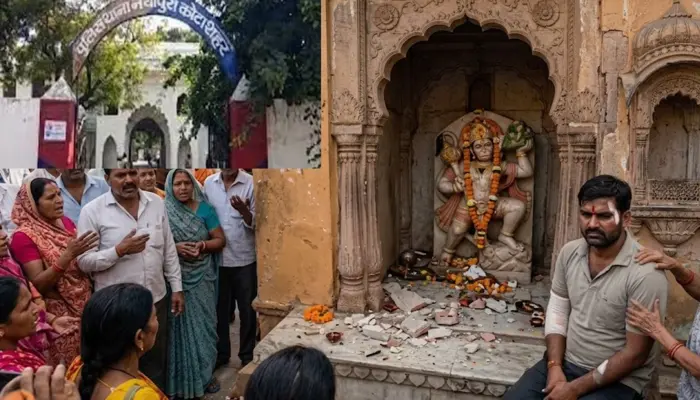
Case Summary
In the Gawadi area of Kota, Rajasthan, a sacred idol of Lord Hanuman installed inside a Hanuman temple was desecrated by a miscreant. The accused also brutally assaulted a Hindu man who tried to intervene and oppose the desecration. This incident occurred just days before the Hanuman Jayanti festival. According to reports, preparations for the Hanuman Jayanti, a revered Hindu festival celebrating the birth of Lord Hanuman, were going on at the Hanuman temple, located at the banks of the Chambal River in the Gawadi area. During this time, a 3-foot-tall idol of Lord Hanuman installed in the temple was deliberately damaged by a man identified as Chotu Singh, a 28-year-old native of Ujjain in Madhya Pradesh. The act took place in the morning hours of 28 March 2026, and when a local Hindu youth named Krishanmurari attempted to intervene and stop the desecration, he was attacked with a wooden stick by the accused, sustaining head injuries that required medical treatment at MBS Hospital. The accused fled the scene immediately after the assault, escalating tensions in the area. A large number of local residents and members of Hindu organisations gathered at the temple site, expressing anger over the desecration and the assault, and demanding swift police action, reconstruction of the damaged temple structure, and installation of a new idol. Police personnel from Nayapura station arrived at the scene, controlled the situation, and initiated an investigation. Using CCTV footage and eyewitness inputs, the police registered a case and detained the accused. Authorities stated that a new idol installation process had been initiated, while the case remained under investigation. SHO Vinod Kumar also claimed that the accused was addicted to Ganja, while some other news reports claimed that the accused was mentally retarded. He further said that a new statue of Hanuman is being installed in the temple.
Why it is Hate Crime ?
This case has been added to the tracker under the primary category- Attack on Hindu religious representations. The subcategory selected is- Desecration of Hindu religious symbols. Icons and symbols or a religious representation of a spiritual ideal are widely revered in Hinduism. Iconography is of vital significance in the Hindu milieu. It helps connect people’s spiritual beliefs with the real world. Iconography within the Hindu faith takes several shapes and forms. Murtis are of most significance to Hindus, to which daily rituals, prayers and offerings are done. Besides the murtis, there are several other symbols which have deep significance in the Hindu faith – the Om and Swastika for example. Since these Hindu religious symbols hold paramount importance in Hinduism, any desecration of symbols, icons, murtis, religious representations and manifestations, is driven by animosity towards the faith itself which manifests itself through these murtis, icons and symbols. Therefore, any desecration of these Hindu religious symbols and representations is considered religiously motivated hate crimes under this category. The other sub-category selected is - Attack on Temples. In Hinduism, a temple is the abode of the Deity. The Deity in the Temple is consecrated, thereby, making it a real, breathing entity. Hindus believe that not just the Deity but the temple premises itself are sacred to Hindus since Hindus hold the faith that the entire Temple space is an amalgamation of the divine energy of the deity. Given the central significance of Temples in Hindu Dharma, any attack against a Hindu Temple or its peripheral premises is an attack on the faith itself and is born out of animosity towards the faith, of which, the Temple is a central tenet. Any manner of attack against a Temple and/or its premises would therefore be considered a religiously motivated hate crime. The second primary category selected here is - Attack not resulting in death. Within it, the sub-category selected is - Attacked for opposing radicals or trying to save victim. . In several cases, Hindus are attacked for opposing religiously motivated crimes being committed against a fellow Hindu or simply for voicing an opinion opposing radical elements, who either have in the past or continue to persecute Hindus. In such cases, the initial attack against the victim, against which the Hindu was trying to defend the victim, would also need to be classified as a religiously motivated hate crime. Since the initial crime itself was religiously motivated and the subsequent crime of attempting to save the victim or speaking against the radical elements ends up inviting a violent attack, it would also be classified as a religiously motivated hate crime under this category. This case is being added to the hate crime database of the Hinduphobia Tracker as the act involved the deliberate desecration of a sacred idol of Lord Hanuman in the Hindu temple, just days before the Hanuman Jayanti. The vandalism of the Hanuman idol, a central object of worship for Hindus, represents not merely damage to property but a targeted assault on a deeply revered religious symbol. In Hindu tradition, idols (murtis) serve as physical embodiments of the divine, consecrated through elaborate rituals like prana pratishtha to house the deity's presence. Hindus hold these murtis in utmost reverence, viewing them as living extensions of gods and goddesses central to worship, festivals, and daily devotion. Therefore, any act of desecration, such as vandalising an idol, strikes at the core of the Hindu faith, symbolising profound disrespect and hostility. This transforms the current incident of idol vandalism into a religiously motivated hate crime, fuelled by animosity against Hindus, as it targets their most sacred symbols rather than mere property. The attack on the Hanuman temple itself showcases deep-seated religious animosity towards the Hindu community. Temples stand as the beating heart of Hindu life, cherished sanctuaries where families gather for prayers, festivals, and life-changing rituals that bind generations in shared reverence for the divine. Temples are institutions where Hindus believe that the deities reside and make their abode. They offer solace, spark joy during celebrations, and anchor daily worship, making every stone and pillar a vessel of profound spiritual energy. Henceforth, this attack and vandalism of the Hanuman temple amount to a clear case of hatred and bigotry towards Hindus, their faith, and their sacred places of worship, making it a clear case of a religiously motivated hate crime. The timing of the incident, occurring just before Hanuman Jayanti, reveals a calculated act of malice rather than random vandalism. This period holds immense religious importance, marked by heightened devotional activities, temple preparations, and community participation. The desecration of the Hanuman idol during this time interfered directly with these preparations, causing distress among devotees and undermining the sanctity of an important religious occasion. Such precise timing showcases deep animosity towards the Hindu community and their faith, elevating this to a clear case of religiously motivated hate crime designed to intimidate the community and disrespect their religious beliefs. Acts carried out in such sensitive periods often have the effect of maximising emotional harm and disrupting religious observances, thereby intensifying their impact. Furthermore, when a local Hindu youth, Krishanmurari, who witnessed the desecration, attempted to intervene in order to protect the sanctity of the temple and its deity, he was violently attacked by the accused using a stick, resulting in injuries. This act of assault against a Hindu individual who was merely trying to safeguard his place of worship reflects an added layer of hostility and intolerance. The willingness to inflict physical harm on a devotee for defending a sacred religious space underscores a deeper pattern of aggression directed not only at Hindu religious symbols but also at those who uphold and protect them. Such violence reinforces the atmosphere of fear and intimidation, further revealing the animosity against Hindus. Another point to highlight is that the police attempted to defend the perpetrator by claiming he acted under the influence of ganja (marijuana). This justification fails utterly to excuse desecrating a Hanuman idol inside a sacred Hindu temple or brutally assaulting devotees who opposed the desecration. Intoxication might impair judgement temporarily, yet it neither erases deliberate choice nor sanctifies targeting a specific faith's holiest symbols and worshippers. Anti-Hindu elements exploit such substances as a convenient shield, knowing full well the targeted violation of temple sanctity and devotee safety constitutes calculated religious aggression, not mere inebriation. Excusing this desecration through narcotics trivialises the profound spiritual wound inflicted on the Hindu community. The act of downplaying the communal nature of hate crimes targeting Hindus is not an isolated incident. The police, in many such cases, where the motive behind the crime is obvious but not explicitly mentioned, deny that the crime committed was in any way motivated by a religious bias or say that there was ‘no communal angle’ to the crime. Several factors are generally at play here. Many a time, the police downplay incidents of low-level communal crime because it is their jurisdiction that comes under question. The police also often say that there was ‘no communal angle’ to a crime when there was one because they wish to ensure that, owing to the crime already committed, there is no further flare-up in the area. However, only a police statement or a media report, for instance, cannot be enough to determine whether there is a communal angle present in the crime that has been committed. In fact, to determine whether the crime is communal in nature or not, we need to give emphasis to the ground realities. For example, in the case of Rinku Sharma, the Bajrang Dal activist who was mercilessly stabbed in his house in front of his family members in Delhi’s Mangolpuri area in the year 2021, the leftist media and the leftist ecosystem had tried to peddle that there was no communal angle to the crime. Even the police denied that the crime was communal in nature. However, a news outlet named OpIndia spoke to several people who are on the ground with the family of Rinku Sharma, and they were told that the communal tension in the area was palpable. The family of Rinku Sharma had said that the Muslims of the area held a grudge against Rinku ever since he celebrated the Ram Mandir verdict Like the case of Rinku Sharma, those cases where even if the police have denied a communal angle or the leftist media have gone on an overdrive to peddle the ‘no communal angle’ trope, the ground reality, like the victim’s family or relative's testimonies, make it clear that there was an obvious religious bias that led to the crime, will be documented in this tracker. Similarly, in this case, the media reports claimed that the accused is mentally ill. In several cases where anti-Hindu elements vandalise and desecrate Hindu places of worship, the media routinely attributes the crime to the perpetrator's mental health, claiming it stemmed from being "mentally ill" or "mentally unstable." The media often denies religious bias in crimes against the Hindu faith by anti-Hindu perpetrators, instead pinning it on mental health issues. This "mental illness" trope shielding anti-Hindu crimes against temples raises serious questions: if the perpetrator truly suffered mental instability, why target Hindu idols and temples exclusively, sparing non-Hindu places of worship? This selective aggression points to religious animosity, not illness. Repeatedly deploying this narrative whitewashes religious hatred, concealing the true anti-Hindu motives of the perpetrator. Therefore, this incident is being classified as a religiously motivated hate crime and is added to the Hate Crime database of the Hinduphobia Tracker.
Victim Details
Total Victim
1
Deceased
0
Gender
- Male 1
- Female 0
- Third Gender 0
- Unknown 0
Caste
- SC/ST 0
- OBC 0
- General 0
- Unknown 1
Age Group
- Minor 0
- Adult 0
- Senior Citizen 0
- Unknown 1


Case Status
Arrested


Perpetrators Details
Perpetrators
Others
Perpetrators Range
One Person
Perpetrators Gender
male
 Sources




