Minor Hindu boy beaten for chanting "Jai Shri Ram"; mother harassed for religious conversion, beef dumped outside their house by Muslims
 West Delhi, Delhi, India
  30 March, 2024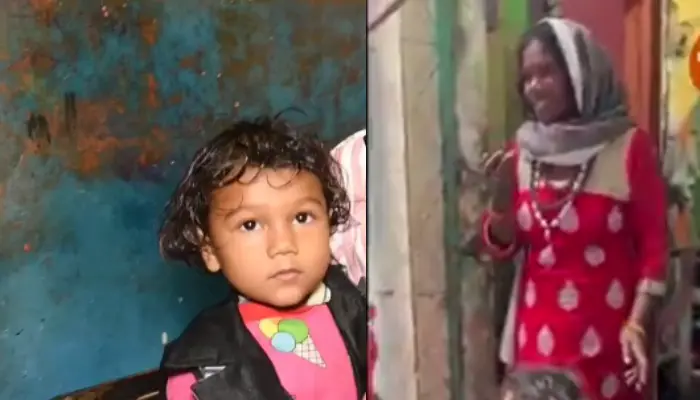
Case Summary
In the Nangloi area of Delhi, a minor Hindu boy aged 4 was beaten for saying "Jai Shri Ram" by his Muslim neighbours. The Muslim neighbours also pressured and harassed the victim's mother, Anju Devi, and minor brother to convert to Islam and raise pro-Pakistan slogans. The perpetrators constantly harassed Anju and her son for their Hindu identity, and also dumped beef outside their house. This incident came to light when media interviews of the victims went viral on X (formerly Twitter). A Hindu page named "Treeni" posted a video of the victim's testimony. In that, the four-year-old Hindu child stated on camera that Muslim neighbours abused him and his mother, and regularly beat them, just for being Hindus living next to their house and for refusing to convert to Islam. They also spat on them, threw cow meat (gaumans), hurled filthy abuses, and threatened to kill the entire family. In the video, Anju Devi also shared her ordeal; she stated that the local Muslims would threaten her and her son for being Hindus. They also pressured them to chant pro-Pakistan slogans like "Pakistan Ki Jai", meaning "Victory to Pakistan". Anju also stated that she would never convert to Islam and said that she would rather choose to die than convert. She also said many times the perpetrators had stripped her and her son and beaten them badly. She also stated that, due to harassment by Muslims, a Brahmin family who previously lived there left the area, and another Hindu man committed suicide. Another video was shared on X by Swati Goel Sharma, a journalist and a Hindu activist, founder of "Rashtra Jyoti", a Hindu organisation. She posted about this incident and stated that the Hindu boy was beaten for chanting "Jai Shri Ram". Swati wrote: "In the heart of Delhi, a Hindu woman named Anju Devi has complained that her Muslim neighbours have been targeting her and her two children out of religious hatred with a motive to make her leave the mohalla. Our ground team in Delhi, led by @RealAzadVinod, met her in Nangloi, discovered that she has sent a dozen complaint letters to the local police station, area police chief, etc." In the video interview of Anju Devi taken by Swati Goel's team, the victim Anju stated that two years back, in 2024, in Janakpur, during a Ram Temple inauguration, her 4-year-old son would chant "Jai Shri Ram". During that time, her Muslim neighbours, Nanhi Begum, and her two sons, Nadeem Khan and Mohsin Khan, attacked the 4-year-old Hindu child, threw him on the ground and asked him to chant "Jai Pakistan". Anju also stated that the Muslims said, "If you want to live here, become Muslim and live or leave this area". In this video, it was also shown that Anju filed several complaints to different state administration officials, but her pleas were unheard. The victim also stated that she filed her complaint in various police stations, and the police often ignored her complaints and did not take any action. Local Nihal Vihar police then randomly downplayed the communal nature of the incident by claiming they “found no proof of forced conversion” and hence did not initiate action against the accused. Rashtra Jyoti, the Hindu organisation, filed a complaint regarding Anju's case to the National Human Rights Commission (NHRC) to seek justice and action against the police for their inaction.
Why it is Hate Crime ?
The first primary category selected is- Attack not resulting in death. The subcategory selected is- Attacked for Hindu identity. In several cases, Hindus are attacked merely for their Hindu identity without any perceived provocation. A classic example of this category of religiously motivated hate crime is a murder in 2016. 7 ISIS terrorists were convicted for shooting a school principal in Kanpur because they got ‘triggered’ seeing the Kalava on his wrist and tilak that he had put. In this, the Hindu victim had offered no provocation except for his Hindu religious identity. The motivation for the murder was purely religious, driven by religious supremacy. Such cases where Hindus are targeted merely for their religious identity would be documented as a hate crime under this category. The other subcategory selected is- Attacked for refusal to convert. When there is pressure, threat or coercion employed upon the Hindu victim to convert to a different religion, in several cases, the victim refuses to succumb to the pressure/threats. Once the victim refuses, the perpetrator proceeds to attack/assault the victim owing to his/her refusal to convert. In such cases, the pressure/threat/intimidation/coercion/violence itself is driven by animosity towards the victim’s Hindu faith. The violence then is another hate crime driven by the victim’s refusal to abandon his professed faith, Hinduism, and convert to the religion of a non-Hindu perpetrator. Since the victim’s faith is at the heart of the pressure to convert and the ensuing violence towards the victim, such cases are considered religiously motivated hate crimes. The second primary category selected is- Predatory Proselytisation. The subcategory selected is- Harassment, threats, coercion for conversion. Harassment covers a wide range of behaviours of an offensive nature. It is commonly understood as behaviour that demeans, humiliates, and intimidates a person, including threats and coercion. Harassment and threats, in this case, find their root on discriminatory grounds which has the effect of nullifying a person’s rights or infringing upon his freedom to exercise his right specifically owing to the victim’s religious identity. Verbal and physical threats and psychological or physical harassment are often used against Hindu victims because they choose to practice their professed religion. Religious harassment also includes forced and involuntary conversions by harassment, threats or coercion. Coercion includes intimidatory tactics like force-feeding a Hindu victim beef to convert to another religion, forceful circumcision etc. In several cases documented, non-Hindu perpetrators or those who harbour specific animosity towards Hinduism, harass victims simply based on their religious identity. Such cases often also include harassment to ensure the Hindu victim abandons his/her professed religion and adopts the religion of the perpetrator. Such cases where Hindu victims are harassed to convert to the perpetrator’s religion are rooted in animosity towards the victim’s religious identity and are therefore documented as religiously motivated hate crimes. The other subcategory selected is- Proselytisation by grooming, brainwashing, manipulation or subtle indoctrination. The tertiary category selected is- Conversion of Minor. Religious brainwashing essentially means the often subtle and forcible indoctrination to induce someone to give up their religious beliefs to accept contrasting regimented ideas. Religious grooming or brainwashing also involves propaganda and manipulation. It involves the systematic effort, driven by religious malice and indoctrination, to persuade “non-believers’ to accept allegiance, command, or doctrine to and of a contrasting faith. Cases of such grooming or brainwashing are far more nuanced than direct threats, coercion, inducement and violence. In such cases, it is often seen that there is repeated, subtle and continual manipulation of the victim to induce disaffection towards their own faith and acceptance of the contrasting faith of the perpetrator. While subtle indoctrination is widely acknowledged as predatory, an element which is often understated in such conversions or the attempts of such conversion is the role of loyalty and trust which might develop between the perpetrator and the victim. Fiduciary relationships are often abused to affect such religious conversion. For example, an educator transmitting religious doctrine of a competing faith to a Hindu student. The Hindu student is likely to accept what the teacher is transmitting owing to existence of the fiduciary relationship. The exploitation of the fiduciary relationship to religiously indoctrinate victims would also be included in this category. Since the underlying animosity towards the victim’s faith forms the basis of predatory proselytization, such cases are considered religiously motivated hate crimes. The third primary category selected is- Hate Speech against Hindus. The subcategory selected is- Anti-Hindu slurs, mocking faith. Anti-Hindu slurs and the deliberate mocking of the Hindu faith owing to religious animosity involve the usage of derogatory terms, stereotypes, or offensive references to religious practices, symbols, or figures. One of the common anti-Hindu slurs used against Hindus is “cow-worshipper” and “cow piss drinker”. The intention of using this term is to demean and mock Hindus as a group and their religious beliefs since Hindus consider the cow holy. Additionally, some symbols and the slurs attached to them have a historical context that exacerbates the insult, hate, stereotyping, dehumanisation and oppression against Hindus. Cow worship has been used for centuries to denigrate Hindus, insult their faith and oppress Hindus specifically as a religious group. There has been overwhelming documentation about how cow slaughter has been used to persecute Hindus with cow meat being thrown in temples and places of worship. There has also been overwhelming documentation where cow meat (beef) has been force-fed to Hindus to either forcefully convert them to Islam or denigrate their faith. Apart from cow worship, the Swastika – which holds deep religious significance for the Hindus – has also been misinterpreted and distorted to use as a slur against Hindus. Similarly, the worship of the Shivling has been used by supremacist ideologies and religions to denigrate Hindus owing to religious animosity. Such slurs and denigration stem out of inherent animosity and hate towards Hindus and their faith, therefore, it is categorised as hate speech targeted at Hindus specifically owing to their religious identity. In this case, a minor Hindu boy was brutally beaten by Muslims for chanting "Jai Shri Ram" slogans, making it a clear instance of a religiously motivated hate crime. This occurred during a local Ram Temple inauguration in Janakpur. The innocent four-year-old boy was simply expressing his faith through the revered "Jai Shri Ram" slogan, a powerful chant honouring Lord Ram that symbolises devotion, victory, and Hindu pride across India. The fact that he was viciously attacked for openly displaying his Hindu faith reveals the deep-seated religious animosity the Muslim perpetrators harboured towards the victim's Hindu identity. Even the victim's mother, Anju Devi, and his minor brother were targeted, harassed, and assaulted several times to convert to Islam. Both victims, Anju Devi and her two sons were singled out purely for their Hindu identity, exposing the religious bigotry of the perpetrators and their utter intolerance for Hindus, their faith, and any open expression of it. This pattern of violence confirms this incident as a religiously motivated hate crime. Anju Devi faced relentless pressure for religious conversion, with constant demands to embrace Islam or abandon the locality entirely. This forced coercion directly violated her religious autonomy, the fundamental right to freely practise and preserve her Hindu faith without external compulsion. Forcing a Hindu woman to convert or leave her home underscores profound religious animosity directed at her and her Hindu identity, stripping her of dignity, security, and spiritual agency in her own neighbourhood. The perpetrators made it abundantly clear that coexistence was impossible unless she renounced her ancestral faith, turning everyday life into a nightmare of coercion and fear. Such actions are a result of the perpetrators' anti-Hindu hostility, making it a hate crime. As Anju Devi was targeted for religious conversion, the same threats and pressure were also extended to her two minor sons by the Muslim perpetrators, as detailed in reports. Since Anju Devi's two sons were minors, the element of consent and genuine change of conscience was absent from the outset. Minors, due to their tender age, lack the capacity to consent to conversion. They do not have the mental capacity to comprehend the profound long-term ramifications of abandoning their ancestral faith or to make such life-altering decisions independently. The perpetrators exploited this vulnerability, attacking the children when they openly expressed their faith and pressuring their mother to convert to Islam, which by default forced these minor children into the same coercive path. This calculated abuse of their age and religious identity cements the case as a religiously motivated hate crime. The Hindu victims faced repeated targeting and brutal assaults specifically for refusing to convert to Islam, with Anju Devi recounting how the Muslim perpetrators stripped her and her young sons naked and beat them savagely on multiple occasions, leaving them physically wounded and emotionally shattered. These vicious reprisals were not random but directly triggered by their steadfast rejection of conversion demands, escalating each time Anju Devi and her children asserted their Hindu faith by refusing to abandon it. This pattern of stripping, a deliberate act of dehumanisation meant to shame, intimidate, and break their spirit, combined with severe beatings, reveals the calculated cruelty rooted in the Muslim perpetrators' inability to tolerate defiance. Such targeted violence for simply upholding one's religious convictions lays bare the profound religious animosity that fuelled every assault, transforming refusal into a punishable offence and exposing the hate-driven intent to eradicate their Hindu identity through terror. Beyond this, the victims endured constant harassment and degradation for their religious identity. For instance, the Muslim perpetrators repeatedly dumped beef inside their house. In Hinduism, the cow holds a sacred status as a symbol of life, motherhood, and non-violence, embodying purity and divine benevolence. Associating with beef, consuming cow meat, or slaughtering cows constitutes an unforgivable sin, viewed as the ultimate impurity that defiles one's soul and faith. By regularly hurling cow meat into their home, the perpetrators aimed to desecrate the victims' faith, inflict maximum spiritual humiliation, and intensify pressure for conversion. Even historically, Islamic extremists have weaponised beef in this manner, force-feeding it to Hindus, dumping it in temples or homes, and using it to sever them from their roots and push conversions. Similarly, in this current case, throwing beef was intended to humiliate Anju Devi and her sons for their faith identity, sever their ties from Hinduism, and forcibly impose Islam upon them. All these acts stem from deep-seated animosity towards Hinduism and the Hindu community, making this a hate-driven offence. The hostility intensified further when the Hindu boy was coerced into chanting "Pakistan Ki Jai" and "Jai Pakistan" slogans. This went beyond mere insult; it represented a direct assault on the religious identity of the Hindu victims. While some may argue that such an act is anti-India and pro-Pakistan, but not necessarily anti-Hindu, compelling Hindus to raise slogans like “Pakistan Zindabad” reveals deep anti-Hindu sentiments. It is vital to recognise that Muslim extremists often harbour a specific animosity towards Hindus and their faith, and frequently view India itself as a Hindu collectivity. The very foundation of the partition of India rested on the belief among Muslims that Islam constituted a distinct nation, incompatible with India, a Hindu collectivity. Many Muslims continue to uphold the concept of transnational unity, the Ummah, which sees all Muslims worldwide as part of a single nation. This ideology often places their loyalty with the broader Muslim community rather than with a Hindu-majority nation-state like India. Thus, the slogan “Pakistan Ki Jai” is not only an expression of support for a Muslim collectivity but also a demonstration of transnational loyalty and anti-Hindu sentiment. Any slogan rooted in such transnational allegiances is, by its nature, an expression against Hindus and the Hindu collectivity. Forcing Hindus to chant it openly exposes the Muslim perpetrators’ animosity towards Hindus. Such acts are clearly aimed at asserting the supremacy of Islam while humiliating the minor Hindu boy and his faith, making it a case of a hate crime. Furthermore, Anju Devi stated that the perpetrators harassed Hindus with such relentless ferocity that a Brahmin family, who had previously lived peacefully in the same area, was ultimately forced to flee the neighbourhood entirely due to the unbearable physical and psychological torment they endured over time. Similarly, another Hindu man residing nearby, pushed beyond all human endurance by this sustained campaign of abuse, intimidation, and degradation targeting his faith, tragically took his own life in despair. These devastating real-world consequences, a Hindu family uprooted from their home and a life lost to hopelessness, vividly illustrate the suffocating religious animosity systematically cultivated by the perpetrators. This hatred created an environment so hostile that it shattered lives, compelled entire families to abandon their roots, and drove vulnerable individuals to the brink of destruction, all solely because of their Hindu identity and refusal to submit. Crucially, this reveals that Anju Devi and her two sons' ordeal was not an isolated incident but part of a broader pattern where Hindus in the locality are systematically targeted by the Muslim perpetrators for their religious identity, confirming it as a clear hate crime. Adding to the pattern of persecution, the local Nihal Vihar police refused to take meaningful action against the perpetrators despite Anju Devi filing multiple complaints across various stations. They systematically ignored her pleas, downplayed the communal and religiously motivated nature of the assaults, and dismissed evidence by claiming no proof of forced conversion existed, thereby shielding the accused from accountability. This blatant inaction constitutes institutionalised discrimination, where law enforcement prioritises appeasement of Muslims over justice, signalling to Hindu victims that their suffering holds no value while emboldening Muslim perpetrators through impunity. Such systemic bias transforms individual hate crimes into community-wide terror, eroding trust in state protection and perpetuating a climate of fear for Hindus in the locality. The act of downplaying the communal nature of hate crimes targeting Hindus is not an isolated incident. The police, in many such cases, where the motive behind the crime is obvious but not explicitly mentioned, deny that the crime committed was in any way motivated by a religious bias or say that there was ‘no communal angle’ to the crime. Several factors are generally at play here. Many a time, the police downplay incidents of low-level communal crime because it is their jurisdiction that comes under question. The police also often say that there was ‘no communal angle’ to a crime when there was one because they wish to ensure that, owing to the crime already committed, there is no further flare-up in the area. However, only a police statement or a media report, for instance, cannot be enough to determine whether there is a communal angle present in the crime that has been committed. In fact, to determine whether the crime is communal in nature or not, we need to give emphasis to the ground realities. For example, in the case of Rinku Sharma, the Bajrang Dal activist who was mercilessly stabbed in his house in front of his family members in Delhi’s Mangolpuri area in the year 2021, the leftist media and the leftist ecosystem had tried to peddle that there was no communal angle to the crime. Even the police denied that the crime was communal in nature. However, a news outlet named OpIndia spoke to several people who are on the ground with the family of Rinku Sharma, and they were told that the communal tension in the area was palpable. The family of Rinku Sharma had said that the Muslims of the area held a grudge against Rinku ever since he celebrated the Ram Mandir verdict Like the case of Rinku Sharma, those cases where even if the police have denied a communal angle or the leftist media have gone on an overdrive to peddle the ‘no communal angle’ trope, the ground reality, like the victim’s family or relative's testimonies, make it clear that there was an obvious religious bias that led to the crime, will be documented in this tracker. Given that the victims in this case clearly stated they were targeted, assaulted, and humiliated specifically for their religious identity, this constitutes a religiously motivated hate crime. Therefore, this case has been added to the hate crime database of the Hinduphobia Tracker. Disclaimer: The Hinduphobia Tracker records incident dates based on when crimes occur. However, in this case, reports have not stated the exact date of the crime. The incident came to light when Swati Goel Sharma and Treeni posted it on social media on 31st March 2026. Available information states the Hindu son was beaten in 2024 for chanting Jai Shri Ram. Therefore, 31st March 2024 is selected as the indicative incident date for documentation purposes. While a Brahmin family was forced to flee and a Hindu man committed suicide due to the Muslim perpetrators, limited specific details exist about their cases. Since this incident centres on Anju Devi and her sons, the victims are recorded solely as Anju Devi and her two minor sons, resulting in a victim count of '3'. In this case, even though multiple Muslim perpetrators were involved, only three have been specifically named: Nanhi Begum, Nadeem Khan, and Mohsin Khan. Therefore, the perpetrator count is recorded as '3'.
Victim Details
Total Victim
3
Deceased
0
Gender
- Male 2
- Female 1
- Third Gender 0
- Unknown 0
Caste
- SC/ST 0
- OBC 0
- General 0
- Unknown 3
Age Group
- Minor 2
- Adult 1
- Senior Citizen 0
- Unknown 0


Case Status
Complaint filed


Perpetrators Details
Perpetrators
Muslim Extremists
Perpetrators Range
From 2 To 5
Perpetrators Gender
both
 Sources




