Hindu couple in Bangladesh assaulted and robbed by armed Muslim mob after Hindu man resists wife's abduction attempt
 Jamalpur District, Bangladesh
  22 March, 2026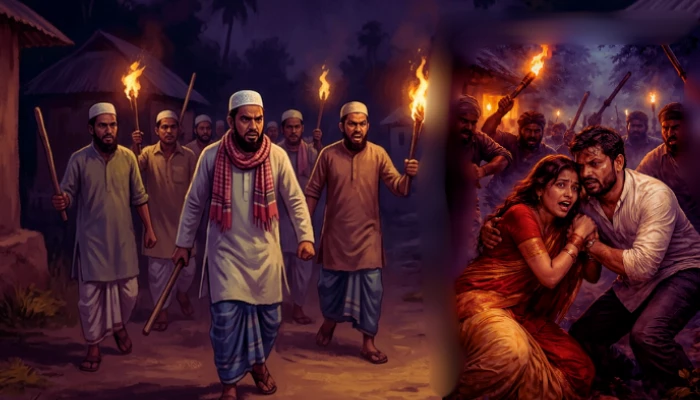
Case Summary
In Jamalpur, Bangladesh, a Hindu couple was assaulted, robbed, and the Hindu woman was attempted to be abducted by an armed Muslim mob. On the night of 23 March 2026, the victims, Ananta Robidas and his wife, Nishi Robidas, were returning home from the Balijhuri Eid Fair in Madarganj Upazila, Jamalpur, Bangladesh. While passing near the Kharika Beel area, they were intercepted by a group of local youths. The Islamic group began verbally harassing the couple. As the confrontation escalated, additional men joined them and surrounded the couple. The assailants, armed with crude local weapons, then attempted to forcibly abduct Nishi Robidas. When Ananta Robidas intervened to resist the abduction attempt, he was severely assaulted by the group. The attack continued until residents, alerted by the disturbance, began gathering at the scene, upon which the assailants fled. Before fleeing, the assailants took the couple’s mobile phones and cash. Following the incident, a formal complaint was lodged at the Madarganj Model Thana. Acting on the complaint, law enforcement personnel carried out a targeted operation and detained three suspects, identified as Zahid, Saiful Islam Sami, and Muhammad Saif from the Muktipara area. Officer-in-Charge Shaker Ahmed stated that the suspects were under interrogation and that efforts were ongoing to identify and apprehend additional individuals involved in the attack. The incident subsequently drew widespread attention on social media and led to calls from local leaders and civil society voices for a transparent and expedited judicial process. Notably, this was not an isolated incident, but must be viewed in continuity with the escalating hostility faced by Hindus in Bangladesh, particularly since the ouster of Sheikh Hasina’s government, which has been followed by repeated and targeted acts of violence against the Hindu minority. The onslaught of violence against Hindus in Bangladesh unfolded in three distinct phases: first, following the ouster of Sheikh Hasina’s government in August 2024; second, after the death of Sharif Osman Bin Hadi in December 2025; and third, in the immediate aftermath of the 13th National Parliamentary Election 2026. The fresh wave of anti-Hindu violence that followed the 13th National Parliamentary Election 2026 in Bangladesh reinforced a recurring pattern of post-poll violence targeting Hindu minorities. Within days of the announcement of results, Hindu families in districts such as Noakhali, Rangpur, Nilphamari, Sylhet, Thakurgaon, and Dinajpur reported coordinated attacks involving arson, looting, assault, and vandalism of temples and homes. In several instances, Hindu homes were selectively targeted, looted, and families were threatened with displacement. This electoral violence unfolded against the broader backdrop of sustained anti-Hindu hostility that had persisted since the ouster of the Sheikh Hasina government in August 2024. During that period, multiple reports documented attacks on Hindu homes, temples, and religious institutions, alongside intimidation campaigns, arson, and mob assaults targeting minority neighbourhoods. The Hinduphobia tracker has recorded 336 such incidents against the Hindu minority, underscoring the scale and persistence of anti-Hindu violence during this period. A further escalation occurred following the death of Sharif Osman Bin Hadi, a Muslim political activist and student leader known for his anti-Hindu and anti-India rhetoric. Hadi had been involved in political unrest after the fall of the Hasina government and was killed in Dhaka on 18 December 2025 during clashes. In the aftermath of his death, Hindu communities were blamed and subsequently targeted in retaliatory violence. Hindu homes were selectively set ablaze in multiple localities, forcing families to flee and leaving many displaced. The attacks appeared patterned rather than sporadic, with Muslim mobs focusing on Hindu neighbourhoods, properties, and religious symbols. Among the victims was Dipu Chandra Das, who was lynched to death and his body was set ablaze by a Muslim mob over false blasphemy allegations. The Hinduphobia tracker documented 51 incidents of anti-Hindu violence in the period following Hadi’s death alone. Such incidents underscore the vulnerability of the Hindu minority amid rising communal hostility and the weaponisation of religious accusations. Reports further indicated that posters and written materials calling for the extermination of Hindus were displayed in public spaces, signalling an alarming normalisation of genocidal rhetoric. When combined with acts of arson, vandalism, assault, and targeted intimidation, these developments suggest a coordinated environment of hostility aimed at terrorising the Hindu community and reinforcing majoritarian dominance.
Why it is Hate Crime ?
This case has been added to the tracker under the primary category of - Attack not resulting in death. Within it, the sub-category selected is- Attacked for Hindu identity. In several cases, Hindus are attacked merely for their Hindu identity without any perceived provocation. A classic example of this category of religiously motivated hate crime is a murder in 2016. 7 ISIS terrorists were convicted for shooting a school principal in Kanpur because they got ‘triggered’ seeing the Kalava on his wrist and the tilak that he had put. In this, the Hindu victim had offered no provocation except for his Hindu religious identity. The motivation for the murder was purely religious, driven by religious supremacy. Such cases where Hindus are targeted merely for their religious identity would be documented as a hate crime under this category. The other subcategory selected is- Attacked for opposing radicals or trying to save a victim. In several cases, Hindus are attacked for opposing religiously motivated crimes being committed against a fellow Hindu or simply for voicing an opinion opposing radical elements, who either have in the past or continue to persecute Hindus. In such cases, the initial attack against the victim, against which the Hindu was trying to defend the victim, would also need to be classified as a religiously motivated hate crime. Since the initial crime itself was religiously motivated and the subsequent crime of attempting to save the victim or speaking against the radical elements ends up inviting a violent attack, it would also be classified as a religiously motivated hate crime under this category. The other sub-category selected here is - Attacked for crossing the 'Muslim area'. One of the reasons that Hindus get attacked unprovoked, specifically by Islamists, is for crossing ‘Muslim areas’. Essentially, Muslim mobs often attack Hindus crossing or present in certain areas that have a majority Muslim population. It has often been cited as one of the reasons to blame Hindus for attacks against themselves, signalling that Hindus displaying religious symbols, taking our religious processions or crossing any area which is dominated by Muslim residents is a provocation in and of itself. These areas are mostly ghettoised areas where mobs mobilise quickly to attack Hindus for a variety of reasons, like playing music during a religious procession, crossing a mosque, wearing a tilak or any other religious symbol in a Muslim-dominated area, praying at a local temple in that area, etc. There have been cases where the few local Hindus of that area have been attacked on their way to the Temple for prayers as well, simply because the area is considered a Muslim-dominated area. Several times, it is entirely possible that the immediate trigger for the violence against Hindus was non-religious in nature; however, the violence became religiously motivated in nature because the area was Muslim-dominated and the residents, on the whole, harboured animosity towards Hindus, evidenced from the actions of the mob, the slogans, and the nature of the attack. Such crimes are motivated by the religious identity of the victims and are therefore classified as hate crimes under this category. This case was added to the tracker because the immediate trigger was the violent assault on a Hindu couple while they were returning home through an area where a Muslim mob quickly gathered and intercepted them. The attack did not arise from any provocation on the part of the victims. They were simply crossing the area on their way back from the fair when they were stopped, surrounded, and attacked. Further, the location and manner of the incident were significant. The couple were passing through a locality where the attackers could mobilise rapidly and act as a group. This reflected a pattern often seen in cases where Hindus become vulnerable merely by being present in or crossing through areas dominated by hostile Muslim groups. The violence was therefore not random street crime but assumed a communal character because of the way the mob formed and acted against identifiable Hindu victims. Moreover, the attempt to forcibly abduct the Hindu woman gave the incident an even more serious dimension. The assault was not limited to verbal intimidation or physical beating. It escalated into an attempt to seize and carry away the woman by force. Such conduct showed targeted aggression and a sense of impunity, particularly because the victims were a Hindu couple travelling alone at night. Additionally, when the husband resisted and tried to protect his wife, he was brutally assaulted. This made it clear that the violence was directed at both victims as a Hindu family unit. The husband was attacked for standing in defence of his wife, while the wife herself was the direct target of the abduction attempt. The nature of the attack reflected deliberate targeting rather than a spontaneous altercation. In this context, the religious identity of the victims remained central. The victims were Hindus belonging to a minority community in Bangladesh, and the incident occurred against the backdrop of sustained and escalating hostility faced by Hindus in the country. Further, during periods of sustained anti-Hindu violence, attacks on Hindu victims cannot be read in a vacuum. Even where the immediate report does not record explicit slogans or verbal references to religion, the surrounding context remains highly relevant. The targeting of a Hindu couple by a Muslim mob in such an environment strongly supported the inference that their identity played a significant role in the violence. Moreover, the theft of their mobile phones and cash before the assailants fled did not reduce the communal nature of the incident. Rather, it showed how violent targeting was accompanied by opportunistic looting, a pattern frequently seen in mob attacks on minority victims. The primary act remained the interception, assault, and attempted abduction. Taken together, accompanied by the backdrop of anti-Hindu persecution in Bangladesh, the incident has been included in the tracker. Disclaimer: The Hinduphobia Tracker records incident dates based on when the victim's ordeal began, rather than when the media reported it. In this case, the report clearly mentions the date 23 March 2026; therefore, it has been recorded as the incident date for documentation purposes.
Victim Details
Total Victim
2
Deceased
0
Gender
- Male 1
- Female 1
- Third Gender 0
- Unknown 0
Caste
- SC/ST 0
- OBC 0
- General 0
- Unknown 2
Age Group
- Minor 0
- Adult 0
- Senior Citizen 0
- Unknown 2


Case Status
Unknown


Perpetrators Details
Perpetrators
Muslim Extremists
Perpetrators Range
From 10 to 100
Perpetrators Gender
unknown
 Sources




