Ram Navami procession attacked, Hindu devotees stone-pelted by Muslims over playing DJ music in Bokaro, Jharkhand
 Bokaro, Jharkhand, India
  27 March, 2026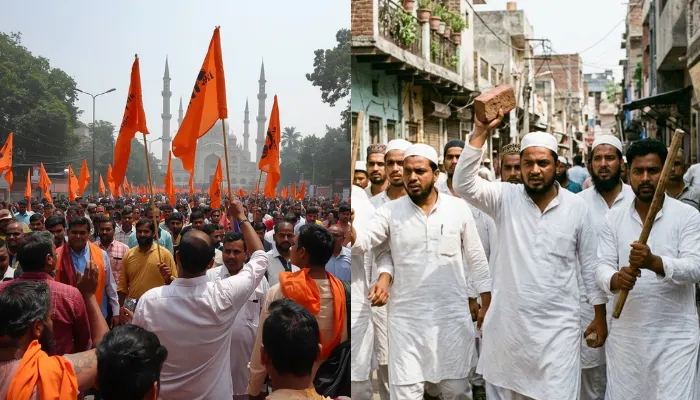
Case Summary
A Ram Navami procession in Pichhri Panchayat of Petarwar police station area in Bokaro, Jharkhand, was attacked by Muslims over playing DJ music. The Hindu devotees were stone-pelted by the perpetrators. According to media reports, a dispute broke out between Muslim youths of Digar Colony of Pichhri South Panchayat and Hindu youths participating in the Ram Navami procession on the main road over dancing to DJ music. As the dispute escalated, the Muslim youths stone-pelted Hindus, which further resulted in youths from both sides clashing with each other. After this, even heavy fighting and stone-pelting took place. In the incident, Khushboo Devi, a Hindu resident of the colony, suffered a head injury, while a young Hindu man was rendered unconscious. A Muslim man from the other side was also injured. All the injured were admitted to the referral hospital in Fusro for treatment. Upon receiving the information, police from the Petarwar police station and Circle Officer Ashok Kumar Ram arrived at the scene. Four or five people from both the Hindu and Muslim sides were injured in the incident. The situation was defused by persuading both parties. At the time of writing this report, the police were investigating the matter.
Why it is Hate Crime ?
The primary category selected in this case is- Attack not resulting in death. The subcategory selected is- Attack on religious procession. The outward celebration and display of religious symbols in an intrinsic part of Hinduism. Religious processions on various festivals are age-old traditions and a way to manifest faith and form a part of the religious practices of Hindus. On several occasions, such religious processions come under attack by non-Hindu mobs, in a manifestation of their animosity towards Hinduism and their practices. The reasons cited for such violent attacks are many and range from crossing a non-Hindu resident-dominated area to playing loud music, crossing from an area where there is a religious structure of another faith etc. The violent attacks are triggered by the outward display of religiosity by Hindus. The attacks are mainly a manifestation of religious supremacist doctrine which believes that idolatry, essentially the Hindu faith, is one that deserves to be annihilated since the very tenets of Hinduism, its practices and traditions are considered a sin in those doctrines. Since these attacks emanate from intrinsic and doctrinal animosity towards Hindus and Hinduism, it is considered a religiously motivated hate crime under this category. The other subcategory selected is- Attack against Hindu devotees. Hindu devotees are a few of the easiest targets of religiously motivated hate crimes because during the festival/procession/puja etc, for non-Hindus it is easy to profile their victims on the basis of religion. Hindu devotees come under attack on several occasions by individual non-Hindus or mobs of non-Hindus owing to their animosity against Hinduism, its symbols and tradition/practices. There are several instances of Hindu devotees being attacked while they worship in temples or temporary religious structures, during religious processions, doing bhajan/kirtan/puja in their own homes, in the residential society etc. These attacks are perpetrated by non-Hindus primarily because of their animosity towards Hindus and their faith. In some cases, the trigger for the violence may be non-religious, however, there are two elements that make these hate crimes. First, the Hindus who come under attack are attacked violently while indulging in religious activity. Whether they are in a place of worship or not is immaterial to the crime. When individuals are attacked while indulging in religious practices, the attack in itself is a hindrance to their freedom to practice religion and therefore constitutes a hate crime. Secondly, religious supremacist doctrines and ideologies deem religious practices of Hindus to be offensive ab initio since they are considered “sinful” by these ideologies, worthy to be annihilated by force or coercion. Driven by these religious supremacist ideologies and doctrines, the attacks against Hindu devotees stem from intrinsic animosity towards Hinduism. In some cases, the trigger for the violence may be non-religious, however, it develops into a religiously motivated crime during the course of the violence. Since these attacks stem from animosity towards Hindus and Hinduism, they are considered religiously motivated hate crimes under this category. The other subcategory selected is- Attacked for Hindu identity. In several cases, Hindus are attacked merely for their Hindu identity without any perceived provocation. A classic example of this category of religiously motivated hate crime is a murder in 2016. 7 ISIS terrorists were convicted for shooting a school principal in Kanpur because they got ‘triggered’ seeing the Kalava on his wrist and tilak that he had put. In this, the Hindu victim had offered no provocation except for his Hindu religious identity. The motivation for the murder was purely religious, driven by religious supremacy. Such cases where Hindus are targeted merely for their religious identity would be documented as a hate crime under this category. The other subcategory selected is- Communal Clash/Attack. Communal clash is a form of collective violence that involves clashes between groups belonging to different religious identities. For a communal clash between Hindus and non-Hindus to qualify as a religiously motivated hate crime, the trigger of the violence itself would have to be anti-Hindu in essence. For example, if there is a Hindu religious procession that comes under attack from a non-Hindu mob and after the initial attack, Hindus retaliate in self-defence, leading to a communal clash between the two religious communities. While at a later stage, both communities are involved in the clash/violence, the initial trigger of the violence was by the non-Hindu mob against the Hindus and therefore, it could safely be termed as an anti-Hindu violence. Further, the trigger would also have to be religiously motivated. In the cited example, the attack by the non-Hindu mob was against religious processions and therefore, can be concluded to be religiously motivated. In some cases, the trigger may be non-religious, however, it develops into religious violence against Hindus at a later stage. In such cases too, the foundational animosity towards Hindus becomes the motivating factor of the crime and therefore, it would be classified as a religiously motivated hate crime against Hindus under this category. This case is a clear instance of a religiously motivated hate crime as the Muslim perpetrators attacked a Ram Navami procession and stone-pelted devotees over playing DJ music in Bokaro, Jharkhand. Despite the later communal clashes between Hindus and Muslims, these actions clearly pointed to a hate-driven offence motivated by anti-Hindu animosity. To understand the severity of the crime, we need to first grasp the significance of Ram Navami. Ram Navami marks the birth of Lord Ram, the seventh avatar of Vishnu, celebrated with immense devotion by Hindus worldwide as a symbol of righteousness, dharma, and moral victory over evil. Devotees observe fasts, recite sacred texts like the Ramcharitmanas and Ramayana, and participate in vibrant shobha yatras (religious processions) carrying idols and flags of Lord Ram, Sita, Lakshmana, and Hanuman, accompanied by bhajans, chants, and DJ music that evoke profound spiritual connection and religious unity. DJ systems amplify devotional songs, bhajans, and patriotic tracks during these processions, energising crowds, fostering communal joy, and symbolising modern expressions of ancient faith in public celebrations. This festival embodies the core values of the Hindu faith, honouring Lord Ram's exemplary life as an ideal king, husband, and warrior who stood for truth and justice. Hence, any attack on a Ram Navami procession desecrates the deeply held religious sentiments of the Hindu community, violating the sanctity of their most cherished traditions. In this case, the brutal assault wounded the hearts of peaceful Hindu devotees honouring Lord Ram's birth through sacred processions, chants, and public worship, while hurling stones over DJ music exposed the Muslim attackers' seething religious hatred and calculated animosity against Hindu identity. These acts represent a brazen affront to Hindu faith, deliberately targeting visible expressions of devotion rather than any legitimate grievance, seeking to terrorise Hindus with a chilling message that open celebrations invite savage hostility. This stone-pelting violence shattered the community's sense of security, instilling profound fear of future brutality, discouraging public processions, and forcing devotees into silent submission under sustained intimidation. This incident unequivocally demonstrates that the attack on Hindus and the Ram Navami procession stemmed directly from its overtly religious nature, with no evidence of personal disputes, property conflicts, or other non-religious triggers. The Muslim perpetrators got triggered specifically by the DJ music amplifying bhajans and chants, a visible and audible expression of Hindu faith during the procession, which they could not tolerate despite Hindus proceeding peacefully. This reaction reveals the assault was not a mere noise dispute but a targeted strike against Hindu identity and public religious expression, as the stone-pelting erupted over devotional sounds symbolising faith rather than volume alone. The perpetrators launched a premeditated assault on peaceful devotees solely for embodying and celebrating their faith in a public space, laying bare their deep-seated, visceral animosity towards the Hindu community and transforming this into a textbook hate crime that hinges on religious prejudice. Overall, this entire incident exemplifies a blatant case of communal hatred directed at the Hindu community and their faith by the Muslim perpetrators. The violence extended further into communal clashes between Hindus and Muslims. Hindus proceeded peacefully with their procession, offering no provocation whatsoever to the Muslims through words, actions, or gestures. Yet, the Ram Navami procession ignited such extreme hostility that the Muslims launched a vicious assault, raining stones on innocent devotees. This disproportionate overreaction to the mere visibility of Hindus publicly celebrating their faith lays bare the profound religious intolerance and bigotry festering within the Muslim perpetrators, who could not tolerate an open expression of Hindu devotion in a shared public space. The ensuing communal clashes stemmed directly from this unprovoked initial attack on Hindus and their procession, with tensions boiling over into further stone-pelting. Such orchestrated violence, triggered solely by the presence of Hindu religious observance, underscores a deliberate animosity towards the Hindu community, firmly establishing this as a hate crime rooted in religious prejudice. Given that this case meets several parameters of a religiously motivated hate crime, it is being added to the hate crime database of the Hinduphobia Tracker. Disclaimer: The Hinduphobia Tracker records the dates of incidents based on when the crime occurred rather than when it is reported by the media. In this case, media reports did not state the exact date when the crime occurred. Hence, the date when the media reported this incident, 28 March 2026, is selected as the indicative incident date. This is recorded for documentation purposes only. In this case, even the total number of Hindu victims has not been specified; it only states that four or five people from both Hindu and Muslim sides were injured. The report specifically mentions only two victims: Khushboo Devi, a Hindu woman, and another Hindu man. Therefore, for documentation purposes, a conservative victim count of two has been selected, referring to Khushboo Devi and the Hindu man alone. While we acknowledge that the total victim count could be higher.
Victim Details
Total Victim
2
Deceased
0
Gender
- Male 1
- Female 1
- Third Gender 0
- Unknown 0
Caste
- SC/ST 0
- OBC 0
- General 0
- Unknown 2
Age Group
- Minor 0
- Adult 0
- Senior Citizen 0
- Unknown 2


Case Status
Unknown


Perpetrators Details
Perpetrators
Muslim Extremists
Perpetrators Range
Unknown
Perpetrators Gender
male
 Sources




