Hindu religious rituals, temples and idols mocked, demeaned and dissed by former Congress Union Minister
 India
India  26 March, 2026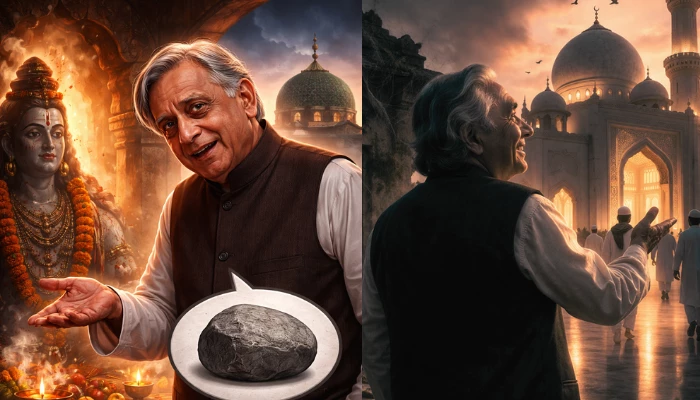
Case Summary
The Hindu religion was demeaned and disregarded by the former Congress leader Mani Shankar Aiyar in a video that surfaced on social media and went viral on Ram Navami. As per the report, in the video, the former Congress leader Mani Shankar Aiyar made remarks about Hindu religious rituals and temple worship. In the video, he stated that he had never liked the Hindu religion and its rituals. He further said that if taken to a mosque, he would go there happily. Aiyar stated with complete candour: “I never liked the Hindu religion and its rituals. So, take me to a mosque, and I will go there happily. My wife believes in these traditions, and I sit with her during puja. At home, there is worship (puja-paath), and I sit there with them. But I only see a stone there. I cannot see God (Khuda) in it.” The video was widely circulated on social media around the period of Ram Navami. The remarks drew public attention because they directly referred to Hindu worship practices, temple rituals, and the significance attached to murti worship within the Hindu faith. Mani Shankar Aiyar was a senior Congress leader and former Union Minister who had served in the Union Government under Prime Minister Manmohan Singh. The report also referred to his earlier public statements and past controversies in the political sphere. The controversy arose from the direct comparison made in the video between Hindu temple worship and visiting a mosque, in which Hindu idol worship was described as seeing only a stone, while willingness and comfort were expressed in relation to a mosque. This was not an isolated instance. He had previously made several controversial public remarks, including comments directed at prominent political leaders and statements made during election campaigns. As per reports, he had called Narendra Modi a “chaiwala” before the 2014 elections and had also earlier used the term “nalayak” for Atal Bihari Vajpayee. Additionally, during his visit to Pakistan in 2015, he attended a dinner with the ISI chief. It had also called for Pakistan’s help in removing Modi from power for talks to resume. During the Gujarat election campaign in December 2017, he described Prime Minister Modi as a “neech kism ka aadmi” (a man of low character). These incidents were presented as part of a recurring pattern of controversial and provocative public remarks. His comments on Hindu temples, idols, and rituals had been known for years and did not stand as a one-off statement. Rather, they formed part of a continuing pattern of remarks touching upon Hindu beliefs and public life.
Why it is Hate Crime ?
This case is being added to the tracker under the primary category: Hate Speech against Hindus. The subcategory selected is: Anti-Hindu slurs, mocking faith. Anti-Hindu slurs and the deliberate mocking of the Hindu faith owing to religious animosity involve the usage of derogatory terms, stereotypes, or offensive references to religious practices, symbols, or figures. One of the common anti-Hindu slurs used against Hindus is “cow-worshipper” and “cow piss drinker”. The intention of using this term is to demean and mock Hindus as a group and their religious beliefs since Hindus consider the cow holy. Additionally, some symbols and the slurs attached to them have a historical context that exacerbates the insult, hate, stereotyping, dehumanisation and oppression against Hindus. Cow worship has been used for centuries to denigrate Hindus, insult their faith and oppress Hindus specifically as a religious group. There has been overwhelming documentation about how cow slaughter has been used to persecute Hindus, with cow meat being thrown in temples and places of worship. There has also been overwhelming documentation where cow meat (beef) has been force-fed to Hindus to either forcefully convert them to Islam or denigrate their faith. Apart from cow worship, the Swastika – which holds deep religious significance for the Hindus – has also been misinterpreted and distorted to use as a slur against Hindus. Similarly, the worship of the Shivling has been used by supremacist ideologies and religions to denigrate Hindus owing to religious animosity. Such slurs and denigration stem from inherent animosity and hate towards Hindus and their faith; therefore, it is categorised as hate speech targeted at Hindus specifically owing to their religious identity. The other sub-category selected is Anti-Hindu subversion and prejudice. Hate speech is defined as any speech, gesture, conduct, writing, or display that is prejudicial against a specific individual and/or group of people, which leads to or may lead to violence, prejudicial action or hate against that individual and/or group. Media plays a specific and overarching role in perpetuating prejudicial attitudes towards a community owing to unfair, untrue coverage and/or misrepresentation/misinterpretation, selective coverage and/or omission of facts of/about issues affecting a specific religious group. This type of bias can dehumanise the victim group, making it easier for others to justify harmful actions against them, which aligns with the objectives of hate speech laws aimed at preventing such harm. It is often observed that the media takes a prejudicial stand against the Hindu community, driven by their need to shield the aggressor community, which happens to be a numeric minority; however, that is the one perpetrating violence against Hindus. For example, the media is often quick to contextualise religiously motivated crimes against Hindus, omit or misrepresent facts that point towards religiously motivated hate crimes, justify and/or downplay religiously motivated hate crimes, or simply present fake news to stereotype Hindus. Such media bias leads to the denial of persecution and is often used to dehumanise Hindus, leading to justification for violence against them. For example, the media covered several fake allegations of Hindus targeting Muslims and forcing them to chant Jai Shree Ram. Most of these cases were proved false and fabricated after police investigation. These fake news reports were subsequently never retracted or clarified. Such fake news led to the justification of violence and dehumanisation of Hindus based on the argument that since Hindus targeted Muslims and forced them to chant Jai Shree Ram, the dehumanisation of Hindus and violence against them was par for the course and merely a retaliation. Such media bias leads to prejudicial portrayals of Hindus and offers a justification for violence against them and, therefore, is considered hate speech under this category. This case was included in the tracker because the trigger lay in Mani Shankar Aiyar’s direct remarks mocking Hindu customary practices and religious rituals. At the outset, the statement made by Mani Shankar Aiyar reduced temple worship and murti reverence to “only a stone”, which had the effect of demeaning a central and deeply sacred aspect of Hindu faith. It also implied that Hindus were superstitious for worshipping idols, thereby portraying their beliefs as irrational. This was not a neutral personal belief expressed in abstract terms. It directly touched upon and mocked a core religious practice followed by millions of Hindus. Additionally, the language used directly mocked a sacred form of worship. Murti worship is not a peripheral custom in Hinduism. It lies at the heart of devotional practice for a large section of Hindus. To reduce it to the level of seeing “only a stone” was to demean not just an object but the faith, reverence, and spiritual meaning attached to it. This transformed the speech from opinion into deliberate ridicule of a religious community’s core beliefs. Further, what made the statement particularly serious was its clear asymmetry. He did not state that he rejected all religion equally or that he did not believe in God anywhere. Instead, he specifically stated that he would happily go to a mosque, while Hindu temples gave him nothing but stones. This distinction was crucial. It showed not general atheism or agnosticism, but a selective rejection directed at Hindu belief and ritual alone. Such selective language naturally conveyed disdain for Hindu worship and carried a clear prejudicial undertone. In this context, the statement also reflected selective secularism. For a senior political figure associated with a party that claimed to represent all communities equally, publicly dismissing Hindu worship as meaningless while simultaneously expressing warmth towards Islamic places of worship created a strong impression of institutional prejudice. The contrast reinforced the sense that Hindu practices alone were being singled out for mockery. Further, the broader pattern of his conduct added another layer of concern. The facts recorded references to his engagement with Pakistan and remarks seen as sympathetic towards external political interests hostile to India. In the Indian context, where Pakistan’s role in terrorism and violence had caused deep national trauma, any senior public figure appearing to align with or seek assistance from Pakistan was widely viewed with grave suspicion. This assumed even greater seriousness when seen alongside repeated disparaging remarks about the Hindu faith, given India’s civilisational and cultural identity as a country with deep Hindu roots. Consequently, the issue was not confined to one offensive statement. The pattern of repeated mockery of Hindu rituals, the selective preference shown towards another religious space, and the broader public conduct together reflected sustained prejudice against Hindu identity and sentiment. Taken together, the direct ridicule of temple worship, the selective nature of the remarks, the repeated pattern over time, and the wider implications of his public conduct clearly justified inclusion in the tracker. The case reflected both deliberate mocking of Hindu faith and a prejudicial attitude that contributed to the normalisation of anti-Hindu discourse in public life. Disclaimer: The Hinduphobia Tracker records incident dates based on when the victim's ordeal began, rather than when the media reported it. In this case, the report does not mention when the video was posted; therefore, the date on which the report was published, 27 March 2026, has been recorded as the indicative incident date for documentation purposes.


Case Status
Unknown


Perpetrators Details
Perpetrators
State and Establishment
Perpetrators Range
One Person
Perpetrators Gender
male
 Sources




