Ram Navami procession attacked near a mosque, devotees stone-pelted by Muslims, leading to communal clashes in Khunti, Jharkhand
 Khunti, Jharkhand, India
  26 March, 2026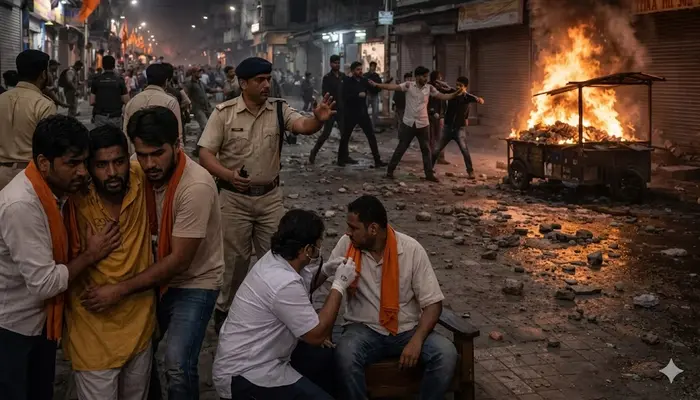
Case Summary
In Murhu, located in the Khunti district of Jharkhand, a Ram Navami procession passing by a mosque was brutally attacked by members of the Muslim community. The attackers stone-pelted the procession on 27 March 2026, injuring Hindu devotees and the police. This further led to communal clashes between Hindus and Muslims on the following day, 28 March 2026. According to media reports, the Ram Navami Committee stated that the procession was being carried out peacefully on the evening of 27 March 2026. The procession was passing by Masjid Wali Gali, a small, narrow lane near a mosque, when the procession was pelted with stones by Muslims. This injured both the Hindu devotees and the police. On the following day, 28 March 2026, the Hindu residents blocked the road and called for a complete shutdown in Murhu to protest the incident. Tensions between the Hindu and Muslim communities persisted for the second day, and stone-pelting incidents broke out again. There were also reports of gunfire, further escalating the situation. Angry Hindu villagers demanded the suspension of the station in charge and the immediate arrest of the shooters. Meanwhile, Vishwa Hindu Parishad President Priyank Bhagat's vehicle was also attacked, damaging it and injuring him. Upon receiving the information, police and administrative teams immediately arrived at the scene and began efforts to control the situation. Sub-divisional Officer Dipesh Kumari was personally present at the scene, monitoring the situation and appealing to the public to maintain peace. To control the situation, the administration imposed prohibitory orders under Section 163 of the Bharatiya Nyaya Sanhita on the Murhu main road. People were being instructed through sound systems not to gather and to vacate the area. A large police force was deployed as a precautionary measure. For riot control, Vajra vehicles, Rapid Action Force quick response teams, water cannons, tear gas shells, and police personnel were also deployed. Security was further tightened by calling in additional forces from nearby police stations. Sub-divisional police officer Varun Rajak, headquarters Deputy Superintendent of Police Akhil Nitish Kujur, Murhu circle officer, police station in-charge, along with in-charges of Torpa, Sayko, Khunti, Maranghada and Tapkara police stations were present on the spot and continuously monitored the situation. The administration assured the villagers that all those involved in the incident would be identified and arrested soon. They also promised to conduct an impartial investigation and take strict action against the culprits. At the time of writing this report, the situation had been brought under control by deploying additional police forces in the area.
Why it is Hate Crime ?
The primary category selected in this case is- Attack not resulting in death. The subcategory selected is- Attack on religious procession. The outward celebration and display of religious symbols in an intrinsic part of Hinduism. Religious processions on various festivals are age-old traditions and a way to manifest faith and form a part of the religious practices of Hindus. On several occasions, such religious processions come under attack by non-Hindu mobs, in a manifestation of their animosity towards Hinduism and their practices. The reasons cited for such violent attacks are many and range from crossing a non-Hindu resident-dominated area to playing loud music, crossing from an area where there is a religious structure of another faith etc. The violent attacks are triggered by the outward display of religiosity by Hindus. The attacks are mainly a manifestation of religious supremacist doctrine which believes that idolatry, essentially the Hindu faith, is one that deserves to be annihilated since the very tenets of Hinduism, its practices and traditions are considered a sin in those doctrines. Since these attacks emanate from intrinsic and doctrinal animosity towards Hindus and Hinduism, it is considered a religiously motivated hate crime under this category. The other subcategory selected is- Attack against Hindu devotees. Hindu devotees are a few of the easiest targets of religiously motivated hate crimes because during the festival/procession/puja etc, for non-Hindus it is easy to profile their victims on the basis of religion. Hindu devotees come under attack on several occasions by individual non-Hindus or mobs of non-Hindus owing to their animosity against Hinduism, its symbols and tradition/practices. There are several instances of Hindu devotees being attacked while they worship in temples or temporary religious structures, during religious processions, doing bhajan/kirtan/puja in their own homes, in the residential society etc. These attacks are perpetrated by non-Hindus primarily because of their animosity towards Hindus and their faith. In some cases, the trigger for the violence may be non-religious, however, there are two elements that make these hate crimes. First, the Hindus who come under attack are attacked violently while indulging in religious activity. Whether they are in a place of worship or not is immaterial to the crime. When individuals are attacked while indulging in religious practices, the attack in itself is a hindrance to their freedom to practice religion and therefore constitutes a hate crime. Secondly, religious supremacist doctrines and ideologies deem religious practices of Hindus to be offensive ab initio since they are considered “sinful” by these ideologies, worthy to be annihilated by force or coercion. Driven by these religious supremacist ideologies and doctrines, the attacks against Hindu devotees stem from intrinsic animosity towards Hinduism. In some cases, the trigger for the violence may be non-religious, however, it develops into a religiously motivated crime during the course of the violence. Since these attacks stem from animosity towards Hindus and Hinduism, they are considered religiously motivated hate crimes under this category. The other subcategory selected is- Attacked for Hindu identity. In several cases, Hindus are attacked merely for their Hindu identity without any perceived provocation. A classic example of this category of religiously motivated hate crime is a murder in 2016. 7 ISIS terrorists were convicted for shooting a school principal in Kanpur because they got ‘triggered’ seeing the Kalava on his wrist and tilak that he had put. In this, the Hindu victim had offered no provocation except for his Hindu religious identity. The motivation for the murder was purely religious, driven by religious supremacy. Such cases where Hindus are targeted merely for their religious identity would be documented as a hate crime under this category. The other subcategory selected is- Attacked for crossing 'Muslim area'. One of the reasons that Hindus get attacked unprovoked specifically by Islamists is for crossing ‘Muslim areas’. Essentially, Muslim mobs often attack Hindus crossing or present in certain areas which have a majority Muslim population. It has often been cited as one of the reasons to blame Hindus for attacks against themselves, signalling that Hindus displaying religious symbols, taking our religious processions or crossing any area which is dominated by Muslim residents is a provocation in and of itself. These areas are mostly ghettoized areas where mobs mobilize quickly to attack Hindus for a variety of reasons like playing music during a religious procession, crossing a mosque, wearing a tilak or any other religious symbol in a Muslim-dominated area, praying at a local temple in that area etc. There have been cases where the few local Hindus of that area have been attacked on their way to the Temple for prayers as well, simply because the area is considered a Muslim-dominated area. Several times, it is entirely possible that the immediate trigger for the violence against Hindus was non-religious in nature, however, the violence became religiously motivated in nature because the area was Muslim dominated and the residents on the whole harboured animosity towards Hindus, evidenced from the actions of the mob, the slogans, and the nature of the attack. Such crimes are motivated by the religious identity of the victims and are therefore classified as hate crimes under this category. The other subcategory selected is- Communal Clash/Attack. Communal clash is a form of collective violence that involves clashes between groups belonging to different religious identities. For a communal clash between Hindus and non-Hindus to qualify as a religiously motivated hate crime, the trigger of the violence itself would have to be anti-Hindu in essence. For example, if there is a Hindu religious procession that comes under attack from a non-Hindu mob and after the initial attack, Hindus retaliate in self-defence, leading to a communal clash between the two religious communities. While at a later stage, both communities are involved in the clash/violence, the initial trigger of the violence was by the non-Hindu mob against the Hindus and therefore, it could safely be termed as an anti-Hindu violence. Further, the trigger would also have to be religiously motivated. In the cited example, the attack by the non-Hindu mob was against religious processions and therefore, can be concluded to be religiously motivated. In some cases, the trigger may be non-religious, however, it develops into religious violence against Hindus at a later stage. In such cases too, the foundational animosity towards Hindus becomes the motivating factor of the crime and therefore, it would be classified as a religiously motivated hate crime against Hindus under this category. This case is a clear instance of a religiously motivated hate crime as the Muslim perpetrators attacked a Ram Navami procession, stone-pelted devotees and the police, as the procession crossed near a mosque. Despite the later communal clashes between Hindus and Muslims, these actions clearly pointed to a hate-driven offence motivated by anti-Hindu animosity. To understand the severity of the crime, we need to first grasp the significance of Ram Navami. Ram Navami marks the birth of Lord Ram, the seventh avatar of Vishnu, celebrated with immense devotion by Hindus worldwide as a symbol of righteousness, dharma, and moral victory over evil. Devotees observe fasts, recite sacred texts like the Ramcharitmanas and Ramayana, and participate in vibrant shobha yatras (religious processions) carrying idols and flags of Lord Ram, Sita, Lakshmana, and Hanuman, accompanied by bhajans and chants that evoke profound spiritual connection and religious unity. This festival embodies the core values of the Hindu faith, honouring Lord Ram's exemplary life as an ideal king, husband, and warrior who stood for truth and justice. Henceforth, any attack on a Ram Navami procession desecrates the deeply held religious sentiments of the Hindu community, violating the sanctity of their most cherished traditions. In this case, the brutal assault desecrated the sanctity of a sacred procession honouring Lord Ram's birth, wounding the hearts of peaceful Hindu devotees chanting bhajans in devotion. These acts represent a brazen affront to Hindu faith and communal harmony, exposing the Muslim attackers' seething religious hatred. By hurling stones at holy processions and participants, the perpetrators sought to terrorise Hindus, sending a chilling message that their open celebration of faith in public spaces invites savage hostility and retribution. Furthermore, attacking Hindu devotees during a Ram Navami procession amounts to a hate crime motivated by religious animosity, as it deliberately targets individuals solely for their visible expression of Hindu faith through sacred idols, chants, and public worship of Lord Ram. The perpetrators unleashed stone-pelting violence on peaceful worshippers simply because they were honouring their deity, revealing a calculated hatred against the Hindu identity and devotional practices rather than any legitimate grievance. This assault creates profound fear and terrorises the Hindu community by shattering their sense of security in openly practising their religion, instilling dread that future celebrations could invite such violent brutality, discouraging public processions, and forcing devotees into silent submission to suppress their faith under the shadow of sustained intimidation. Overall, this incident unequivocally demonstrates that the attack on Hindus and the Ram Navami procession stemmed directly from its overtly religious nature, with no evidence of personal disputes, property conflicts, or other non-religious triggers. The perpetrators launched a premeditated stone-pelting assault on peaceful devotees, targeting them solely for embodying and celebrating their faith in a public space. The assault on Hindus and their processions purely for their Hindu identity, devoid of any provocation or alternative motive, lays bare the perpetrators' deep-seated, visceral animosity towards the Hindu community, transforming this into a textbook hate crime that hinges on religious prejudice. The fact that this attack occurred near a mosque revealed a disturbing sense of Islamic supremacy held by the attackers, who viewed the area near the mosque as an exclusive Muslim zone where non-Muslims, particularly Hindus, were unwelcome. Muslims often consider areas near mosques, dargahs, or where their community is in the majority as "Muslim areas," reflecting this entitlement. The attackers looked down upon Hindus and believed they had the right to control who could move freely in their perceived territory. This Islamic supremacist ideology motivated the assault on Hindu victims, rooted in prejudice and an attempt to assert religious dominance over public spaces. Such exclusionary intolerance exemplifies a dangerous mindset, marking this as a prime case of religiously motivated animosity. Even the Vishwa Hindu Parishad President, Priyank Bhagat, a prominent Bajrang Dal activist, faced a targeted assault when his vehicle was viciously attacked and damaged. This brazen strike occurred amidst the ongoing stone-pelting and clashes, leaving him injured and underscoring the Muslim perpetrators' relentless pursuit of Hindu figures actively defending their community's faith. Such deliberate attacks on Hindu activists like Priyank Bhagat during this period of orchestrated religious violence exemplify the perpetrators' seething hatred towards the Hindu community, amplifying the terror and specifically aiming to neutralise vocal defenders of Hindu rights. By extending their aggression to identifiable leaders involved in safeguarding religious processions, these acts reveal a calculated intent to dismantle Hindu resistance, cementing the incident as a hate crime fuelled by profound religious animosity. Overall, this entire incident exemplifies a blatant case of communal hatred directed at the Hindu community and their faith by the Muslim perpetrators. The violence extended far beyond the initial stone-pelting of the Ram Navami procession, escalating into sustained communal clashes between Hindus and Muslims over two consecutive days. It is crucial to emphasise that the Hindus proceeded peacefully with their procession past the mosque area, offering no provocation whatsoever to the Muslims through words, actions, or gestures. Yet, the simple passage of this sacred Ram Navami procession ignited such extreme hostility that the Muslims launched a vicious assault, raining stones on innocent devotees and even the accompanying police personnel. This disproportionate overreaction to the mere visibility of Hindus publicly celebrating their faith lays bare the profound religious intolerance and bigotry festering within the Muslim perpetrators, who could not tolerate an open expression of Hindu devotion in a shared public space. The ensuing communal clashes stemmed directly from this unprovoked initial attack on Hindus and their procession the previous day, with tensions boiling over into road blockades, further stone-pelting, and even gunfire on 28 March 2026. Such orchestrated violence, triggered solely by the presence of Hindu religious observance, underscores a deliberate animosity towards the Hindu community, firmly establishing this as a hate crime rooted in religious prejudice. Given that this case meets several parameters of a religiously motivated hate crime, it is being added to the hate crime database of the Hinduphobia Tracker. Disclaimer: The Hinduphobia Tracker acknowledges that several Hindu victims were attacked and targeted during this incident. However, the total number of victims has not been specified in the available accounts. Only Bajrang Dal activist Priyank Bhagat has been named, whose vehicle was also damaged in the assault. Henceforth, a conservative victim count of one (1) has been selected for documentation purposes only.
Victim Details
Total Victim
1
Deceased
0
Gender
- Male 1
- Female 0
- Third Gender 0
- Unknown 0
Caste
- SC/ST 0
- OBC 0
- General 0
- Unknown 1
Age Group
- Minor 0
- Adult 1
- Senior Citizen 0
- Unknown 0


Case Status
Unknown


Perpetrators Details
Perpetrators
Muslim Extremists
Perpetrators Range
Unknown
Perpetrators Gender
unknown
 Sources




