Hindu man abused and brutally assaulted by group of Muslim men for being seen with Muslim woman
 Bareilly, Uttar Pradesh, India
  28 March, 2026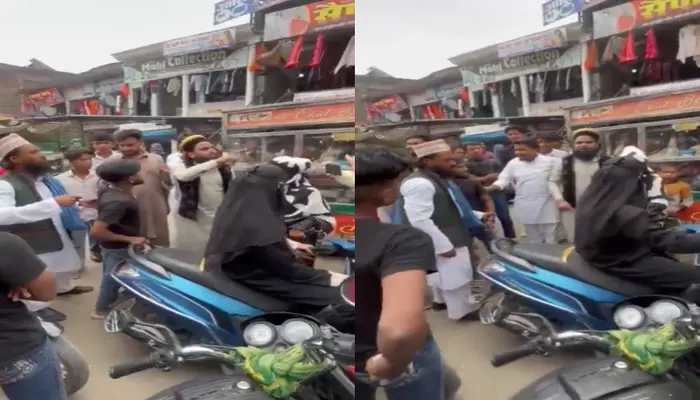
Case Summary
In the Bhojipura area of Bareilly, Uttar Pradesh, a Hindu man named Anil Kumar Diwakar was beaten up by a group of Muslim men for being seen with a Muslim woman. The incident occurred on 27 March 2026, when Anil went to Jadonpur to have his motorcycle repaired. While waiting at the closed railway gate, he encountered a Muslim woman from his village, who was also his sister-in-law, and began speaking to her. During this time, 4-5 Muslim men from Jadonpur arrived at the scene and immediately began kicking and punching Anil without any provocation. When the Muslim woman tried to intervene, the attackers verbally abused her and drove her away. Anil managed to escape and return home but did not initially report the incident to the police due to fear of the perpetrators After Hindutva leader Himanshu Patel shared a video of the attack on social media, the Bhojipura police took action. Subsequently, Anil filed a complaint on 29 March 2026, and the Inspector-in-Charge, Rajiv Kumar Singh, confirmed that a case had been registered against five unidentified individuals, and police initiated a search to apprehend the attackers.
Why it is Hate Crime ?
This case has been added to the tracker under the primary category of: - Men attacked for being associated with non-Hindu women. Within it, the sub-category selected is: - Attacked/killed for being associated or suspicion of being associated with Muslim woman. There have been several cases documented of Hindu men/boys being attacked specifically by Muslim groups/mobs for merely being associated or suspicion of being associated or being seen with a Muslim woman in public. In most of such cases, the Hindu man is not in a relationship with the Muslim woman, however, the mob proceeds to threaten and/or assault the Hindu man for merely being associated with the Muslim woman in any capacity. The rise of such crimes stems from a particularly sinister campaign run by several Muslim ideologues and activists. The campaign claims that Hindu men are attempting to ‘lure’ Muslim women into relationships to ensure that Muslim women leave their faith and follow Hinduism. The propaganda has been spearheaded with the help of WhatsApp groups and the extensive use of social media, sans evidence of the same. In many cases, pamphlets were fabricated to lend credence to this campaign. The root of this campaign lies in the fact that several cases of sectarian crimes against Hindu women in relationships with Muslim men have been documented. In such cases, Hindu women have often been forced/pressured to convert to Islam, assaulted, threatened and even murdered owing specifically to their religious identity and their refusal to give up that religious identity to adopt Islam. To delegitimize the suffering of Hindu women when such sectarian crimes are committed against them, the theory of ‘Bhagwa Love Trap’ was floated by sections of the Muslim community. As this theory gained traction, Muslim mobs started targeting Hindu men who were seen with Muslim women. In several such cases, the Hindu man was assaulted merely for offering to drop a Muslim woman in his vehicle or being friends. The differentiating factor between such cases and legitimate cases of Hindu women being targeted while in a relationship with Muslim men is that there is no sectarian violence, and force/pressure to convert. The nature of sectarian violence against Hindu women is not about two adults in a consensual relationship, working together, studying together, or even marrying each other where religious considerations are declared. In this category of crimes, it is pertinent to remember that in none of the cases, there is an element of the Hindu man masking his identity or forced religious conversion. Such cases are driven by specific religious motivations and against the religious identity of the victim and are therefore qualified as hate crimes. This case constitutes a clear instance of a targeted act of violence wherein a Hindu man, Anil Kumar Diwakar, was physically assaulted for interacting with a Muslim woman. The incident was not triggered by any misconduct, provocation, or unlawful behaviour, but solely by the religious identities of the individuals involved. The violence inflicted on the Hindu victim, for being seen with a Muslim woman, who was in fact his relative, by the Muslim attackers demonstrates a deliberate attempt to police social interaction through force and intimidation. The Muslim attackers objected to the interaction itself, that a Muslim woman was seen in the company of a Hindu man, demonstrating a mindset rooted in enforcing rigid communal boundaries. Their reaction stemmed not from concern for the woman's safety or consent but from ingrained religious bias and a drive to enforce sectarian boundaries through intimidation and violence. The fact that the Hindu victim was assaulted without any inquiry and that even the woman was verbally abused and driven away when she attempted to intervene further underscores the coercive and prejudicial nature of the act. The deliberate attack sends a broader message to the wider Hindu community that they may face similar retaliatory violence if they engage with a Muslim woman, even consensually. This was not an isolated outburst, but a targeted act driven by a deeply ingrained hostility toward the Hindu identity of the man. The actions were deliberate, unprovoked, and carried out with the intent to publicly enforce a discriminatory belief system that denies Hindu men the right to associate with Muslim women freely, even though in this case, the Muslim woman was actually his relative. The justification for such actions stems from the conspiracy theory of ‘Bhagwa Love Trap’, which is explicitly rooted in anti-Hindu sentiment. This false narrative vilifies Hindu men by portraying them as predators targeting Muslim women, despite no basis in reality. It is weaponised to legitimise violence against Hindus, as seen in this case, where a group of Muslim men took it upon themselves to harass the duo for simply being seen together. The delay in reporting the incident due to fear of the perpetrators further highlights the climate of intimidation surrounding such acts, where victims hesitate to seek justice due to threats and lack of immediate recourse. The eventual intervention of the police only after the incident gained public attention through social media also indicates the role of external pressure in prompting action. Considering the unprovoked nature of the assault, the clear intent to target the victim for engaging in with a Muslim woman, and the use of violence to enforce discriminatory social norms, this case reflects a pattern of targeted hostility. Such incidents highlight the systematic and deliberate nature of religious intolerance, deeply rooted in hatred for Hindus and their faith. Considering these factors, the case has been categorised as a religiously motivated hate crime, driven by the perpetrators' hostility toward the Hindu community and its beliefs. Disclaimer: The Hinduphobia Tracker accounts for crimes committed against Hindus by perpetrators, and for this reason, we are just considering the Hindu boy as the victim. Thus, the victim count is recorded as 1, referring to the Hindu boy alone.
Victim Details
Total Victim
1
Deceased
0
Gender
- Male 1
- Female 0
- Third Gender 0
- Unknown 0
Caste
- SC/ST 0
- OBC 0
- General 1
- Unknown 0
Age Group
- Minor 0
- Adult 1
- Senior Citizen 0
- Unknown 0


Case Status
Complaint registered


Perpetrators Details
Perpetrators
Muslim Extremists
Perpetrators Range
From 2 To 5
Perpetrators Gender
male
 Sources




