Ancient Hindu Temple illegally encroached and defiled with Islamic inscriptions in Sindh, Pakistan
 Karachi, Sindh, Pakistan
  27 March, 2026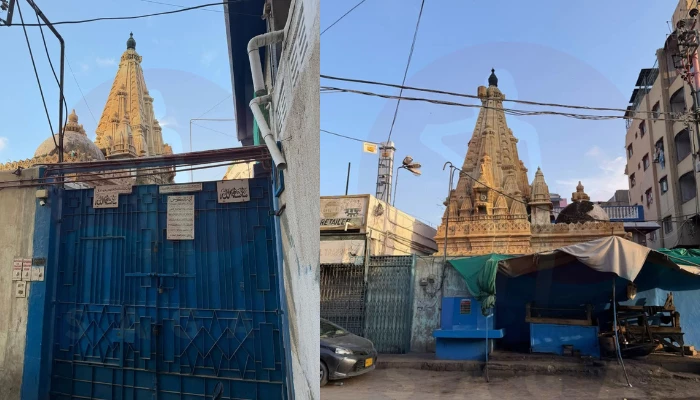
Case Summary
In Pakistan, a historic Hindu temple identified as the Ramchandra Mandir in Karachi, Sindh, was illegally encroached upon near the Preedy Police Station in the Saddar area by Muslims. The matter came to light after residents and heritage observers raised concerns about changes to the structure and its surroundings. The temple was situated on Ratan Talao Street, a narrow lane connecting the area near Preedy Police Station to M. A. Jinnah Road. The street historically contained several pre-Partition buildings and community structures. At the end of this lane stood an old stone dome structure, which locals identified as part of the Ramchandra Temple complex. According to residents and witnesses, new cement walls were erected around the temple, and a large metal gate was installed at the entrance. Witnesses stated that the gate carried Islamic inscriptions, including the words “Masha Allah.” It was further stated that these newly built walls and the gate had concealed the temple from public view. Historical references cited by local observers state that the site belonged to the old locality of Ratan Talao, formerly known as Ram Talao because of a pond that existed there before the Partition of 1947. The temple was described as a pre-Partition Hindu religious structure and had remained locked and inactive for several decades. Shopkeepers in the area stated that a caretaker or watchman used to guard the premises until about 25 to 30 years ago, after which the site was left unattended. Heritage observers also noted that the temple’s stone dome and architectural design resembled the historic Swaminarayan Mandir in Karachi, suggesting that both structures may have belonged to the same architectural period when Karachi had a significant Hindu population before Partition. Following the reported encroachment, local activists and heritage observers called upon the Evacuee Trust Property Board and the Ministry of Religious Affairs and Interfaith Harmony, Pakistan, to verify the ownership records, investigate the property's status, and take steps to protect the historic Hindu religious site.
Why it is Hate Crime ?
This case is being added to the tracker under the primary category- Attack on Hindu religious representations. The selected subcategory is: Encroachment or illicit takeover of temple land or land near the temple. In Hinduism, a temple is the abode of the Deity. The Deity in the Temple is consecrated, thereby making it a real, breathing entity. Hindus believe that not just the Deity but the temple premises itself are sacred, since they hold that the entire Temple space is an amalgamation of the deity's divine energy. Not only the Temple, but the Temple premises in their entirety, are considered sacred by Hindus. In several cases, the premises of the Temple and/or religious centre are illegally taken over by institutions of other faiths, such as the Waqf board or the Church. Other times, the temple property, land or the property of religious centres are illicitly encroached upon by non-Hindu groups. Any illicit takeover or encroachment is a crime an initio; however, when non-Hindu groups illicitly take over or encroach on the sacred land of Hindus, it is an affront to the Hindu community and is therefore classified as a religiously motivated hate crime under this category. The other subcategory selected here is- Desecration of Hindu religious symbol. Icons and symbols or a religious representation of a spiritual ideal are widely revered in Hinduism. Iconography is of vital significance in the Hindu milieu. It helps connect people’s spiritual beliefs with the real world. Iconography within the Hindu faith takes several shapes and forms. Murtis are of most significance to Hindus, to which daily rituals, prayers and offerings are done. Besides the murtis, there are several other symbols which have deep significance in the Hindu faith – the Om and Swastika for example. Since these Hindu religious symbols hold paramount importance in Hinduism, any desecration of symbols, icons, murtis, religious representations and manifestations, is driven by animosity towards the faith itself which manifests itself through these murtis, icons and symbols. Therefore, any desecration of these Hindu religious symbols and representations is considered religiously motivated hate crimes under this category. This case is a clear instance of targeted hostility against a Hindu place of worship, as it involves both the illegal takeover of a historic temple site and the deliberate alteration of its religious character. The Ramchandra Mandir, a pre-Partition Hindu religious structure, was encroached upon through the construction of new cement walls and the installation of a metal gate, effectively enclosing and taking control of the premises. The act of physically enclosing the site and cutting off public visibility indicates a deliberate attempt to appropriate and erase a Hindu religious space that had historical and cultural significance. The nature of the encroachment is particularly significant because it was not carried out on a neutral or disputed piece of land, but on a site that historically belonged to a Hindu temple complex. The transformation of the site’s physical structure, including the concealment of the temple dome and the blocking of access, reflects an effort to sever the site from its original religious identity and community association. Further, the installation of a gate bearing Islamic inscriptions, including “Masha Allah,” on the premises of a Hindu temple constitutes a clear act of desecration. This was not a passive alteration but an active imposition of a different religious identity onto a Hindu sacred space. By placing Islamic markings on a Hindu temple, the sanctity of the site was undermined, and its original religious significance was deliberately disregarded. Such acts go beyond mere encroachment or property disputes. The combination of physical takeover and symbolic alteration demonstrates an intent to overwrite the Hindu character of the site and replace it with markers of another faith. This reflects a deeper pattern of marginalisation where abandoned or vulnerable Hindu religious sites are targeted for appropriation and transformation. Taken together, the illegal occupation of a historic Hindu temple, the concealment of its structure, and the imposition of non-Hindu religious symbols establish that the act was rooted in disregard and hostility towards Hindu religious heritage. It is therefore documented as a religiously motivated hate crime in the Hinduphobia Tracker database. Disclaimer: The Hinduphobia Tracker records incident dates based on when crimes occur, not when they are reported in the media. Since the exact date of the incident was not specified, 28 March 2026, being the date of the first published report, was selected as the indicative incident date for documentation purposes.


Case Status
Unknown


Perpetrators Details
Perpetrators
Muslim Extremists
Perpetrators Range
Unknown
Perpetrators Gender
unknown
 Sources




