Temple construction opposed, idol damaged, Hindus involved in the activity attacked as violence erupts in Haryana village
 Mahendragarh, Haryana, India
  27 March, 2026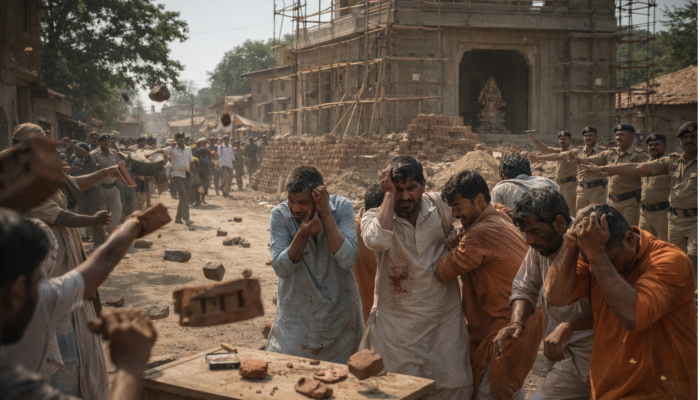
Case Summary
Hindu villagers engaged in temple construction in Jatvas village, Mahendragarh district, Haryana, were attacked by some villagers who opposed the construction. An idol installed in the temple was also damaged during the dispute. A communal clash ensued in which 12 villagers were injured. Police arrived at the scene, brought the situation under control, and deployed additional force from Narnaul Police Lines in the village. According to reports, Hindu villagers in Jatvas village were engaged in constructing a temple when some individuals from the opposing faction began actively opposing the construction. The opposition to the temple construction triggered a verbal altercation between the two sides that rapidly escalated into a violent clash. Both sides began pelting each other with bricks and stones, creating chaos and panic across the area. Approximately twelve individuals from both sides sustained injuries during the clash. The injured were hospitalised for treatment, with some of those more seriously injured referred to higher medical centres. During the violent dispute, the idol installed in the temple was damaged, further inflaming the already tense atmosphere in the village. City police station officers arrived at the scene upon receiving information about the clash and brought the situation under control. Given the tense atmosphere, an additional police force was summoned from Narnaul Police Lines and deployed in the village. Police pacified both sides and initiated a full investigation into the matter. Police force remained deployed in the village as a precautionary measure with the situation being continuously monitored.
Why it is Hate Crime ?
The primary category for this case is "Attack on Hindu religious representations". The sub-category here is "Desecration of Hindu religious symbol". Icons and symbols or a religious representation of a spiritual ideal are widely revered in Hinduism. Iconography is of vital significance in the Hindu milieu. It helps connect people’s spiritual beliefs with the real world. Iconography within the Hindu faith takes several shapes and forms. Murtis are of most significance to Hindus, to which daily rituals, prayers and offerings are done. Besides the murtis, there are several other symbols which have deep significance in the Hindu faith – the Om and Swastika for example. Since these Hindu religious symbols hold paramount importance in Hinduism, any desecration of symbols, icons, murtis, religious representations and manifestations, is driven by animosity towards the faith itself which manifests itself through these murtis, icons and symbols. Therefore, any desecration of these Hindu religious symbols and representations is considered religiously motivated hate crimes under this category. Another sub-category here is "Attack on Temples". In Hinduism, a temple is the abode of the Deity. The Deity in the Temple is consecrated, thereby, making it a real, breathing entity. Hindus believe that not just the Deity but the temple premises itself are sacred to Hindus since Hindus hold the faith that the entire Temple space is an amalgamation of the divine energy of the deity. Given the central significance of Temples in Hindu Dharma, any attack against a Hindu Temple or its peripheral premises is an attack on the faith itself and is born out of animosity towards the faith, of which, the Temple is a central tenet. Any manner of attack against a Temple and/or its premises would therefore be considered a religiously motivated hate crime. Another primary category for this case is "Attack not resulting in death". The sub-category here is "Communal attack/clash". Communal clash is a form of collective violence involving conflicts between groups with different religious identities. For a communal clash between Hindus and non-Hindus to qualify as a religiously motivated hate crime, the trigger of the violence itself would have to be anti-Hindu in essence. For example, if there is a Hindu religious procession that comes under attack from a non-Hindu mob and after the initial attack, Hindus retaliate in self-defence, leading to a communal clash between the two religious communities. While at a later stage, both communities are involved in the clash/violence, the initial trigger of the violence was by the non-Hindu mob against the Hindus, and therefore, it could safely be termed as an anti-Hindu violence. Further, the trigger would also have to be religiously motivated. In the cited example, the attack by the non-Hindu mob was against religious processions and therefore can be concluded to be religiously motivated. In some cases, the trigger may be non-religious; however, it develops into religious violence against Hindus at a later stage. In such cases, too, the foundational animosity towards Hindus becomes the motivating factor of the crime, and therefore, it would be classified as a religiously motivated hate crime against Hindus under this category. This case qualified as a religiously motivated hate crime as Hindu villagers engaged in the sacred act of temple construction were violently attacked through sustained stone pelting by individuals opposing the construction. The violence also damaged the idol installed in the temple under construction. The construction of a Hindu temple is not merely a building project but one of the most sacred and spiritually significant acts of collective Hindu community life, representing the establishment of a permanent centre of divine presence, worship, and community identity within a village. The deliberate and violent opposition to the temple construction by anti-Hindu individuals reflected a conscious and calculated decision to prevent the Hindu community from establishing a sacred place of worship in their own village, attacking the most fundamental expression of Hindu community life and religious identity at its very inception. The violent attack on Hindu villagers engaged in temple construction through sustained stone pelting constituted a direct and targeted act of violence against Hindu individuals engaged in a deeply sacred religious activity. The fact that the violence was triggered specifically by the act of Hindu temple construction confirmed that the attack was directed at the Hindu villagers' religious identity and their right to establish a Hindu place of worship, rather than any personal or individual dispute between the parties involved. The damage to the idol installed within the temple during the violent clash constituted a direct and targeted act of desecration of a sacred Hindu religious symbol. The idol is not merely a decorative object but a consecrated representation of the divine, whose physical integrity holds profound spiritual significance for the Hindu devotees who installed it and were in the process of constructing the temple around it. The damage to the idol during the violent opposition to the temple construction reflected a deliberate assault on the most sacred dimension of the Hindu community's temple construction project, combining physical violence against Hindu individuals with the desecration of their most sacred religious symbol. The violent opposition to the temple construction and the damage to the idol collectively constituted a direct act of violence against the Hindu temple as a sacred structure and centre of community worship. A Hindu temple under construction is as sacred as a completed temple, representing the community's collective commitment to establishing a permanent centre of divine presence in their village. The violent attack on the temple construction project and the damage to its installed idol reflected a conscious and deliberate attempt to prevent the Hindu community from completing the establishment of their sacred place of worship, combining violence against the Hindu community's persons with violence against their sacred religious structure. Here, it is important to note that the attack on the Hindu villagers engaged in the construction of the temple was an unprovoked one. The trigger for the attack was their participation in the activity. It was only after the miscreants launched an attack on the Hindu villagers that members of the Hindu community retaliated. They were not the ones to start the violence. The Hindus acted merely in reprisal, leading to a communal clash. Given that this case met the parameters of a religiously motivated hate crime, it was added to the hate crime database of the tracker. Disclaimer: The Hinduphobia Tracker recorded incident dates based on when the victim's ordeal began, rather than when the media reported it. Since the exact date of the administrative order was not specified in the report, the publication date was taken as the indicative incident date for documentation purposes.
Victim Details
Total Victim
12
Deceased
0
Gender
- Male 0
- Female 0
- Third Gender 0
- Unknown 12
Caste
- SC/ST 0
- OBC 0
- General 0
- Unknown 12
Age Group
- Minor 0
- Adult 0
- Senior Citizen 0
- Unknown 12


Case Status
Complaint not filed


Perpetrators Details
Perpetrators
Unknown
Perpetrators Range
Unknown
Perpetrators Gender
unknown
 Sources




