Hindu devotees in Deoghar barred from DJ music and processions during Ram Navami by district administration
 Deogarh, Jharkhand, India
  25 March, 2026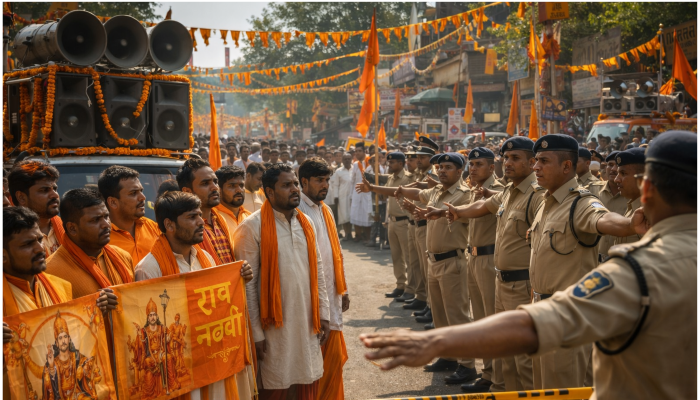
Case Summary
In Deoghar district of Jharkhand, Hindu devotees' freedom to celebrate the Hindu festival of Ram Navami was curtailed by the district administration. Restrictions were imposed and the use of DJ music was banned by the police ahead of the festival, with unauthorised processions also prohibited across the entire district citing court orders as the basis for the restrictions. The Deoghar police administration issued clear instructions on the directions of the Superintendent of Police stating that no DJ music would be permitted during Ram Navami and that no procession could be taken out without prior permission. Public awareness campaigns were conducted through loudspeaker announcements across the Nagar Thana area and the entire district to inform residents of the restrictions. Police stated that the ban was implemented in accordance with court directions and that compliance was mandatory for all residents. Hindu devotees and organisers of Ram Navami celebrations across Deoghar district were directed not to play DJ music during the religious event and not to take out processions without prior administrative permission. The administration imposed a complete prohibition on the use of DJ music as part of the Ram Navami celebrations, extending the ban beyond urban areas to rural areas of the district as well, with special surveillance maintained in rural areas and police forces activated at the police station level with continuous patrolling. Police officers warned that strict action would be taken under various legal sections against anyone found violating the restrictions, with relevant DJ vehicles also liable to seizure. Police also stated that strict surveillance was being maintained against anyone spreading rumours or creating disturbances, and appealed to the general public to follow the rules and cooperate with the administration so that Ram Navami could be celebrated in a peaceful and safe environment.
Why it is Hate Crime ?
The primary category for this case is "Restriction/ban on Hindu practices". The sub-category here is "Administration restricting religious practice". In several cases, it is seen that the administration/state disallows a religious practice owing to prejudicial orders and concerns, targeted specifically against the Hindu community. Such restriction/prohibition would be considered documented as a hate crime because the orders are often a result of pressure by groups that harbour animosity towards Hinduism and Hindus. Often, the restriction by the authorities is driven by bias, hostility, or prejudice against the specific community being stopped from holding a religious practice, by pressure groups that harbour animosity towards Hindus, intrinsic to their faith. Since practices are intrinsic to the faith of the Hindus, such prejudicial restriction is considered a curtailing of the fundamental rights of the Hindu community. In several cases, for example, the authorities ban a Hindu religious practice due to pressure from groups opposed to the religion. In other instances the prohibition is selectively enforced against one religious group (Hindus) while others are allowed to proceed. There are still other cases where the authorities preemptively restrict a religious practice by Hindus because those who hold animosity towards Hindus may get “provoked” leading to them being violent, thereby assuaging the sentiments of those who hold animosity towards Hindus by curtailing the religious rights of Hindus. Such acts and orders are prejudiced, indicating discriminatory motives owing to the capitulation to groups that harbour animosity towards Hindus and therefore, would be categorized as a religiously motivated hate crime since the original pressure leading to the order itself is a result of hatred/bias/prejudice/religious hate against Hindus. Another sub-category for this case is "Restriction on expression of Hindu Identity'". An example of the state-affected prejudicial and targeted orders against the Hindu community would be a government denying the right of a Hindu or a group of Hindus to hold a religious procession owing to the animosity of non-Hindu groups. Denial of the religious right of the Hindus to assuage the non-Hindu group which harbours animosity to a point where it could lead to violence against Hindus is not only a failure of law and order but is a prejudicial order against Hindus, denying them their fundamental rights to express their religious identity. An example of a hate crime against Hindus by a non-Hindu would be a non-Hindu institution forcing its Hindu employees to abandon religious symbols that a Hindu would wear as an expression of faith owing to inherent prejudice against the faith professed by the victim or a non-Hindu group of people restricting a Hindu group from constructing a place of worship simply because the demography of the area in which the temple is being built is dominated by non-Hindus. Such actions are driven by religious animosity and/or prejudice against Hindus and their faith and would therefore be categorized as a hate crime. This case has been added to the tracker because the imposition of a blanket ban on DJ music and unauthorised processions during Ram Navami across the entire Deoghar district amounted to a direct restriction on the manner in which Hindu devotees traditionally practised and expressed their faith during one of Hinduism's most sacred and widely celebrated festivals. The trigger of the restriction lay in the religious nature of the event. The ban was not imposed in a general or neutral setting but specifically in the context of Ram Navami, a sacred Hindu festival during which the use of devotional music, DJ systems, and public processions forms an established and deeply cherished dimension of Hindu religious and cultural expression. The participants directly affected were Hindu devotees who traditionally incorporate music and public processions as central and inseparable elements of their Ram Navami celebrations. The blanket ban on DJ music and unauthorised processions directly interfered with these established modes of Hindu religious celebration, making the Hindu religious identity of the festival central to the restriction imposed. The nature of the administrative action reflected a disproportionate limitation rather than a balanced or measured regulation of the festival. While the authorities cited court orders as the basis for the restrictions, a complete and blanket prohibition on DJ music and processions was imposed across the entire district rather than adopting measured safeguards proportionate to specific areas or identified risks. The extension of the ban from urban areas to rural areas of the entire district, combined with the activation of police forces at the police station level, continuous patrolling, drone surveillance, and the threat of vehicle seizure and strict legal action, indicated a sweeping and pre-emptive administrative control over the Hindu festival celebration that went well beyond what proportionate regulation of public order would require. The justification for the restrictions was rooted in maintaining law and order and preventing untoward incidents during the Ram Navami celebrations. However, this reasoning effectively placed the burden of ensuring communal peace on Hindu devotees themselves, requiring them to dilute and curtail their established religious practices in anticipation of potential disturbances rather than targeting those who might actually cause disruption. Instead of focusing enforcement efforts on those who might seek to disrupt the harmony of the Hindu festival, the administration imposed pre-emptive and sweeping restrictions on the lawful religious expression of Hindu devotees, requiring Hindus to curtail their sacred festival practices due to anticipated reactions from others rather than any inherent illegality in their own conduct. The broader implication of this case reflects a pattern of administrative restrictions specifically targeting Hindu festival celebrations under the justification of maintaining law and order. The blanket nature of the ban, its extension across the entire district including rural areas, the deployment of drone surveillance, and the threat of strict legal action and vehicle seizure collectively created an environment in which Hindu devotees were required to celebrate one of their most sacred festivals in a significantly curtailed and restricted form. The cumulative effect of these restrictions was to limit the Hindu community's right to practise and publicly express their faith in its traditional and established form during Ram Navami, bringing this case within the scope of a targeted administrative restriction on Hindu religious observance and expression. Given that this case met the parameters of a religiously motivated hate crime, it was added to the hate crime database of the tracker.a


Case Status
Unknown


Perpetrators Details
Perpetrators
State and Establishment
Perpetrators Range
N/A
Perpetrators Gender
unknown
 Sources




