Hindu woman lured into relationship, sexually exploited by Muslim man pretending to be Hindu in Dewas, Madhya Pradesh
 Dewas, Madhya Pradesh, India
  24 March, 2024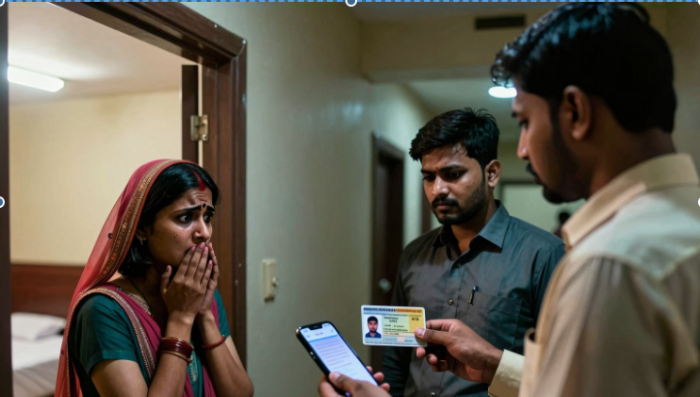
Case Summary
In Dewas, Madhya Pradesh, a Hindu woman originally from Jharkhand, who was employed in data entry work for a government department, was deceived into a two-year relationship by a Muslim youth named Anas Khan. He concealed his Muslim identity and presented himself as Anshul Panchal, a Hindu man, on social media. The accused had also created a fake Aadhaar card bearing the Hindu name and his photograph to use for hotel bookings. He also sexually exploited the victim in hotels across different locations in India over the course of the relationship. The conspiracy came to light when Bajrang Dal workers caught Anas Khan at a hotel in Dewas with the Hindu woman and handed him over to the police. A case was registered against him, and he was arrested. Anas Khan, 26, a resident of the Nai Abadi area of Dewas and an employee of an online delivery company, befriended the Hindu woman from Jharkhand on social media approximately two years earlier, in 2024, presenting himself under the false Hindu name Anshul Panchal. Over the course of the two-year relationship, he met the Hindu woman at hotels across different locations in India and engaged in physical relations with her under his false Hindu identity. To facilitate the hotel bookings, Anas Khan created a fake Aadhaar card by placing his photograph on the Aadhaar card of a person named Anshul, taking a colour printout, and using it to check into hotels. On the night of the incident, Bajrang Dal workers received information that Anas Khan was staying at a hotel on AB Road in Dewas with the Hindu woman. Following this, the workers arrived at the hotel, found Anas Khan in possession of two different Aadhaar cards reflecting his double identity, and handed him over to the Kotwali police. Objectionable photographs of the victim were also found on his mobile phone. Initial investigation confirmed that the fake Aadhaar card had been created by placing his photograph on another person's Aadhaar card and using it for hotel bookings. Bajrang Dal official Ramesh Kaushal raised the possibility that Anas Khan might be connected to a larger gang involved in creating fake Aadhaar cards. Police registered a case against Anas Khan under sections related to concealing identity to engage in physical relations and creating forged documents. His mobile phone was seized for cyber analysis. Superintendent of Police Punit Gehlod confirmed the arrest and stated that all aspects of the case were being investigated.
Why it is Hate Crime ?
The primary category for this case is "Crimes against women in relationships and other sexual crimes". The sub-category here is "Man pretends to be Hindu". The tertiary category for this case is "Name changed". When a non-Hindu man pretends to be a Hindu to deceive a Hindu woman into a relationship, the act is seen as triggered by malafide intentions. In some cases, the woman eventually accepts the man’s original religious identity and converts after the man’s identity is revealed. These cases could be argued as cases of religious brainwashing and a result of the pressure a woman feels after getting into a relationship with a man. The woman, it can be argued, also changed her religious identity because of the stigma she believes she might face if she chooses to walk out of a deceptive relationship. However, for the purpose of documenting hate crimes, the cases in this subcategory are limited to those where there is explicit violence aimed at religious conversion against the wishes of the victim (force-feeding beef, blackmailing with intimate videos, rape on refusal to convert, etc), or if the woman herself complains of the man’s religious deception. In such cases, it is established that the deception of the non-Hindu man had a specific aim of religious conversion or targeting of the victim due to her Hindu religious identity, therefore, making it a religiously motivated hate crime. Another sub-category for this case is "Brainwashed and/or groomed". The tertiary category selected is "Rape and sexual assault/harassment". In our database, we have not added incidents where women have converted to another religion of their free will and no allegations of forced/involuntary conversion have been made. However, there are certain cases of conversion where the consent itself is a result of the brainwashing or grooming of a minor by the non-Hindu perpetrator trying to victimise a woman for her Hindu religious identity. The phenomenon of grooming points to non-Hindu perpetrators identifying their Hindu victims’ vulnerabilities and exploiting them over months and sometimes years, to extract the supposed ‘consent’ in order to convert their religion. In most cases of grooming, the victims are minors or the grooming started when the victim was a minor. In other cases of grooming, the non-Hindu perpetrator brainwashes and grooms a minor victim to extract their trust and then proceeds to rape them repeatedly with the intent of converting them to their faith. It is pertinent to understand here that when the victim is a minor, the ‘consent’ to convert or enter into a romantic relationship with an adult itself is redundant – addressed by POCSO. While every case of conversion of a minor and incidents of establishing a physical relationship with a minor by an adult is a crime, for the purpose of this database, a case would be considered a hate crime only if there is a distinct religious angle to the grooming. For example, in the UK, if a Hindu minor is targeted by Pakistani grooming gangs, it would be considered a hate crime because the victims are specifically targeted owing to their non-Muslim religious identity with the perpetrators being Muslim. In other cases, if a Hindu minor is brainwashed into entering a physical relationship with the non-Hindu adult perpetrator and the family alleges grooming/brainwashing of the minor to convert her religion, it would form a part of this database. If the victim is a Hindu adult, the case would form a part of this database only if the victim herself says that she was brainwashed/groomed to convert her religion. However, if the victim is deceased (murdered or otherwise), the case would form a part of this database if her family/friends provided testimony that the victim was brainwashed/groomed to convert her religion. Since these crimes have a distinct religious angle where the victim is being targeted owing to her Hindu religious identity, these cases are considered a hate crime. In this case, the Hindu woman was deceived into a two-year relationship by a Muslim man pretending to be Hindu. After this, she was sexually exploited across multiple hotel locations. This entire sequence of events showcases the religious motivations behind this crime, making it a premeditated anti-Hindu offence. First, the perpetrator's act of deception by posing as a Hindu demonstrated clear bias and malicious intent towards the victim's religion. By hiding his true identity, Anas Khan manipulated the Hindu woman's trust and targeted her under false pretences, indicating a premeditated effort to exploit her based on her religious background. Additionally, the fake Aadhaar card and hotel bookings legitimised his fabricated identity in her eyes. This constituted a direct violation of her right to informed consent regarding whom she chooses to be in a relationship with, as well as an infringement upon her religious beliefs. Thus, the perpetrator's deliberate decision to hide his religious identity strongly underscored the religious motive behind this crime. In such instances, identity concealment is not just a deceptive tactic for personal reasons but a calculated strategy rooted in religious profiling and targeting. The accused knew that the victim, being Hindu, would likely refuse his advances if she knew his real identity, and he circumvented this by lying, which directly pointed to religiously driven intent. This deception reflects a larger pattern where Hindu women are specifically singled out using false identities by Muslim men. Such targeted victimisation based on religion demonstrates a fundamental disregard for Hinduism and exposes deeper animosity towards Hindu women and their beliefs, making it a religiously driven hate crime. Secondly, through deliberate deception, the Hindu woman was sexually exploited by the Muslim perpetrator under the false pretext of a relationship built on forged identity. This was not a random act of sexual exploitation; it was a targeted sexual assault driven by religious bias, aimed at singling out and violating a Hindu woman because of her religious identity. By concealing his actual religion and presenting himself as a Hindu under a fake name and a forged Aadhaar card, the accused deliberately manipulated the victim’s religious and social expectations to gain her trust and access. Such acts of exploitation, rooted in religious profiling and identity fraud, clearly underline the religiously aggravated nature of this crime and demonstrate that the deception was used as a tool to breach both her bodily and religious boundaries. Thirdly, the sexual exploitation continued for two years under the forged Hindu identity, which underscores the religiously driven zeal of the perpetrator in exploiting the victim based on her faith and identity. This prolonged deception and exploitation reveal that, in the accused's eyes, the victim was reduced to a sexual object whose value lay in her religious identity, which he viewed as a vulnerability to be exploited. The entire pattern of conduct, extended manipulation, forged documents, and identity‑based entrapment, was fuelled by religious hatred and demonstrates that the crime was not merely personal or opportunistic, but fundamentally rooted in anti‑Hindu animus and religiously motivated targeting. Given that this case met the parameters of a religiously motivated hate crime, it was added to the hate crime database of the tracker. Disclaimer: The Hinduphobia Tracker records incident dates based on when a crime occurred, or a victim's ordeal began, rather than when the media reported it. In this case, the sources confirm that Anas Khan first made contact with the Hindu woman from Jharkhand on social media approximately two years prior to the incident, marking the beginning of her ordeal. The article was published on March 25, 2026. Therefore, based on both these pieces of information, March 25, 2024, has been chosen as the indicative incident date as it represents the approximate date on which the Hindu woman's ordeal began. This date was recorded for documentation purposes only.
Victim Details
Total Victim
1
Deceased
0
Gender
- Male 0
- Female 1
- Third Gender 0
- Unknown 0
Caste
- SC/ST 0
- OBC 0
- General 0
- Unknown 1
Age Group
- Minor 0
- Adult 1
- Senior Citizen 0
- Unknown 0


Case Status
Arrested


Perpetrators Details
Perpetrators
Muslim Extremists
Perpetrators Range
One Person
Perpetrators Gender
male
 Sources




