Hindu villagers subjected to conversion pressure and cremation ground encroachment; complaint submitted to District Collector
 Kondagaon, Chhattisgarh, India
  24 March, 2026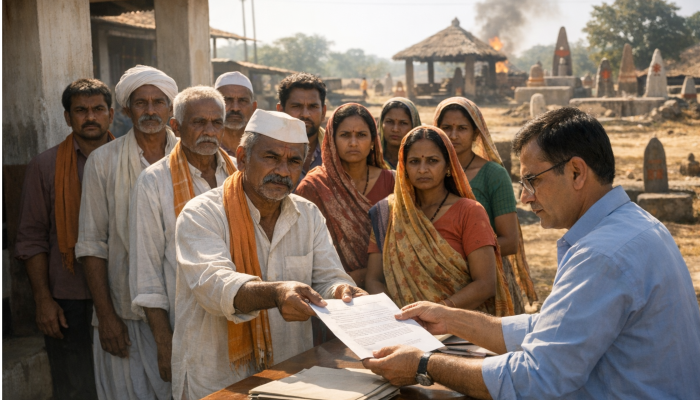
Case Summary
Hindu villagers in Kondagaon district, Chhattisgarh, submitted a written application to the District Collector, demanding an immediate halt to conversion activities being carried out in their village by outsiders. The villagers stated that these religious activities had disrupted the social fabric of the village, created disputes among residents, and generated a tense atmosphere through sustained pressure on some villagers to convert. They also raised concerns regarding encroachment on the village cremation ground, which had further intensified the conflict. The villagers explained in their application that outside individuals had been conducting religious activities in the village for a considerable period, creating divisions within the community and weakening long-standing traditions and unity. Several villagers faced persistent pressure to change their faith, leading to growing unease and conflict in what had once been a peaceful, close-knit community. The encroachment on the cremation ground, a space of deep cultural and spiritual importance, further aggravated the situation and added a tangible dimension to the disruption being experienced in the village. The villagers demanded a fair and impartial investigation by the administration and called for immediate action to restore peace and social harmony. They warned that if the matter was not addressed in time, the situation could escalate further. Administrative officials confirmed receipt of the application and assured the villagers that the matter would be thoroughly investigated, stating that no unlawful activities would be tolerated and that those found responsible would face action in accordance with the law.
Why it is Hate Crime ?
The primary category for this case is "Predatory Proselytisation". The sub-category here is "Harassment, threats, coercion for conversion". Harassment covers a wide range of behaviours of an offensive nature. It is commonly understood as behaviour that demeans, humiliates, and intimidates a person, including threats and coercion. Harassment and threats, in this case, find their root on discriminatory grounds which has the effect of nullifying a person’s rights or infringing upon his freedom to exercise his right specifically owing to the victim’s religious identity. Verbal and physical threats and psychological or physical harassment are often used against Hindu victims because they choose to practice their professed religion. Religious harassment also includes forced and involuntary conversions by harassment, threats or coercion. Coercion includes intimidatory tactics like force-feeding a Hindu victim beef to convert to another religion, forceful circumcision etc. In several cases documented, non-Hindu perpetrators or those who harbour specific animosity towards Hinduism, harass victims simply based on their religious identity. Such cases often also include harassment to ensure the Hindu victim abandons his/her professed religion and adopts the religion of the perpetrator. Such cases where Hindu victims are harassed to convert to the perpetrator’s religion are rooted in animosity towards the victim’s religious identity and are therefore documented as religiously motivated hate crimes. The actions in this case carry clear signs of religious targeting because the pressure was directed specifically at Hindu villagers with the aim of changing their faith and weakening the religious and cultural unity of the community. Sustained conversion efforts in a small rural Hindu village do not affect only individual belief systems but also disrupt shared customs, traditions, and social bonds that are closely tied to Hindu religious life. The pressure to convert is significant because it was not described as an ordinary religious discussion but as a continuous activity that created division, tension, and conflict within the village. Such conduct reflects an attempt to gradually alter the religious composition of the community by targeting vulnerable villagers and separating them from their traditional faith practices. The encroachment on the cremation ground further strengthens the religious dimension of the case. Hindu cremation grounds are spiritually significant spaces connected to funeral rites, ancestral traditions, and the community’s religious continuity. Interference with such spaces is not merely a land issue but an intrusion into an essential aspect of Hindu religious and cultural life. Taken together, the conversion pressure and interference with a Hindu cremation ground point towards a pattern of religiously motivated actions aimed at weakening Hindu identity, disrupting community cohesion, and undermining spaces and traditions that hold deep importance for the Hindu community.


Case Status
Complaint filed


Perpetrators Details
Perpetrators
Unknown
Perpetrators Range
Unknown
Perpetrators Gender
unknown
 Sources




