Centuries old Hindu religious temple procession curtailed by Police; musical instruments barred during Panguni festival in Kanyakumari, Tamil Nadu
 Kanniyakumari, Tamil Nadu, India
  26 March, 2026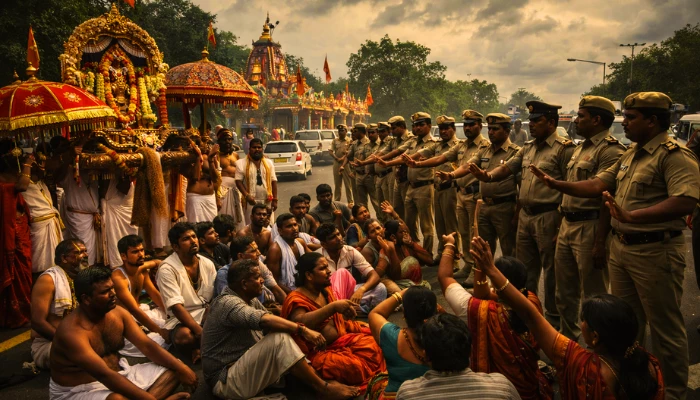
Case Summary
In Kanyakumari district, a Hindu religious temple procession was stopped by the police administration during the Panguni festival. The incident occurred during the Panguni festival at the Bhadreswari Amman Temple. The festival had commenced with the ceremonial flag hoisting and was set to conclude with the traditional Aarattu ritual. On the penultimate evening of the celebrations, temple idols were taken out in a ceremonial procession towards the Thengapattinam coast for the ritual bath. When the procession reached Amsi junction, the police stopped it and instructed the organisers to proceed without drumbeats or musical instruments. Devotees objected to the restriction, which led to a heated exchange with the police. The protest escalated when MR Gandhi joined the gathering and led a road blockade, with the idols placed on the road. The blockade caused significant traffic disruption along the Thengapattinam–Kuzhithurai highway, affecting vehicular movement for a considerable period. Senior officials subsequently held discussions with the protesters. Following these talks, the police allowed the procession to continue without restrictions. The idols were later taken to the sea for the Aarattu ritual and brought back to the temple in a concluding procession, marking the end of the festival.
Why it is Hate Crime ?
The primary category selected is- Restriction/ban on Hindu practices. The subcategory selected is- Administration disallows religious procession. The tertiary category selected is- Religious procession. In several cases, it is seen that the administration/state disallows a religious procession owing to prejudicial orders and concerns, targeted specifically against the Hindu community. Such restriction/prohibition would be considered documented as a hate crime because the orders are often a result of pressure by groups that harbour animosity towards Hinduism and Hindus. Often, the restriction by the authorities is driven by bias, hostility, or prejudice against the specific community being stopped from holding a religious procession, by pressure groups that harbour animosity towards Hindus, intrinsic to their faith. Since the religious procession is inherent to the faith of the Hindus, such prejudicial restriction is considered a curtailing of the fundamental rights of the Hindu community. In several cases, for example, the authorities ban a Hindu religious procession due to pressure from groups opposed to the religion. In other instances, the prohibition is selectively enforced against one religious group (Hindus) while others are allowed to proceed. There are still other cases where the authorities preemptively restrict a religious process by Hindus because those who hold animosity towards Hindus may get “provoked”, leading to them being violent, thereby assuaging the sentiments of those who hold animosity towards Hindus by curtailing the religious rights of Hindus. Such acts and orders are prejudiced, indicating discriminatory motives owing to the capitulation to groups that harbour animosity towards Hindus and therefore, would be categorised as a religiously motivated hate crime since the original pressure leading to the order itself is a result of hatred/bias/prejudice/religious hate against Hindus. The other subcategory selected is- Administration restricting religious practice. In several cases, it is seen that the administration/state disallows a religious practice owing to prejudicial orders and concerns, targeted specifically against the Hindu community. Such restriction/prohibition would be considered documented as a hate crime because the orders are often a result of pressure by groups that harbour animosity towards Hinduism and Hindus. Often, the restriction by the authorities is driven by bias, hostility, or prejudice against the specific community being stopped from holding a religious practice, by pressure groups that harbour animosity towards Hindus, intrinsic to their faith. Since practices are intrinsic to the faith of the Hindus, such prejudicial restriction is considered a curtailing of the fundamental rights of the Hindu community. In several cases, for example, the authorities ban a Hindu religious practice due to pressure from groups opposed to the religion. In other instances, the prohibition is selectively enforced against one religious group (Hindus) while others are allowed to proceed. There are still other cases where the authorities preemptively restrict a religious practice by Hindus because those who hold animosity towards Hindus may get “provoked”, leading to them being violent, thereby assuaging the sentiments of those who hold animosity towards Hindus by curtailing the religious rights of Hindus. Such acts and orders are prejudiced, indicating discriminatory motives owing to the capitulation to groups that harbour animosity towards Hindus and therefore, would be categorised as a religiously motivated hate crime since the original pressure leading to the order itself is a result of hatred/bias/prejudice/religious hate against Hindus. The other subcategory selected is- Restriction on expression of Hindu identity. An example of the state-affected prejudicial and targeted orders against the Hindu community would be a government denying the right of a Hindu or a group of Hindus to hold a religious procession owing to the animosity of non-Hindu groups. Denial of the religious right of the Hindus to assuage the non-Hindu group, which harbours animosity to a point where it could lead to violence against Hindus, is not only a failure of law and order but is a prejudicial order against Hindus, denying them their fundamental rights to express their religious identity. An example of a hate crime against Hindus by a non-Hindu would be a non-Hindu institution forcing its Hindu employees to abandon religious symbols that a Hindu would wear as an expression of faith owing to inherent prejudice against the faith professed by the victim or a non-Hindu group of people restricting a Hindu group from constructing a place of worship simply because the demography of the area in which the temple is being built is dominated by non-Hindus. Such actions are driven by religious animosity and/or prejudice against Hindus and their faith and would therefore be categorised as a hate crime. This case was included in the Hinduphobia Tracker because a Hindu religious procession was stopped midway by the police, directly interfering with an ongoing sacred ritual. The trigger lay in halting the Panguni festival procession and imposing restrictions on its manner of conduct. This affected Hindus by interrupting a live act of worship, causing distress and anger among devotees who had gathered to carry out a deeply rooted religious tradition. The Panguni, a ten day long festival, held significant importance in Hindu tradition, especially in temples dedicated to Amman deities. It marked a period of devotion, community participation, and ritual continuity. The Aarattu ritual, where idols were ceremonially taken for a sacred bath, formed a central part of the celebrations. This procession was not symbolic alone; it was a live religious act, carried forward over generations, where music, movement, and collective participation were integral. However, when the procession was stopped at Amsi junction, and devotees were instructed to proceed without drumbeats or musical instruments, it altered the very nature of the ritual. Temple processions in Hinduism were not silent movements; they were vibrant expressions of faith, where sound, rhythm, and devotion went together. Restricting these elements reduced the ritual to a constrained form, thereby interfering with how the faith had traditionally been practised. Moreover, stopping the procession midway disrupted its sanctity. Such sacred processions were meant to follow a continuous, pre-determined route, culminating in the ritual at the water body. Interrupting this flow broke the spiritual continuity of the event. It signalled that even established religious customs could be halted without regard for their significance, creating a sense of uncertainty among devotees. Further, the fact that devotees had to resort to a road blockade to assert their right to continue the procession showed the extent of the grievance. The presence of idols on the road during the protest reflected how deeply the interruption had affected the community. It was not merely a disagreement with the authorities; it was a reaction to the disruption of a sacred act. Although the restriction was later withdrawn, the initial act of stopping and altering the procession had already impacted the devotees. It demonstrated how administrative action could directly interfere with religious expression. Taken together, the interruption of a long-standing ritual, the imposition of conditions on its conduct, and the resulting distress among devotees showed a clear curtailment of the Hindu community’s ability to practise their faith freely. Disclaimer: The Hinduphobia Tracker records incident dates based on when the victim's ordeal began, rather than when the media reported it. In this case, the report does not mention the exact date when the procession was stopped, therefore, the date on which the report was published, has been recorded as the indicative incident date for documentation purposes.


Case Status
Unknown


Perpetrators Details
Perpetrators
State and Establishment
Perpetrators Range
Unknown
Perpetrators Gender
unknown
 Sources




