Ancient Hindu temple site illegally encroached by miscreants in Unnao, Uttar Pradesh
 Unnao, Uttar Pradesh, India
  23 March, 2026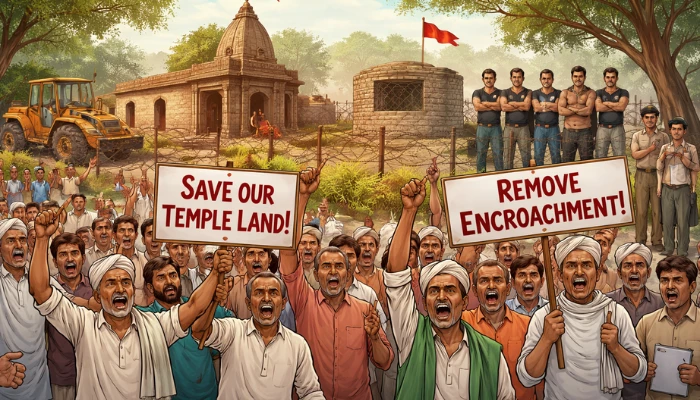
Case Summary
In Unnao district, Uttar Pradesh, under Bangarmau police station limits, an ancient Hindu temple land was illegally encroached upon by unknown assailants. As per reports, a dispute arose in Kachhiyanpurwa village over encroachment on land belonging to an ancient temple and a well. On Thursday, 24 March 2026, villagers staged a protest regarding the occupation of this land and demanded action against those responsible, along with protection of the religious land. The villagers stated that some dominant individuals from the village were attempting to occupy the temple land. They said that complaints had been made multiple times to the administration and police, but no concrete action had been taken. Residents, including Medhai, Rajaram, Amarsingh, Indal, Mangli, Ramnath, Tulsi, Ramdeen, Mangatram, Maiku, Chhatrapal, Anees, Dinesh, Suresh, Avdhesh, Rajbahadur, Vijaypal, Roopan and Swadesh, along with hundreds of other villagers, reached the tehsil and submitted a memorandum to SDM Brijendra Mohan Shukla. They demanded that the sacred land be freed from encroachment. The villagers further stated that three revered sites in the village, the temple, the well, and the Holika land, had been encroached upon by the accused individuals. When the villagers collectively asked them to vacate the land, the accused began threatening them. The villagers also approached the Chief Minister’s portal, the District Magistrate, and the SDM, seeking removal of the encroachment. Taking cognisance of the seriousness of the matter, SDM Brijendra Mohan Shukla ordered an immediate inquiry into the matter.
Why it is Hate Crime ?
This case is being added to the tracker under the primary category- Attack on Hindu religious representations. The selected subcategory is: Encroachment or illicit takeover of temple land or land near the temple. In Hinduism, a temple is the abode of the Deity. The Deity in the Temple is consecrated, thereby making it a real, breathing entity. Hindus believe that not just the Deity but the temple premises itself are sacred, since they hold that the entire Temple space is an amalgamation of the deity's divine energy. Not only the Temple, but the Temple premises in their entirety, are considered sacred by Hindus. In several cases, the premises of the Temple and/or religious centre are illegally taken over by institutions of other faiths, such as the Waqf board or the Church. Other times, the temple property, land or the property of religious centres are illicitly encroached upon by non-Hindu groups. Any illicit takeover or encroachment is a crime an initio; however, when non-Hindu groups illicitly take over or encroach on the sacred land of Hindus, it is an affront to the Hindu community and is therefore classified as a religiously motivated hate crime under this category. This case was included in the Hinduphobia Tracker because a deliberate and direct interference with a space that Hindus considered sacred was committed by the encroachers. This affected Hindus not merely as a property dispute, but as a disruption of their religious environment, where worship, rituals, and community practices had been carried out for generations. In Hindu tradition, a temple was not limited to the idol inside the sanctum. The surrounding land formed part of the sacred whole. Devotees used this space for gatherings, rituals, and festivals. The presence of a well and a Holika site further showed that the area held layered religious meaning. Therefore, any attempt to occupy such land did not remain a neutral act; it disturbed the continuity of lived religious practice. Moreover, the act of moving into this land and refusing to vacate it, despite collective objection from the village, showed a disregard for its religious sanctity. When the entire community came together to protect the space and was met with threats, the issue escalated beyond a civil disagreement. It created fear and reinforced the sense that sacred Hindu spaces could be encroached upon without consequence. Further, the repeated complaints made by villagers, without timely action, deepened the grievance. When administrative response lagged, the burden shifted onto the community to defend its own religious space. This imbalance weakened their confidence in the protection of their rights and added to the distress already caused by the encroachment. Taken together, the targeting of land integral to temple life, the obstruction of its use, and the intimidation faced by those resisting it demonstrated a clear pattern of interference with Hindu religious space. The incident, therefore, met the threshold for inclusion, as it reflected not just a land issue, but a deeper impact on the ability of Hindus to preserve and practise their faith freely. Therefore, this case is being added to the hate crime database of the tracker. Disclaimer: The Hinduphobia Tracker records incident dates based on when the victim's ordeal began, rather than when the media reported it. In this case, the report does not mention the exact date when encroachment was committed but mentions the date when the protest was staged by the villagers, 24 March,2026; therefore, this date has been recorded as the indicative incident date for documentation purposes.


Case Status
Complaint filed


Perpetrators Details
Perpetrators
Unknown
Perpetrators Range
Unknown
Perpetrators Gender
unknown
 Sources




