Ram Navami procession restricted from crossing 'Muslim area'; police subject Hindu devotees to brutal assault in Palghar, Maharashtra
 Nala Sopara, Maharashtra, India
  25 March, 2026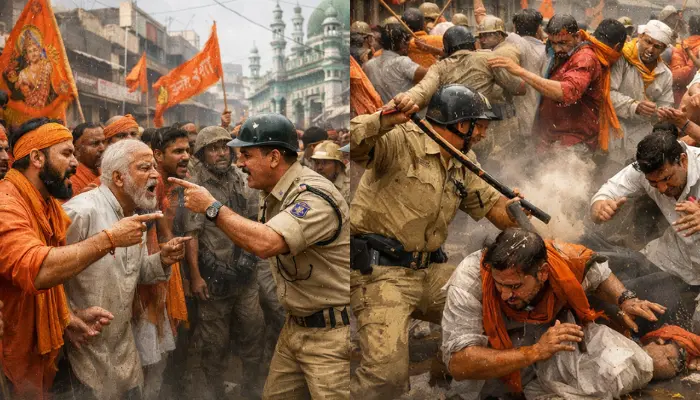
Case Summary
In Nalasopara, Palghar, Maharashtra, a Ram Navami procession on its traditional route was obstructed by police as it was about to cross a Muslim-dominated area. The procession was restricted, and the devotees were physically assaulted by the police. According to media reports, this occurred on 26 March 2026. The Ram Navami procession was taken out from Oswal Nagari Circle in Nalasopara East. The rally moved towards the Rahmat Nagar area, a Muslim-dominated area, with enthusiasm. However, while the rally passed through a particular lane leading to Rahmat Nagar, police objected to the route of the rally and stopped the procession for some time. An argument started between police officers and Hindu organisers over whether to proceed with the rally. Soon, this argument turned into a scuffle and a brawl. When organisers and police came face to face, the situation got out of hand. Organisers and devotees present stated that police resorted to a lathi charge against them. This action of the police led to a huge stampede among devotees who had come for the procession. Angered by this incident, devotees sat on the road, protested against the administration, and shouted slogans. This also had a major impact on traffic. The news of the incident spread all around the city, and tensions escalated. Senior police officers immediately called for additional help to prevent the situation from escalating further. At the time of writing this report, a large police force had been deployed in the relevant area of Nalasopara, and the area had taken on the form of a camp. Police appealed to citizens not to believe rumours, and the administration stated that the situation was under control. Amidst all this, a video of a few Hindu women devotees went viral. In the video, the women stated that the police restricted the Ram Navami procession because the area ahead on the route was Muslim-dominated. They also questioned why such restrictions were not imposed during Muharram celebrations and why Hindu festivals were curbed selectively.
Why it is Hate Crime ?
The primary category selected is- Restriction/ban on Hindu practices. The subcategory selected is- Administration disallows religious procession. The tertiary category selected is- Religious procession. In several cases, it is seen that the administration/state disallows a religious procession owing to prejudicial orders and concerns, targeted specifically against the Hindu community. Such restriction/prohibition would be considered documented as a hate crime because the orders are often a result of pressure by groups that harbour animosity towards Hinduism and Hindus. Often, the restriction by the authorities is driven by bias, hostility, or prejudice against the specific community being stopped from holding a religious procession, by pressure groups that harbour animosity towards Hindus, intrinsic to their faith. Since the religious procession is inherent to the faith of the Hindus, such prejudicial restriction is considered a curtailing of the fundamental rights of the Hindu community. In several cases, for example, the authorities ban a Hindu religious procession due to pressure from groups opposed to the religion. In other instances, the prohibition is selectively enforced against one religious group (Hindus) while others are allowed to proceed. There are still other cases where the authorities preemptively restrict a religious process by Hindus because those who hold animosity towards Hindus may get “provoked” leading to them being violent, thereby assuaging the sentiments of those who hold animosity towards Hindus by curtailing the religious rights of Hindus. Such acts and orders are prejudiced, indicating discriminatory motives owing to the capitulation to groups that harbour animosity towards Hindus and therefore, would be categorized as a religiously motivated hate crime since the original pressure leading to the order itself is a result of hatred/bias/prejudice/religious hate against Hindus. The other subcategory selected is- Administration restricting religious practice. In several cases, it is seen that the administration/state disallows a religious practice owing to prejudicial orders and concerns, targeted specifically against the Hindu community. Such restriction/prohibition would be considered documented as a hate crime because the orders are often a result of pressure by groups that harbour animosity towards Hinduism and Hindus. Often, the restriction by the authorities is driven by bias, hostility, or prejudice against the specific community being stopped from holding a religious practice, by pressure groups that harbour animosity towards Hindus, intrinsic to their faith. Since practices are intrinsic to the faith of the Hindus, such prejudicial restriction is considered a curtailing of the fundamental rights of the Hindu community. In several cases, for example, the authorities ban a Hindu religious practice due to pressure from groups opposed to the religion. In other instances the prohibition is selectively enforced against one religious group (Hindus) while others are allowed to proceed. There are still other cases where the authorities preemptively restrict a religious practice by Hindus because those who hold animosity towards Hindus may get “provoked” leading to them being violent, thereby assuaging the sentiments of those who hold animosity towards Hindus by curtailing the religious rights of Hindus. Such acts and orders are prejudiced, indicating discriminatory motives owing to the capitulation to groups that harbour animosity towards Hindus and therefore, would be categorized as a religiously motivated hate crime since the original pressure leading to the order itself is a result of hatred/bias/prejudice/religious hate against Hindus. The other subcategory selected is- Restriction on expression of Hindu identity. An example of the state-affected prejudicial and targeted orders against the Hindu community would be a government denying the right of a Hindu or a group of Hindus to hold a religious procession owing to the animosity of non-Hindu groups. Denial of the religious right of the Hindus to assuage the non-Hindu group which harbours animosity to a point where it could lead to violence against Hindus is not only a failure of law and order but is a prejudicial order against Hindus, denying them their fundamental rights to express their religious identity. An example of a hate crime against Hindus by a non-Hindu would be a non-Hindu institution forcing its Hindu employees to abandon religious symbols that a Hindu would wear as an expression of faith owing to inherent prejudice against the faith professed by the victim or a non-Hindu group of people restricting a Hindu group from constructing a place of worship simply because the demography of the area in which the temple is being built is dominated by non-Hindus. Such actions are driven by religious animosity and/or prejudice against Hindus and their faith and would therefore be categorized as a hate crime. In this case, the police restricted the Ram Navami procession solely because its traditional route passed through a Muslim-dominated area. Following this, they thwarted Hindu devotees with lathi charges against them, beating participants who sought only to practise their faith peacefully. Ram Navami processions carry profound sacred significance for Hindus, commemorating Lord Ram's birth through vibrant marches with chants, music, and flags that symbolise dharma's triumph, uniting communities from the starting point to the endpoint in unbroken devotion. Halting such a procession midway under the mere pretext of entering a Muslim-dominated area showcased the police's deep-seated religious animosity and institutionalised bias against Hindus. Midway desecration by imposing restrictions on passage through such areas exposed the police's profound hostility towards the Hindu community, violating the sanctity of rituals meant to flow unimpeded. Police attempted to restrict Hindu processions from passing 'Muslim areas' because a dangerous precedent existed where Muslims consider Muslim-majority areas as exclusive zones for Muslims alone. These areas become exclusive enclaves, barring non-Muslims and asserting territorial control. This reflected a disturbing sense of Islamic supremacy, enabling Muslims to dictate terms to Hindus on conducting festivals and navigating public spaces meant for all citizens. If police truly prioritised law and order, they would have bolstered security, provided protection to Hindu devotees, and ensured safe passage rather than completely halting the procession and desecrating its sanctity. Instead, this action showcased deep-seated religious animosity and institutionalised bias within police administration. The stark fact that Hindu devotees highlighted in viral videos, such as police restrictions never applied to Muharram processions or other Muslim events, yet targeted Hindu celebrations selectively, exposed a rotten discriminatory policy within police ranks. If police deemed Hindu processions entering Muslim areas impermissible, why did Muharram processions freely traverse Hindu-majority neighbourhoods without hindrance, blaring alam processions and tazia marches through public spaces? This blatant double standard showcased the police's deliberate appeasement of the Muslim community, prioritising their sensitivities over Hindu rights while unleashing violence on Hindu devotees. Far from upholding impartial law and order, police bowed subserviently to Islamic street veto, enforcing one rule for Muslims and repression for Hindus. This institutionalised prejudice against Hindus, their community, and faith identity constituted naked bias, enabling one group's dominance at the expense of the other's sacred practices and confirming systemic anti-Hindu discrimination. The police launched savage lathi charges against defenceless Hindus after a trivial scuffle, brutally assaulting devotees with unrestrained baton blows that targeted chanting worshippers mid-procession. Officers acted as aggressors, mercilessly striking men, women, and youth carrying sacred symbols, inflicting injuries while devotees screamed in agony and fled in terror. This reign of police brutality shattered families' festive joy, deeply traumatising Hindu participants who sought only to honour Lord Ram, reducing their sacred procession to a battlefield of fear. Police desecrated the celebratory movement and procession's sanctity through their thuggish violence, calculated to intimidate and humiliate Hindus into submission, rendering it a blatant case of anti-Hindu hate crime orchestrated by those sworn to protect. Such actions stemmed from deep-seated animosity and prejudice against the Hindu community and their faith, harboured by state administration such as the police, rendering it a clear hate crime. Given that this case met multiple parameters of hate crime through targeted disruption of Hindu religious expression, selective enforcement favouring one community, and violent suppression of devotees, it was added to the hate crime database of the Hinduphobia Tracker.


Case Status
Unknown


Perpetrators Details
Perpetrators
State and Establishment
Perpetrators Range
Unknown
Perpetrators Gender
unknown
 Sources




