Hindu devotees denied from carrying out religious procession by Police authorities in Aligarh, Lucknow
 Aligarh, Uttar Pradesh, India
  25 March, 2026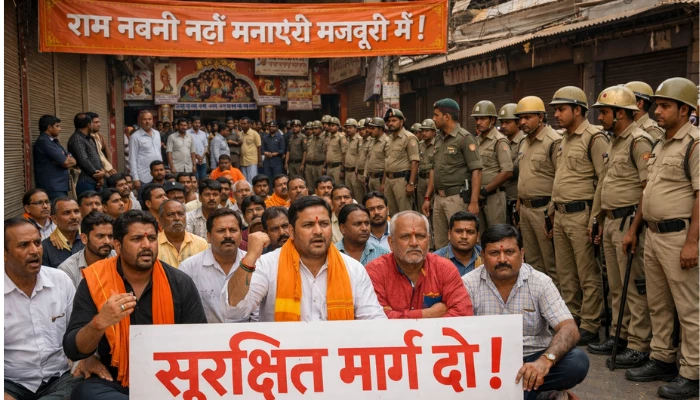
Case Summary
In Aligarh, under the Delhi Gate police station area, Hindu devotees were restricted from carrying out a celebratory ‘Ram Navami’ procession by the police authorities. As per reports, a dispute arose between the administration and the Maa Durga Maharani Temple Committee over the route for the procession in Kanwari Ganj. The temple committee, led by President Akhil Mangalik, opposed the administration’s insistence on using the old traditional route. The committee stated that the old route had become unsafe due to narrow lanes, hanging electric wires and heavy crowd pressure, posing a risk of a major accident. The committee clearly stated that they would not take out the procession by putting devotees’ lives at risk. The committee declared that the Ram Navami procession would only be carried out if permission was granted for a safer or alternative route. They stated that in case of any untoward incident, the responsibility would lie with the administration. The committee also expressed concern about previous FIRs and said they were not willing to take further legal risks. The disagreement escalated into an open confrontation as protests continued for two consecutive days. Traders in Kanwari Ganj shut down the entire market in support of the temple committee and staged a sit-in protest. The administration issued notices to 47 individuals, which further increased anger among locals and traders. Protesters stated that instead of dialogue, pressure tactics were being used. Posters stating “Ram Navami nahi manayenge” were put up in the market, indicating that the decision to not celebrate was being taken due to a lack of safe arrangements. It was also stated that the procession involves participation from 12–14 temples, leading to large crowds, making the narrow old route unsuitable. While permission was granted for the Kalash Yatra on 26 March, no permission was given for the Ram Navami procession on 27 March via the proposed new route. The committee pointed out that the procession had been taken out through the new route in the previous year, questioning the denial this time.
Why it is Hate Crime ?
This case is being added to the tracker under the primary category- Restriction/ban on Hindu practices. The subcategory selected is- Administration restricting religious practice. In several cases, it is seen that the administration/state disallows a religious practice owing to prejudicial orders and concerns, targeted specifically against the Hindu community. Such restriction/prohibition would be considered documented as a hate crime because the orders are often a result of pressure by groups that harbour animosity towards Hinduism and Hindus. Often, the restriction by the authorities is driven by bias, hostility, or prejudice against the specific community being stopped from holding a religious practice, by pressure groups that harbour animosity towards Hindus, intrinsic to their faith. Since practices are intrinsic to the faith of the Hindus, such prejudicial restriction is considered a curtailing of the fundamental rights of the Hindu community. In several cases, for example, the authorities ban a Hindu religious practice due to pressure from groups opposed to the religion. In other instances, the prohibition is selectively enforced against one religious group (Hindus) while others are allowed to proceed. There are still other cases where the authorities preemptively restrict a religious practice by Hindus because those who hold animosity towards Hindus may get “provoked”, leading to them being violent, thereby assuaging the sentiments of those who hold animosity towards Hindus by curtailing the religious rights of Hindus. Such acts and orders are prejudiced, indicating discriminatory motives owing to the capitulation to groups that harbour animosity towards Hindus and therefore, would be categorised as a religiously motivated hate crime since the original pressure leading to the order itself is a result of hatred/bias/prejudice/religious hate against Hindus. The other sub-category is- Restriction on the expression of Hindu identity. An example of the state-affected prejudicial and targeted orders against the Hindu community would be a government denying the right of a Hindu or a group of Hindus to hold a religious procession owing to the animosity of non-Hindu groups. Denial of the religious right of the Hindus to assuage the non-Hindu group, which harbours animosity to a point where it could lead to violence against Hindus, is not only a failure of law and order but is a prejudicial order against Hindus, denying them their fundamental rights to express their religious identity. An example of a hate crime against Hindus by a non-Hindu would be a non-Hindu institution forcing its Hindu employees to abandon religious symbols that a Hindu would wear as an expression of faith owing to inherent prejudice against the faith professed by the victim or a non-Hindu group of people restricting a Hindu group from constructing a place of worship simply because the demography of the area in which the temple is being built is dominated by non-Hindus. Such actions are driven by religious animosity and/or prejudice against Hindus and their faith and would therefore be categorised as a hate crime. This case has been added to the tracker because the failure of the police authorities to provide a safe route effectively barred Hindu devotees from carrying out the Ram Navami procession. The temple committee had clearly raised concerns that the old route was narrow, congested, and unsafe due to hanging wires and heavy crowd movement, yet the administration insisted on the same route while denying permission for an alternative. Notably, the procession had been allowed through the new route on earlier occasions, making the refusal this time arbitrary and inconsistent. In effect, devotees were left with no viable option to safely conduct the procession, which resulted in its suspension. This amounted to a direct curtailment of their right to practise and manifest their faith through a traditional religious procession. Further, this incident stood in contrast to actions taken in other states where authorities, under the pretext of maintaining safety, imposed restrictions such as banning DJs during Hindu processions. While those measures were justified as precautionary steps, here, when devotees themselves sought a safer route to avoid potential harm, the request was disregarded. This selective approach reflected a pattern where administrative decisions, whether by imposing restrictions or denying reasonable safeguards, ultimately operated to limit the manner in which Hindu festivals could be observed. Moreover, the impact was not limited to logistical inconvenience but extended to the effective denial of religious practice. The temple committee openly stated that they would not conduct the procession under unsafe conditions, reflecting that the festival itself was being withheld under compulsion. This demonstrated how the situation resulted in Hindus being unable to celebrate their own festival in a free and secure manner. Taken together, the sequence of events showed a pattern where a Hindu religious celebration became the subject of restrictive control, leading to its curtailment. The combination of unsafe conditions, denial of reasonable alternatives, and coercive administrative measures created an environment where devotees were effectively prevented from practising their faith, fulfilling the criteria of a targeted restriction impacting the Hindu community.


Case Status
Unknown


Perpetrators Details
Perpetrators
State and Establishment
Perpetrators Range
Unknown
Perpetrators Gender
unknown
 Sources




