Hindu temple in Pune demolished by authorities after false complaint from anti-social elements ahead of Ram Navami festival
 Pune, Maharashtra, India
  23 March, 2026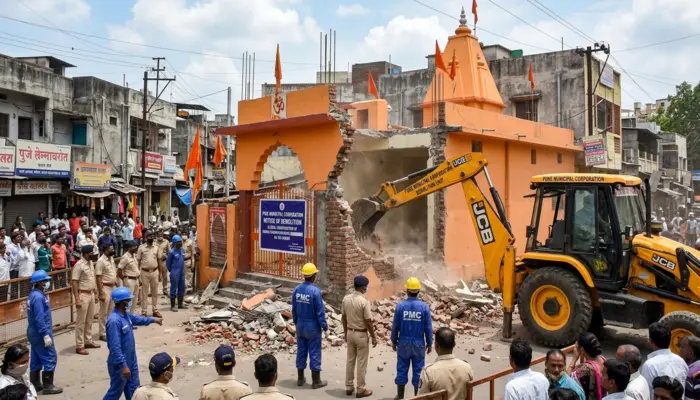
Case Summary
In Viman Nagar, Pune, Maharashtra, a Hindu temple of Lord Ram was demolished by Municipal Corporation authorities ahead of the Ram Navami festival. This happened after a few anti-social elements lodged a false complaint to the Municipal Corporation that the temple was built illegally. This incident occurred on 24 March 2026 in a society behind Phoenix Mall in Viman Nagar and in front of the society, there was a Shri Ram temple for the past five years. Some anti-social elements complained to the Municipal Corporation over the phone on the eve of Shri Ram Navami that the temple was unauthorised. Following this, without any investigation, the Municipal Corporation's corrupt Sanjay Pol officer demolished the temple without giving any notice. After the temple demolition, there was an atmosphere of tension in the area. All Hindu devotees rushed to the Viman Nagar police station. The police did not respond to any requests or complaints for the first two to three hours. Later, after Vishva Hindu Parishad and Bajrang Dal workers jointly questioned the police, the person who did this promised that the temple would be built in one night, and the construction of the temple started.
Why it is Hate Crime ?
This case is added to the tracker under the primary category- Attack on Hindu religious representations. The subcategory selected is- Attack on Temples. In Hinduism, a temple is the abode of the Deity. The Deity in the Temple is consecrated, thereby, making it a real, breathing entity. Hindus believe that not just the Deity but the temple premises itself are sacred to Hindus since Hindus hold the faith that the entire Temple space is an amalgamation of the divine energy of the deity. Given the central significance of Temples in Hindu Dharma, any attack against a Hindu Temple or its peripheral premises is an attack on the faith itself and is born out of animosity towards the faith, of which, the Temple is a central tenet. Any manner of attack against a Temple and/or its premises would therefore be considered a religiously motivated hate crime. Ther other subcategory selected is- Desecration of Hindu religious symbols. Icons and symbols or a religious representation of a spiritual ideal are widely revered in Hinduism. Iconography is of vital significance in the Hindu milieu. It helps connect people’s spiritual beliefs with the real world. Iconography within the Hindu faith takes several shapes and forms. Murtis are of most significance to Hindus, to which daily rituals, prayers and offerings are done. Besides the murtis, there are several other symbols which have deep significance in the Hindu faith – the Om and Swastika for example. Since these Hindu religious symbols hold paramount importance in Hinduism, any desecration of symbols, icons, murtis, religious representations and manifestations, is driven by animosity towards the faith itself which manifests itself through these murtis, icons and symbols. Therefore, any desecration of these Hindu religious symbols and representations is considered religiously motivated hate crimes under this category. This case is a clear instance of a religiously motivated hate crime, as the Municipal Corporation of Pune demolished the sacred Ram temple due to a mere complaint of unauthorised or illegal construction. They desecrated it without notice or prior confirmation, ahead of the sacred Ram Navami festival. This brazen act showcased deep-seated religious animosity, transforming a place of worship into rubble just when devotees prepared to honour their beloved deity. Temples hold profound significance in Hinduism as sacred symbols of faith, community, and divine presence. They serve as living hearts of devotion where families gather for prayers, festivals, and life's milestones, embodying centuries of spiritual heritage. The demolition of such temples, without authorisation, prior notice, or verification, exposed the authorities' deep-seated religious animosity and bias against Hindus and their sacred religious sites. Just under a mere complaint, unchecked, unverified, and without notifying the temple custodians, they razed the entire structure. This inflicted deep hurt on the religious sentiments of the Hindu community, desecrating their sacred symbols and leaving devotees heartbroken, making it a hate-driven offence. The anti-Hindu nature of the anti-social elements stood revealed as they falsely accused the temple of being illegal, prompting the corrupt Municipal Corporation to demolish it. Their malicious complaint acted as the spark, igniting a chain of destruction that made this a clear case of religiously motivated crime, where prejudice masqueraded as official duty. This incident occurred during Ram Navami, its deliberate timing underscoring the perpetrators' malicious intent to desecrate sacred Hindu sites amidst one of the Hindu community's most revered festivals. Ram Navami symbolises renewal, righteousness, and unyielding faith in dharma, drawing millions into ecstatic worship of their beloved deity. By targeting the Ram temple on the very eve of celebrations honouring Lord Ram's divine incarnation and triumph over adharma, they sought to inflict maximum spiritual injury, disrupting rituals of devotion, processions, and communal unity that define this auspicious occasion for Hindus worldwide. Such desecration of a Ram temple during their sacred festival exemplifies deep-seated religious animosity towards the Hindu community, calculated to wound the faithful at their devotional zenith. Instances where sacred Hindu symbols faced demolition under mere flimsy pretexts of illegality, perpetrated by state authorities, showcase anti-Hindu bias entrenched in the state administration. These acts amounted to desecration of sacred symbols, making them clear cases of religiously motivated hate crime. Therefore, this case has been added to the Hate Crime database of the Hinduphobia Tracker.


Case Status
Unknown


Perpetrators Details
Perpetrators
State and Establishment
Perpetrators Range
One Person
Perpetrators Gender
male
 Sources




