Hindu festival targeted; DJ banned, celebrations unreasonably restricted by State administration in Motihari, Bihar
 Mothihari, Bihar, India
  25 March, 2026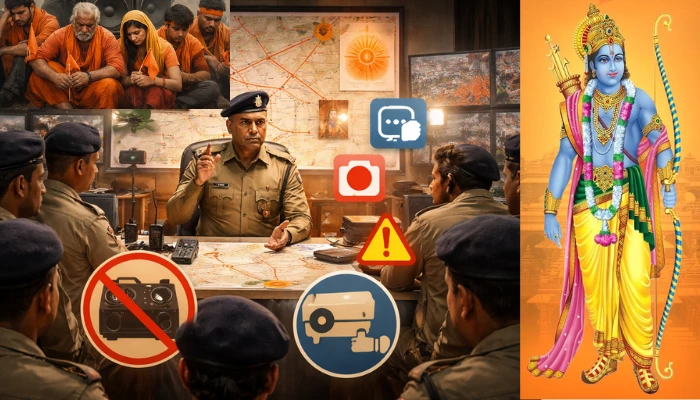
Case Summary
In the Motihari district of Bihar, Hindu devotees' freedom to celebrate the Hindu festival of Ram Navami was curtailed by the State administration. Severe restrictions were imposed, and the DJ was banned by the Police before the festival. As per reports, the district administration intensified security arrangements and conducted a flag march ahead of the Ram Navami festival. The flag march was conducted under the supervision of the Deputy Superintendent of Police (DSP). The Hindu devotees organising Ram Navami processions were directed not to play DJ music during the religious procession. The administration imposed a complete ban on the use of DJs during the event. The organisers were instructed to strictly follow a predetermined route chart for the Ram Navami procession. They were warned that any deviation from the prescribed route would invite action. According to reports, these measures were introduced as part of a broader effort to maintain peace and prevent any untoward incidents during the celebrations.
Why it is Hate Crime ?
This case is being added to the tracker under the primary category- Restriction/ban on Hindu practices. The subcategory selected is- Administration restricting religious practice. In several cases, it is seen that the administration/state disallows a religious practice owing to prejudicial orders and concerns, targeted specifically against the Hindu community. Such restriction/prohibition would be considered documented as a hate crime because the orders are often a result of pressure by groups that harbour animosity towards Hinduism and Hindus. Often, the restriction by the authorities is driven by bias, hostility, or prejudice against the specific community being stopped from holding a religious practice, by pressure groups that harbour animosity towards Hindus, intrinsic to their faith. Since practices are intrinsic to the faith of the Hindus, such prejudicial restriction is considered a curtailing of the fundamental rights of the Hindu community. In several cases, for example, the authorities ban a Hindu religious practice due to pressure from groups opposed to the religion. In other instances, the prohibition is selectively enforced against one religious group (Hindus) while others are allowed to proceed. There are still other cases where the authorities preemptively restrict a religious practice by Hindus because those who hold animosity towards Hindus may get “provoked”, leading to them being violent, thereby assuaging the sentiments of those who hold animosity towards Hindus by curtailing the religious rights of Hindus. Such acts and orders are prejudiced, indicating discriminatory motives owing to the capitulation to groups that harbour animosity towards Hindus and therefore, would be categorised as a religiously motivated hate crime since the original pressure leading to the order itself is a result of hatred/bias/prejudice/religious hate against Hindus. The other sub-category is- Restriction on the expression of Hindu identity. An example of the state-affected prejudicial and targeted orders against the Hindu community would be a government denying the right of a Hindu or a group of Hindus to hold a religious procession owing to the animosity of non-Hindu groups. Denial of the religious right of the Hindus to assuage the non-Hindu group, which harbours animosity to a point where it could lead to violence against Hindus, is not only a failure of law and order but is a prejudicial order against Hindus, denying them their fundamental rights to express their religious identity. An example of a hate crime against Hindus by a non-Hindu would be a non-Hindu institution forcing its Hindu employees to abandon religious symbols that a Hindu would wear as an expression of faith owing to inherent prejudice against the faith professed by the victim or a non-Hindu group of people restricting a Hindu group from constructing a place of worship simply because the demography of the area in which the temple is being built is dominated by non-Hindus. Such actions are driven by religious animosity and/or prejudice against Hindus and their faith and would therefore be categorised as a hate crime. This case had been recorded as a hate crime under institutional discrimination, as it involved administrative action that imposed restrictions on Hindu religious expression during the festival of Ram Navami. The measures were enforced specifically in the context of the festival, thereby directly affecting the celebration of the Hindu festival. The public processions and musical celebrations had formed an intrinsic part of Ram Navami observances. Devotees had traditionally participated in Shobha Yatras, accompanied by devotional music, as an open and collective expression of faith. However, the imposition of a DJ ban curtailed this customary practice, thereby limiting the manner in which the festival could be observed. Thus, these restrictions were not peripheral but had touched the core of how the religious event was traditionally celebrated. Moreover, the justification for these measures had been rooted in maintaining law and order and preventing any potential disturbance. However, this reasoning had effectively placed the burden of ensuring peace on Hindu devotees themselves. Instead of focusing on those who might disrupt harmony, the administration had imposed pre-emptive restrictions on lawful religious expression. Consequently, Hindus had been required to dilute their practices due to anticipated reactions from others, rather than any inherent illegality in their conduct. In addition, such actions reflected a broader pattern where administrative caution translated into selective restraint. When one community had repeatedly been asked to scale down its visible religious expression to maintain public order, it created an imbalance in the application of the law. As a result, the emphasis shifted from protecting the right to practise religion to managing it through limitation, thereby affecting the community’s confidence in equal treatment. Notably, the impact had extended beyond a single event. Recurrent restrictions of this nature had contributed to a perception that Hindu festivals were subjected to greater scrutiny and control. Over time, this had eroded the sense of fairness and normalised the idea that Hindu religious practices in public spaces must operate under conditional permissions, rather than as a matter of right. Taken together, the targeted restrictions during Ram Navami showed a clear issue. To protect Hindu devotees during their own festival, the police had put restrictions on the movement and celebration of the devotees themselves. In effect, this limited their rights while claiming to ensure their safety. In simple terms, it meant that devotees were expected not to celebrate freely to avoid any possible trouble from others. Accordingly, this case had been included in the Hinduphobia Tracker database as an instance of discriminatory restriction on Hindu religious practices. Disclaimer: The Hinduphobia Tracker recorded the perpetrator count as one (1) in this case, considering the administrative authority, DSP Dilip Kumar, as responsible for enforcing the restrictions during the festival. The Hinduphobia Tracker recorded incident dates based on when the victim's ordeal began, rather than when the media reported it. Since the exact date of the administrative order was not specified in the report, the publication date was taken as the indicative incident date for documentation purposes.


Case Status
Unknown


Perpetrators Details
Perpetrators
State and Establishment
Perpetrators Range
One Person
Perpetrators Gender
male
 Sources




