Hindu devotees conducting Akhand Kirtan and Kalash Visarjan in Gaya subjected to violent stone-pelting attack by Muslim group
 Gaya, Bihar, India
  24 March, 2026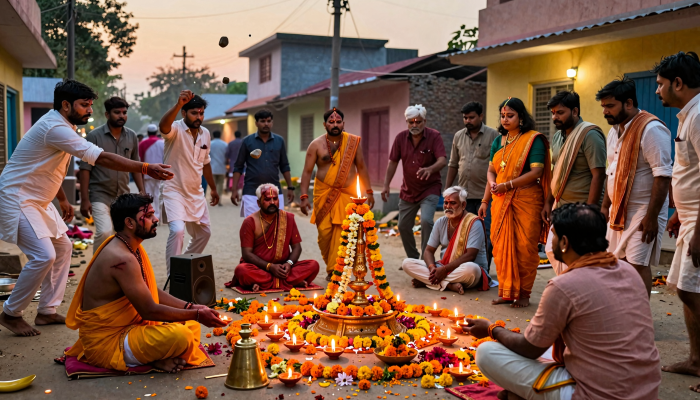
Case Summary
Seven Hindu individuals were injured in a violent stone-pelting attack by a Muslim group in Gaya district, Bihar during a 24-hour Kirtan (continuous devotional singing ceremony) when members of the Muslim community objected to loudspeakers being placed at various locations for the religious event. Two of the seven injured Hindu individuals sustained serious injuries and were referred to Magadh Medical College and Hospital in Gaya after initial treatment. An Akhand Kirtan had been organised in Sitachak village with loudspeakers placed at multiple locations by the organisers. Members of the Muslim community objected to the placement of the microphones and loudspeakers across the village, triggering an argument with the Hindu organisers. The dispute escalated during the Kalash Visarjan (the sacred concluding ritual of immersing the ceremonial pot, marking the culmination of the Akhand Kirtan) when religious songs were being played, at which point both communities came face to face and stone-pelting began. Seven Hindu individuals sustained injuries in the stone-pelting. Police arrived at the scene and brought the situation under control. Six individuals from both communities were arrested and sent to jail. A total of 22 individuals were named in the First Information Report while cases were also registered against 40 unidentified individuals. A pickup vehicle and a DJ sound system were seized from the scene. Heavy police force was deployed in the village given the tense atmosphere and police were camping at the scene monitoring the situation continuously.
Why it is Hate Crime ?
The primary category for this case is "Attack not resulting in death". The sub-category here is "Attacked for Hindu identity". In several cases, Hindus are attacked merely for their Hindu identity without any perceived provocation. A classic example of this category of religiously motivated hate crime is a murder in 2016. 7 ISIS terrorists were convicted for shooting a school principal in Kanpur because they got ‘triggered’ seeing the Kalava on his wrist and tilak that he had put. In this, the Hindu victim had offered no provocation except for his Hindu religious identity. The motivation for the murder was purely religious, driven by religious supremacy. Such cases where Hindus are targeted merely for their religious identity would be documented as a hate crime under this category. Another sub-category for this case is "Attack against Hindu devotees". Hindu devotees are a few of the easiest targets of religiously motivated hate crimes because during the festival/procession/puja etc, for non-Hindus it is easy to profile their victims on the basis of religion. Hindu devotees come under attack on several occasions by individual non-Hindus or mobs of non-Hindus owing to their animosity against Hinduism, its symbols and tradition/practices. There are several instances of Hindu devotees being attacked while they worship in temples or temporary religious structures, during religious processions, doing bhajan/kirtan/puja in their own homes, in the residential society etc. These attacks are perpetrated by non-Hindus primarily because of their animosity towards Hindus and their faith. In some cases, the trigger for the violence may be non-religious, however, there are two elements that make these hate crimes. First, the Hindus who come under attack are attacked violently while indulging in religious activity. Whether they are in a place of worship or not is immaterial to the crime. When individuals are attacked while indulging in religious practices, the attack in itself is a hindrance to their freedom to practice religion and therefore constitutes a hate crime. Secondly, religious supremacist doctrines and ideologies deem religious practices of Hindus to be offensive ab initio since they are considered “sinful” by these ideologies, worthy to be annihilated by force or coercion. Driven by these religious supremacist ideologies and doctrines, the attacks against Hindu devotees stem from intrinsic animosity towards Hinduism. In some cases, the trigger for the violence may be non-religious, however, it develops into a religiously motivated crime during the course of the violence. Since these attacks stem from animosity towards Hindus and Hinduism, they are considered religiously motivated hate crimes under this category. The other subcategory selected is- Communal clash/attack. Communal clash is a form of collective violence that involves clashes between groups belonging to different religious identities. For a communal clash between Hindus and non-Hindus to qualify as a religiously motivated hate crime, the trigger of the violence itself would have to be anti-Hindu in essence. For example, if there is a Hindu religious procession that comes under attack from a non-Hindu mob and after the initial attack, Hindus retaliate in self-defence, leading to a communal clash between the two religious communities. While at a later stage, both communities are involved in the clash/violence, the initial trigger of the violence was by the non-Hindu mob against the Hindus and therefore, it could safely be termed as an anti-Hindu violence. Further, the trigger would also have to be religiously motivated. In the cited example, the attack by the non-Hindu mob was against religious processions and therefore, can be concluded to be religiously motivated. In some cases, the trigger may be non-religious, however, it develops into religious violence against Hindus at a later stage. In such cases too, the foundational animosity towards Hindus becomes the motivating factor of the crime and therefore, it would be classified as a religiously motivated hate crime against Hindus under this category. This case qualified as a religiously motivated hate crime on the basis that seven Hindu individuals conducting a sacred 24-hour Akhand Kirtan in Sitachak village, Gaya district, Bihar were violently attacked through sustained stone-pelting by a Muslim group that objected to the loudspeakers placed for the Hindu religious ceremony, with the violence escalating specifically during the Kalash Visarjan, the sacred concluding ritual of the Akhand Kirtan, resulting in seven injuries including two serious cases requiring hospitalisation. The Akhand Kirtan is a continuous and uninterrupted devotional singing ceremony of deep spiritual significance in Hinduism, representing a sustained and collective act of worship in which Hindu devotees dedicate an extended and unbroken period of time to the devotional glorification of the divine. The Kalash Visarjan, the sacred concluding ritual involving the ceremonial immersion of the holy pot that marks the culmination of the Akhand Kirtan, is among the most spiritually significant moments of the entire ceremony, representing the sacred conclusion of the devotional gathering. The Muslim group's deliberate escalation of the dispute into violent stone-pelting, specifically during this sacred concluding ritual, reflected a conscious and calculated decision to attack the Hindu devotees at the most spiritually significant and emotionally charged moment of their religious observance, maximising both the physical harm and the religious violation inflicted on the Hindu community. The Muslim group's objection was directed not at any provocative or aggressive conduct by the Hindu devotees but specifically at the placement of loudspeakers for the Akhand Kirtan and the playing of religious songs during the Kalash Visarjan. The use of loudspeakers and devotional music during Hindu religious ceremonies is a deeply established and widely practised expression of Hindu devotional identity, through which Hindu communities collectively celebrate and publicly express their faith during sacred religious events. The Muslim group's violent objection to this expression of Hindu devotional identity reflected a deliberate and conscious decision to suppress the public and collective expression of Hindu religious identity through violence, targeting the Hindu devotees specifically because of their visible and audible expression of their Hindu faith through sacred devotional music and ceremony. Given that this case met the parameters of a religiously motivated hate crime, it was added to the hate crime database of the tracker.
Victim Details
Total Victim
7
Deceased
0
Gender
- Male 0
- Female 0
- Third Gender 0
- Unknown 7
Caste
- SC/ST 0
- OBC 0
- General 0
- Unknown 7
Age Group
- Minor 0
- Adult 0
- Senior Citizen 0
- Unknown 7


Case Status
Complaint registered


Perpetrators Details
Perpetrators
Muslim Extremists
Perpetrators Range
From 10 to 100
Perpetrators Gender
unknown
 Sources




