Ram Navami procession attacked in 'Muslim area', devotees assaulted for hoisting saffron flags near mosque
 Mumbai, Maharashtra, India
  24 March, 2026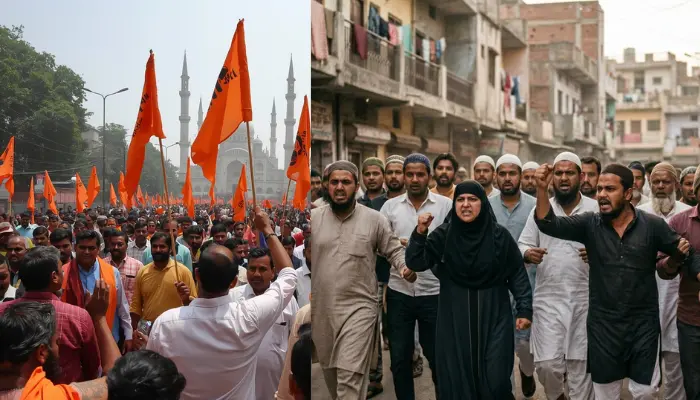
Case Summary
In a Muslim-majority neighbourhood of Malvani, Malad West, Mumbai, Maharashtra, a Ram Navami procession was targeted and attacked by a Muslim mob. This occurred as Hindus hoisted saffron flags just away from a mosque on their route. It then sparked violence against Hindu devotees by the perpetrators. Afterwards, police took one-sided action, arresting only Hindus while taking no action against the Muslim perpetrators. According to information available as shared by local media reports and official social media handles of two Hindu organisations, namely, Sakal Hindu Samaj and Bajrang Dal, this started when the Ram Navami procession was passing by a mosque and Hindu devotees were carrying bhagwa (saffron) flags. Hindus were hoisting saffron flags on the Number 7 Road in Malvani. There is a mosque nearby, but they were hoisting the flags away from the mosque, from where the rally was to start. But even this was opposed by Muslims, and an altercation broke out. Following this, the police took a one-sided action and arrested five Hindu devotees. A Muslim woman then physically attacked a Hindu devotee, aiming to incite religious tensions. Soon after, a mob of Muslim men targeted and assaulted the Hindu devotees. The situation escalated, forcing police to seal off the Muslim neighbourhood with barricades. At the time of writing, police had taken no strict action against the Muslim perpetrators but arrested five Hindu devotees for hoisting saffron flags. This drew criticism from local Hindus who said that their festivals were facing restrictions and biased policing.
Why it is Hate Crime ?
The case is being added to the tracker under the primary category-Attack not resulting in death. The subcategory selected is- Attack on religious procession. The outward celebration and display of religious symbols in an intrinsic part of Hinduism. Religious processions on various festivals are age-old traditions and a way to manifest faith and form a part of the religious practices of Hindus. On several occasions, such religious processions come under attack by non-Hindu mobs, in a manifestation of their animosity towards Hinduism and their practices. The reasons cited for such violent attacks are many and range from crossing a non-Hindu resident-dominated area to playing loud music, crossing from an area where there is a religious structure of another faith etc. The violent attacks are triggered by the outward display of religiosity by Hindus. The attacks are mainly a manifestation of religious supremacist doctrine which believes that idolatry, essentially the Hindu faith, is one that deserves to be annihilated since the very tenets of Hinduism, its practices and traditions are considered a sin in those doctrines. Since these attacks emanate from intrinsic and doctrinal animosity towards Hindus and Hinduism, it is considered a religiously motivated hate crime under this category. The other subcategory selected is- Attack against Hindu devotees. Hindu devotees are a few of the easiest targets of religiously motivated hate crimes because during the festival/procession/puja etc, for non-Hindus it is easy to profile their victims on the basis of religion. Hindu devotees come under attack on several occasions by individual non-Hindus or mobs of non-Hindus owing to their animosity against Hinduism, its symbols and tradition/practices. There are several instances of Hindu devotees being attacked while they worship in temples or temporary religious structures, during religious processions, doing bhajan/kirtan/puja in their own homes, in the residential society etc. These attacks are perpetrated by non-Hindus primarily because of their animosity towards Hindus and their faith. In some cases, the trigger for the violence may be non-religious, however, there are two elements that make these hate crimes. First, the Hindus who come under attack are attacked violently while indulging in religious activity. Whether they are in a place of worship or not is immaterial to the crime. When individuals are attacked while indulging in religious practices, the attack in itself is a hindrance to their freedom to practice religion and therefore constitutes a hate crime. Secondly, religious supremacist doctrines and ideologies deem religious practices of Hindus to be offensive ab initio since they are considered “sinful” by these ideologies, worthy to be annihilated by force or coercion. Driven by these religious supremacist ideologies and doctrines, the attacks against Hindu devotees stem from intrinsic animosity towards Hinduism. In some cases, the trigger for the violence may be non-religious, however, it develops into a religiously motivated crime during the course of the violence. Since these attacks stem from animosity towards Hindus and Hinduism, they are considered religiously motivated hate crimes under this category. The other subcategory selected is- Attacked for Hindu identity. In several cases, Hindus are attacked merely for their Hindu identity without any perceived provocation. A classic example of this category of religiously motivated hate crime is a murder in 2016. 7 ISIS terrorists were convicted for shooting a school principal in Kanpur because they got ‘triggered’ seeing the Kalava on his wrist and tilak that he had put. In this, the Hindu victim had offered no provocation except for his Hindu religious identity. The motivation for the murder was purely religious, driven by religious supremacy. Such cases where Hindus are targeted merely for their religious identity would be documented as a hate crime under this category. The other subcategory selected is- Attacked for crossing 'Muslim area'. One of the reasons that Hindus get attacked unprovoked specifically by Islamists is for crossing ‘Muslim areas’. Essentially, Muslim mobs often attack Hindus crossing or present in certain areas which have a majority Muslim population. It has often been cited as one of the reasons to blame Hindus for attacks against themselves, signalling that Hindus displaying religious symbols, taking our religious processions or crossing any area which is dominated by Muslim residents is a provocation in and of itself. These areas are mostly ghettoized areas where mobs mobilize quickly to attack Hindus for a variety of reasons like playing music during a religious procession, crossing a mosque, wearing a tilak or any other religious symbol in a Muslim-dominated area, praying at a local temple in that area etc. There have been cases where the few local Hindus of that area have been attacked on their way to the Temple for prayers as well, simply because the area is considered a Muslim-dominated area. Several times, it is entirely possible that the immediate trigger for the violence against Hindus was non-religious in nature, however, the violence became religiously motivated in nature because the area was Muslim dominated and the residents on the whole harboured animosity towards Hindus, evidenced from the actions of the mob, the slogans, and the nature of the attack. Such crimes are motivated by the religious identity of the victims and are therefore classified as hate crimes under this category. The other subcategory selected is- Communal Clash/Attack. Communal clash is a form of collective violence that involves clashes between groups belonging to different religious identities. For a communal clash between Hindus and non-Hindus to qualify as a religiously motivated hate crime, the trigger of the violence itself would have to be anti-Hindu in essence. For example, if there is a Hindu religious procession that comes under attack from a non-Hindu mob and after the initial attack, Hindus retaliate in self-defence, leading to a communal clash between the two religious communities. While at a later stage, both communities are involved in the clash/violence, the initial trigger of the violence was by the non-Hindu mob against the Hindus and therefore, it could safely be termed as an anti-Hindu violence. Further, the trigger would also have to be religiously motivated. In the cited example, the attack by the non-Hindu mob was against religious processions and therefore, can be concluded to be religiously motivated. In some cases, the trigger may be non-religious, however, it develops into religious violence against Hindus at a later stage. In such cases too, the foundational animosity towards Hindus becomes the motivating factor of the crime and therefore, it would be classified as a religiously motivated hate crime against Hindus under this category. Another primary category selected is- Restriction/ban on Hindu practices. The subcategory selected is- Restriction on expression of Hindu identity. An example of the state-affected prejudicial and targeted orders against the Hindu community would be a government denying the right of a Hindu or a group of Hindus to hold a religious procession owing to the animosity of non-Hindu groups. Denial of the religious right of the Hindus to assuage the non-Hindu group which harbours animosity to a point where it could lead to violence against Hindus is not only a failure of law and order but is a prejudicial order against Hindus, denying them their fundamental rights to express their religious identity. An example of a hate crime against Hindus by a non-Hindu would be a non-Hindu institution forcing its Hindu employees to abandon religious symbols that a Hindu would wear as an expression of faith owing to inherent prejudice against the faith professed by the victim or a non-Hindu group of people restricting a Hindu group from constructing a place of worship simply because the demography of the area in which the temple is being built is dominated by non-Hindus. Such actions are driven by religious animosity and/or prejudice against Hindus and their faith and would therefore be categorized as a hate crime. The other subcategory selected is- Administration restricting religious practice. In several cases, it is seen that the administration/state disallows a religious practice owing to prejudicial orders and concerns, targeted specifically against the Hindu community. Such restriction/prohibition would be considered documented as a hate crime because the orders are often a result of pressure by groups that harbour animosity towards Hinduism and Hindus. Often, the restriction by the authorities is driven by bias, hostility, or prejudice against the specific community being stopped from holding a religious practice, by pressure groups that harbour animosity towards Hindus, intrinsic to their faith. Since practices are intrinsic to the faith of the Hindus, such prejudicial restriction is considered a curtailing of the fundamental rights of the Hindu community. In several cases, for example, the authorities ban a Hindu religious practice due to pressure from groups opposed to the religion. In other instances the prohibition is selectively enforced against one religious group (Hindus) while others are allowed to proceed. There are still other cases where the authorities preemptively restrict a religious practice by Hindus because those who hold animosity towards Hindus may get “provoked” leading to them being violent, thereby assuaging the sentiments of those who hold animosity towards Hindus by curtailing the religious rights of Hindus. Such acts and orders are prejudiced, indicating discriminatory motives owing to the capitulation to groups that harbour animosity towards Hindus and therefore, would be categorized as a religiously motivated hate crime since the original pressure leading to the order itself is a result of hatred/bias/prejudice/religious hate against Hindus. This case is a clear instance of a religiously motivated hate crime, as the Muslim perpetrators targeted and attacked a Hindu religious procession in a Muslim-majority neighbourhood near a mosque in the Malvani area of Mumbai. The perpetrators launched an attack that disrupted the Ram Navami procession only because the Hindu devotees were carrying bhagwa (saffron) flags and hoisted them on a road some distance away from the mosque. The violence was not prompted by any proportionate provocation but by the visible assertion of Hindu religious identity in a public space that the attackers treated as exclusively Muslim. Even the police administration took one-sided action against the Hindu devotees and allowed the Muslim perpetrators to remain free, which further underscores the religiously charged nature of the entire incident. The Hindu religious procession of Ram Navami was attacked in a manner that was both physical and symbolic. Ram Navami commemorates the birth of Lord Ram and is one of the most significant festivals in the Hindu religious calendar, especially for Hindu devotees who view Lord Ram as a revered deity, an ideal king and moral exemplar. Processions on this day typically involve chanting sacred hymns, singing devotional songs, carrying idols or images of deities, and displaying saffron or bhagwa flags as a mark of devotion and victory of dharma. The bhagwa flag, in particular, carries strong religious and cultural symbolism for Hindus, representing purity, sacrifice, and the assertion of Hindu identity. Attacking a Ram Navami procession just for carrying bhagwa flags and for being in a Muslim-majority locality near a mosque demonstrates the perpetrators’ deep‑rooted religious animosity towards the Hindu community. The targeting and violence against the procession desecrated the sanctity of a sacred religious event and caused profound hurt to the religious sentiments of the Hindu devotees. The act of attacking Hindu devotees present at the religious procession inflicted deep‑seated trauma on them. The devotees were filled with terror as their sacred Hindu religious procession was violently disrupted, their flags were targeted, and their celebration was treated as an offence. At the same time, they were subjected to physical assault and verbal intimidation by the Muslim perpetrators, who singled them out purely because of their religious identity. This combination of physical violence, symbolic desecration, and targeted intimidation meets the core definition of a hate crime where the victims are selected not for any individual wrongdoing but because they belong to a particular religious group. The fact that the attack was directed at individuals participating in a religious festival, wearing their religious colours and following their faith, makes it a clear case of a religiously motivated hate crime. The way the Muslim perpetrators targeted Hindus solely for carrying bhagwa flags and hoisting them further reveals their deep‑seated religious animosity. The perpetrators did not respond to any violence, threat, or genuine religious violation; they reacted because the sight of Hindu religious symbols was intolerable to them. A hate crime is characterised by the selection of victims based on their identity rather than any specific wrongdoing, and in this instance, the only distinguishing feature of the victims was their Hindu religious identity expressed through flags and processional markers. Attacking and targeting a religious procession and its devotees purely due to their religious identity constitutes a hate crime because it is an act of group‑based hostility intended to intimidate and humiliate an entire community, not just the individuals directly assaulted. It is important to note that this incident occurred near a mosque in a Muslim-majority neighbourhood in Malvani, which shaped how the perpetrators understood the space. Muslims often treat areas around mosques, dargahs, or zones where their community is in the majority as “Muslim areas” where non‑Muslims are expected to be unobtrusive or even unwelcome. In this case, the attackers operated with a sense of religious entitlement, viewing the vicinity of the mosque and Muslim neighbourhood as an exclusive zone where Hindus should not openly display their religious symbols. This mindset reflects a disturbing sense of Islamic supremacy in which public space is treated as belonging to one religious community, and any assertion of Hindu religious identity is framed as an intrusion. The assault on the Hindu victims was motivated by this supremacist ideology, under which Muslims in the neighbourhood looked down upon Hindus and believed they had the right to control who could move freely and express their faith in “their area”. Such an attitude is rooted in exclusion, intolerance, and religious animosity, making this case a clear illustration of a crime motivated by religious hatred. This attack on Hindus cannot be dismissed as an isolated outburst or spontaneous rage. The Hindu devotees did not do anything provocative that could reasonably be seen as hurting Muslim religious sentiments; they were simply hoisting saffron flags some distance away from a mosque in a Muslim-majority area. That alone triggered a violent and coordinated assault on the Hindu procession. The attack began when a Muslim woman physically assaulted a Hindu man, which then escalated into a larger mob of Muslim men who tried to attack Hindus, and were premeditatedly ready for confrontation. The timing, location, and pattern of the attack indicate that it was not a random quarrel but a targeted, premeditated act of violence directed at Hindus solely because of their religious identity. The fact that the devotees were attacked for nothing more than carrying and hoisting bhagwa flags in a public space confirms that this is a clear case of a religiously motivated hate crime. Overall, this incident showcases a communal attack on Hindus that was driven by religious animosity. A communal attack is one in which members of one religious community are targeted because of their collective identity, with the intent to intimidate, humiliate, or threaten the entire group. In this case, the Ram Navami procession was specifically chosen as the target because it visibly represented the Hindu community, and the violence was intended to send a message that Hindus would not be allowed to freely express their faith in Muslim-majority areas. Such attacks are not merely criminal acts but weapons of communal intimidation, designed to create fear and force the targeted community into self‑censorship. When communal attacks are carried out explicitly because of the victims’ religious identity, they qualify as religiously motivated hate crimes, as they aim to punish and subjugate an entire religious group rather than address any individual wrongdoing. The attempt to restrict Hindus from hoisting bhagwa flags itself reveals the perpetrators’ deep‑seated religious animosity. The act of hoisting a flag is a basic form of religious and cultural expression, and the violent opposition to it in this case shows that the perpetrators were intolerant of Hindu public celebration and visible religious identity. The attackers were not objecting to any specific threat or concrete violation of law but to the simple assertion of Hindu symbols in a public space. This insistence on preventing Hindus from displaying their religious colours indicates a desire to suppress the public expression of Hindu faith and to normalise the idea that Muslim-majority neighbourhoods are off‑limits for Hindu religious expression. Such restrictions are not about maintaining peace but about enforcing religious dominance and marginalising the Hindu community’s right to celebrate its festivals openly. The way the police administration took one-sided action against Hindus who were actually victims of violence further illustrates institutionalised bias. The Hindu devotees were attacked while peacefully participating in a religious procession, and their religious expressions were curbed by the Muslim perpetrators, yet the police responded by arresting the Hindu victims instead of holding the attackers accountable. In doing so, the police lent indirect support to the Muslim perpetrators by effectively criminalising the victims’ religious expression and allowing the suppression of the Ram Navami celebration and the hoisting of bhagwa flags to proceed without consequence for the Muslim aggressors. This pattern of inaction against the perpetrators and punitive action against the targeted community signals a broader institutional bias that disadvantages Hindus when they are victims of hate crimes. It reinforces the perception that Hindu religious festivals and public expressions of Hindu identity are less protected than those of other communities, thereby deepening the sense of religious animosity and discrimination. Overall, this case meets several key parameters of a religiously motivated hate crime. The entire incident from beginning to end was marked by deep animosity and hatred towards Hindus, who were singled out solely for participating in a religious procession and displaying bhagwa flags in a Muslim-majority locality. The fact that the police administration sided with the Muslim perpetrators instead of protecting the Hindu victims only intensifies the hateful character of the attack, as it legitimises the effort to suppress Hindu religious expression. The cumulative effect of the violence, the communal targeting, the symbolic desecration of the Ram Navami procession, and the institutional complicity demonstrates that this is not merely an episode of mob violence but a clear case of anti‑Hindu hatred and can be described as Hinduphobia. For these reasons, this case is being added to the hate crime database of the Hinduphobia Tracker. Disclaimer: In this case, Muslim perpetrators took part in the attack, but the total number of perpetrators has not been specified in the available information. Therefore, the perpetrator count is recorded as unknown, and the gender of the perpetrators is documented as both male and female, reflecting that both Muslim men and women were involved in the incident. For documentation purposes, the Hinduphobia Tracker is maintaining the perpetrator count as unspecified and the gender category as inclusive of both males and females. Similarly, the total number of victims is also not specifically stated in the information available. From the details that are accessible, five Hindu devotees were arrested by the police and are being treated as the core group of victims in this incident. This is considered a conservative estimate, as additional individuals may have been affected but are not clearly documented in the public record. The Hinduphobia Tracker is therefore using these five arrested devotees as the minimum documented victim count for this case. The Hinduphobia Tracker records the dates of incidents based on when the crime occurs rather than when it is reported by the media. In this case, media reports have not stated the exact date on which the crime took place; they only mention that the incident occurred without specifying the precise day. Hence, for documentation purposes, the date is being taken from the earliest available public information, which comes from Hindu organisations posting about the incident on their social media handles. The earliest such posts appeared on 25 March 2026. This date is therefore being used as the indicative incident date for documentation only.
Victim Details
Total Victim
5
Deceased
0
Gender
- Male 0
- Female 0
- Third Gender 0
- Unknown 5
Caste
- SC/ST 0
- OBC 0
- General 0
- Unknown 5
Age Group
- Minor 0
- Adult 5
- Senior Citizen 0
- Unknown 0


Case Status
Perpetrators not caught


Perpetrators Details
Perpetrators
Muslim Extremists
Perpetrators Range
Unknown
Perpetrators Gender
both
 Sources




